
Floodwaters have just receded, observe the rice leaves to fertilize: read the leaf color, calculate the amount of Phú Mỹ NPK 15-5-20+TE for the panicle initiation stage in the Autumn-Winter crop.
Published · Út Nữ Co., Ltd
> Warning: The content of this article was created / supported by AI based on a synthesis of public documents. Út Nữ Co., Ltd disclaims responsibility for damages arising from the use of information in this article. You should cross-reference packaging, manufacturer's instructions, local seasonal calendars, and contact the hotline for advice suitable for actual conditions.
In the last days of September and early October, high water overflowed the banks of many fields along the Tiền and Hậu rivers. In Vĩnh Long, the high tide period from approximately September 25 to October 1, 2026, is forecast to cause deep flooding in many low-lying areas (DASCO, 2026). In Cần Thơ, by mid-September, over 46,000 hectares of Autumn-Winter – Main season rice were in the heading stage, and about 20,800 hectares were still in the tillering stage; from late September to mid-November 2026, an additional 4–5 high tide events exceeding alarm level III are expected (TTXVN, 2026).
The water has receded. Looking at the fields, many farmers notice the rice leaves are pale, some yellow, some still green. A common question at the store is: "The rice is about to panicle, how many kilograms per công (1000m²) is appropriate?" The answer lies right on the rice leaves and at the base of the rice plant. This article guides you on how to read the roots first, then the leaf color, and then convert the leaf color into the amount of fertilizer in kilograms for each công of rice field, using NPK Phú Mỹ 15-5-20+TE as an example, following the principle of the right type – the right time – the right amount.
Step 1: Once the water has receded, pull up a rice clump to inspect the roots
Can Tho Department of Agriculture recommends: when the water recedes, farmers should check the growth of the plants, reduce nitrogen and increase potassium for rice to recover (TTXVN, 2026). The word "check" here is the first thing to do. Flooding causes oxygen deficiency in the root zone, and roots absorb fertilizer poorly; therefore, do not rush to apply a lot of fertilizer immediately after flooding, but first examine the roots, soil moisture, and plant vigor (DASCO, 2026).
Simple way to check: pull up a few plants from the lowest and highest spots in the field, then wash off the mud.
- Roots have many new white, light yellowish-brown roots: roots are recovering, fertilization can be prepared.
- Roots are coarse, sparse, with many black roots, lower leaves have small brown spots starting from the leaf tips, leaves turn orange-yellow: this is a symptom of iron toxicity commonly found in fields that have been flooded for a long time and have poor drainage (IRRI, n.d.-b). At this point, even if fertilizer is applied, the roots will have difficulty absorbing it. IRRI recommends draining the water, keeping the field moist but not waterlogged for about 7–10 days to provide oxygen to the roots (this recommendation is for the tillering stage), and simultaneously applying balanced and sufficient potassium (IRRI, n.d.-b). Wait until new white roots emerge before fertilizing.
Step 2: Read leaf color correctly
After flooding, looking at the entire field from the dike, it's very easy to "see yellow, apply nitrogen." To interpret leaf color with a scientific basis, one can use the Leaf Color Chart (LCC) from the International Rice Research Institute (IRRI) – a tool that the high-quality, low-emission rice production process in the Mekong Delta also encourages using for nitrogen adjustment (Nguyen Thi Thuy Kieu, 2025). How to read according to IRRI (IRRI, n.d.-a):
1. Randomly select at least 10 rice clumps that are healthy and evenly grown. 2. For each clump, select the uppermost fully opened leaf, place the middle part of the leaf on the chart, do not pluck the leaf. 3. Stand to shade the leaf when comparing, as direct sunlight will distort the color. It is recommended that the same person read, at the same time of day. 4. If the color is between two squares, take the average, for example, between square 3 and square 4, record 3.5. Take the average of 10 leaves.
IRRI's chart has 4 cells from yellowish-green (cell 2) to dark green (cell 5). For most varieties, IRRI stipulates: yellowish-green ≈ cell 3, medium green ≈ cell 3.5, green ≈ cell 4 (IRRI, 2007). The chart can be used up to about 5–10 days after panicle initiation (IRRI, n.d.-a), which is precisely the panicle emergence stage for late-sown Autumn-Winter rice currently.
Special note for fields that have just experienced high water levels: read leaf color after roots have recovered, do not read when the field is still submerged or roots are still black. Yellow leaves due to damaged roots are different from yellow leaves due to nitrogen deficiency; adding more nitrogen to fields with damaged roots will only waste fertilizer.
Step 3: Convert leaf color to fertilizer kg per công
IRRI recommends increasing nitrogen when leaves are yellowish-green, and decreasing it when leaves are green; from panicle initiation to heading, the reference level is about 25 kg N/ha, and do not apply too much nitrogen during this period, especially in seasons with less sunlight, to reduce the risk of lodging and pests/diseases (IRRI, 2007). The rainy Autumn-Winter crop is precisely a season with less sunlight.
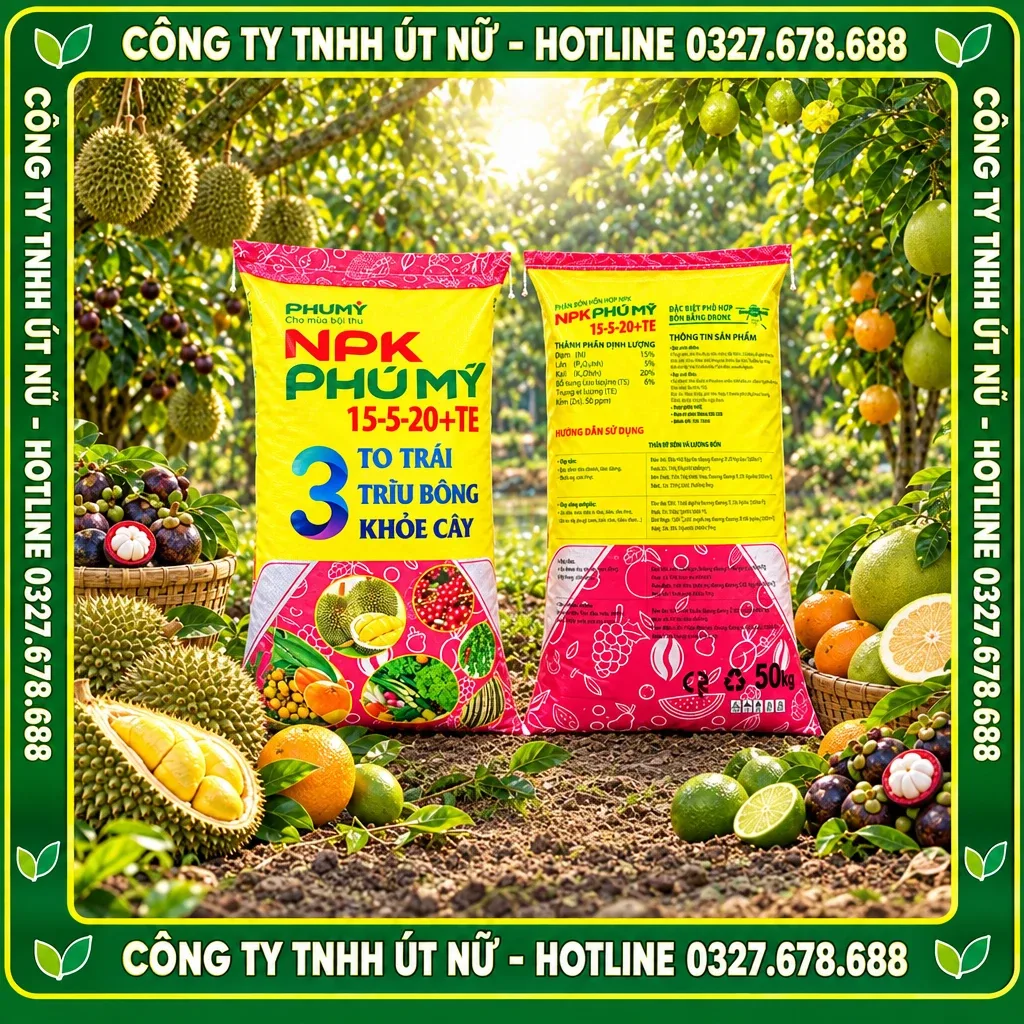
Each 10 kg of NPK Phú Mỹ 15-5-20+TE provides 1.5 kg of nitrogen (N), 0.5 kg of phosphorus (P₂O₅), and 2 kg of potassium (K₂O). From this, an illustrative conversion for a 1,000 m² rice field is as follows:
| Average leaf color (after root recovery) | What the field indicates | Illustrative amount of 15-5-20+TE | Corresponding nutrients per hectare | |---|---|---|---| | Dark green, around box 4 or above | Sufficient nitrogen remaining | 6–8 kg/cong (60–80 kg/ha) | 9–12 kg N; 12–16 kg K₂O | | Medium green, around box 3.5 | On schedule | 10–15 kg/cong (100–150 kg/ha) | 15–22.5 kg N; 20–30 kg K₂O | | Yellowish green, around box 3 or below, white roots have emerged | Needs more nitrogen | 15–17 kg/cong (150–170 kg/ha) | 22.5–25.5 kg N; 30–34 kg K₂O | | Yellow with black roots, brown spots from leaf tips | Roots not yet recovered | Do not apply, treat water first (Step 1) | – |
A few things to understand correctly about this table:
- This is an illustrative calculation based on the ingredients listed on the package and IRRI's reference levels, not a specific recommendation from the manufacturer for individual fields. IRRI also notes that leaf color thresholds need to be adjusted according to variety and local conditions (IRRI, 2007).
- Even for fields with yellowish-green leaves, the illustrative level keeps nitrogen around 25 kg N/ha, not far exceeding the reference level, because a strong increase in nitrogen at this time during the rainy season can easily lead to lodging and disease.
- Cumulative for the entire crop. Research by Can Tho University on major soil types in the Mekong Delta suggests a total amount for the entire rice crop of about 85–95 kg N/ha on alluvial soil, 70–80 kg N/ha on acid sulfate soil and saline soil, and 25–35 kg K₂O/ha when straw is incorporated (Ngo Ngoc Hung et al., 2020). If the field has received a lot of nitrogen in previous applications, this application should be at a lower level.
- The manufacturer instructs for food crops to apply 100–500 kg/ha for the entire crop (PVFCCo, n.d.); the amount for the panicle initiation stage is a part of that total.
Why take NPK Phú Mỹ 15-5-20+TE as an example?
The recommendation after flooding is to reduce nitrogen, increase potassium (TTXVN, 2026), and the 15-5-20 formula has higher potassium than nitrogen. According to the announcement by PetroVietnam Fertilizer and Chemicals Corporation (PVFCCo), NPK Phú Mỹ 15-5-20+TE (code 05388) is an NPK fertilizer with added micronutrients, used for root application, with a shelf life of 36 months from the manufacturing date, with the following components (PVFCCo, n.d.):
- Total Nitrogen (Nts): 15%
- Available Phosphorus (P₂O₅hh): 5%
- Available Potassium (K₂Ohh): 20%
- Trace elements (TE): zinc (Zn) 50 ppm, boron (B) 50 ppm
- Moisture: 5%
According to IRRI's rice nutrition documents, rice lacking potassium is prone to lodging, has many empty grains, weak roots, and is susceptible to disease; potassium deficiency is common in sandy soils, old acid sulfate soils that have been leached, and fields where nitrogen and phosphorus are applied heavily but potassium is low (Dobermann and Fairhurst, 2000). Therefore, for fields with moderately green leaves that have just experienced high water levels, a formula with moderate nitrogen and high potassium helps compensate for potassium without making the rice too dense.
Fertilizing after high tide: a few small but important things
- Check the weather before spreading. IRRI notes not to apply nitrogen topdressing when heavy rain is forecast (IRRI, 2007). This season, local tide schedules and rain forecasts should also be monitored.
- Do not spread when water is still overflowing the banks or flowing through the field, as fertilizer can easily be washed into canals.
- Manage water stably after flooding. The high-quality, low-emission rice cultivation process guides alternate wetting and drying from tillering to before heading, with each re-watering not exceeding 5 cm (Nguyễn Thị Thúy Kiều, 2025).
- Spread evenly, especially in low-lying areas where water accumulates: these areas often require closer root inspection, so do not apply extra fertilizer.
- Read the bag before applying: cross-check the product name, ingredients, fertilizer code, and production date printed on the bag.
- One week after application, re-read the leaf color using the correct method in Step 2 to know if the field has recovered.
What should dealers advise farmers?
When farmers come to the store asking for panicle initiation fertilizer after heavy rains, the dealer can give three short pieces of advice: pull up a rice clump to check the roots, shade the leaves to read their color, then calculate the fertilizer amount per công. If the roots are already white and the leaves are medium green, it's easy to use NPK Phú Mỹ 15-5-20+TE as illustrated above; if the roots are still black, treat the water first.
Út Nữ Co., Ltd distributes fertilizer wholesale in Vĩnh Long and the Mekong Delta region. If you need further consultation or to replenish stock, please call the hotline 02943 882069.
Conclusion
After heavy floods, Autumn-Winter rice fields do not need a lot of fertilizer, but rather need to be applied when roots have recovered and in the correct amount based on leaf color. Check the roots first, interpret leaf color methodically, then convert to kilograms per công and add to previous applications. Phú Mỹ NPK 15-5-20+TE, with moderate nitrogen and high potassium, is a suitable example for the "reduce nitrogen, increase potassium" approach after flooding; the actual amount should depend on the rice variety, soil type, and advice from local technical staff.
References
DASCO – Dong Thap Agricultural Development Service Co., Ltd (2026) *How do high tides affect agricultural production? Proactively prepare for floods and high tides at the end of September 2026*. September 26. Available at: https://dasco.vn/trieu-cuong-anh-huong-san-xuat-nong-nghiep-nhu-the-nao-chu-dong-truoc-lu-va-trieu-cuong-cuoi-thang-9-2026/ (Accessed: 4 October 2026).
Dobermann, A. and Fairhurst, T. (2000) *Rice: Nutrient disorders & nutrient management*. Singapore and Los Baños: PPI, PPIC and IRRI. Summarized at IRRI Rice Knowledge Bank, section Potassium deficiency. Available at: http://www.knowledgebank.irri.org/training/fact-sheets/nutrient-management/deficiencies-and-toxicities-fact-sheet (Accessed: 4 October 2026).
IRRI – International Rice Research Institute (2007) *Nitrogen application* (Rice Production e-learning, Nutrient management). Available at: http://www.knowledgebank.irri.org/ericeproduction/pop_up_Nitrogen_application.htm (Accessed: 4 October 2026).
IRRI – International Rice Research Institute (n.d.-a) *Leaf Color Chart*. IRRI Rice Knowledge Bank. Available at: http://www.knowledgebank.irri.org/step-by-step-production/growth/soil-fertility/leaf-color-chart (Accessed: 4 October 2026).
IRRI – International Rice Research Institute (n.d.-b) *Iron toxicity*. IRRI Rice Knowledge Bank (based on Dobermann and Fairhurst, 2000). Available at: http://www.knowledgebank.irri.org/training/fact-sheets/nutrient-management/deficiencies-and-toxicities-fact-sheet/item/iron-toxicity (Accessed: 4 October 2026).
Ngô Ngọc Hưng, Lý Ngọc Thanh Xuân, Trần Ngọc Hữu, Lâm Văn Thông, Nguyễn Bảo Vệ, Lê Phước Toàn, Lê Văn Dang, Nguyễn Kim Quyên, Trần Văn Dũng and Trịnh Quang Khương (2020) 'Using NPK for rice on major soil types in the Mekong Delta', *Can Tho University Journal of Science*, 56 (Special Issue on Soil Science), pp. 177–184. doi: 10.22144/ctu.jsi.2020.083.
Nguyễn Thị Thúy Kiều (2025) 'High-quality and low-emission rice production process in the Mekong Delta', *Cần Thơ City Agricultural Extension and Services Center*, 17 December. Available at: https://kndvnn.cantho.vn/Default.aspx?ndid=18483&tabId=1441 (Accessed: 4 October 2026).
PVFCCo – PetroVietnam Fertilizer and Chemicals Corporation (n.d.) *NPK Phú Mỹ 15-5-20+TE* (code 05388). Available at: https://dpm.vn/san-pham/npk-phu-my-15-5-20-te-50kg (Accessed: 4 October 2026).
TTXVN (2026) 'Can Tho proactively protects nearly 100,000 hectares of rice from heavy rain and high tides', *Báo Tin Tức – TTXVN*, 17 September. Available at: https://baomoi.com/can-tho-chu-dong-bao-ve-gan-100-000-ha-lua-truoc-mua-lon-trieu-cuong-c56073252.epi (Accessed: 4 October 2026).
About Content and Responsibility
Content developed by Grokbot AI. Út Nữ Co., Ltd and Grokbot AI disclaim responsibility for any damages arising from the use of information in this article. All content is for exploratory and academic purposes only, does not replace professional technical advice, official recommendations from manufacturers or state agencies, and does not constitute a commercial promise of yield or economic efficiency.