
Salinity intrusion threatens the 2026–2027 dry season: prepare potassium and fresh water for fruit orchards
Published · Út Nữ Co., Ltd
> Warning: The content of this article was created / supported by AI based on a synthesis of public documents. Út Nữ Co., Ltd disclaims responsibility for damages arising from the use of information in this article. You should cross-reference packaging, manufacturer's instructions, local seasonal calendars, and contact the hotline for advice suitable for actual conditions.
Salinity intrusion threatens the 2026–2027 dry season: prepare potassium and fresh water for fruit orchards
This October, the information causing the most concern for farmers in the Mekong Delta is El Nino. According to the report from the Ministry of Agriculture and Environment submitted to the Prime Minister on September 30, this year's El Nino is assessed to be very strong, with a high risk of widespread drought and saltwater intrusion starting from November 2026 and lasting until around May 2027 in the Mekong Delta; saltwater intrusion is forecast to be equivalent to the 2015–2016 dry season, with the 4 g/l salinity boundary at the Mekong River estuaries potentially penetrating 50–70 km inland (Phụ nữ & Thời đại, 2026). UNICEF Vietnam also noted that the 2026–2027 El Nino has formed and is expected to extend into 2027 with a probability of over 95 percent, with the Mekong Delta being among the areas facing the highest risk of drought, water scarcity, and saltwater intrusion from late 2026 to May 2027 (UNICEF, 2026).
Notable figures for farmers: approximately 45,000 hectares of fruit trees in the coastal areas of Tây Ninh, Đồng Tháp, Vĩnh Long, and Cần Thơ are at risk of being affected by saltwater intrusion (Phụ nữ & Thời đại, 2026); specifically, Vĩnh Long has about 25,000 hectares, and Cần Thơ City has about 3,000 hectares (thitruonghanghoa.com, 2026). Durian and other salt-sensitive fruit trees in downstream areas are among the most vulnerable if irrigation water sources cannot be kept stable.
This article follows the objective of "proper fertilization": placing potassium in its correct role within the solution set to help fruit trees become more resilient before the dry and saline intrusion season — along with storing fresh water and mulching to retain moisture.
Why are fruit trees sensitive to salinity?
Citrus trees (oranges, mandarins, grapefruits, lemons) are generally classified as salt-sensitive plants and require a lot of water, especially during the fruit development stage (Ziogas et al., 2021). When irrigation water or soil is saline, trees face two simultaneous challenges: first is "physiological drought" — roots absorb water with difficulty even if the soil is still moist, due to increased osmotic pressure of the soil solution; second is ion toxicity — sodium (Na+) and chloride (Cl−) accumulate in leaves, causing leaf margin burn, defoliation, and reduced photosynthesis. On fruit trees, the clear consequences are small fruits, premature fruit drop, and reduced fruit quality.
How does Potassium benefit plants?
Among nutrients, potassium (K+) is the most studied for its role in salinity and drought tolerance. The review by Ziogas et al. (2021) shows that potassium is an essential element for regulating osmotic pressure in cells, and also participates in stomatal opening and closing — meaning it helps plants retain water better and "breathe" more appropriately when facing salt stress. Also according to this review, citrus plants tend to accumulate K+ preferentially in leaf and stem tissues; in experiments, when 10 mM potassium chloride was added to a 50 mM NaCl salinizing solution, lemon plants showed less Cl− in leaves but more K+ (Ziogas et al., 2021).
Another review by Hasanuzzaman et al. (2018) further reinforces: under salinity stress, potassium contributes to maintaining ion balance and regulating osmotic pressure; under drought stress, potassium regulates stomatal opening and closing, helping plants adapt better. In wheat, foliar application of potassium under drought conditions showed better drought tolerance, improved physiological efficiency, and reduced sodium accumulation in the plant (Raza et al., 2013) — this is evidence from another crop, presented to show the general mechanism of potassium, not to be inferred as results for fruit trees.
Practical evidence on orange groves also exists. A salinity irrigation experiment conducted from 1982 to 1988 on Shamouti orange groves in Israel showed that supplemental potassium fertilization (360 kg K2O per hectare) helped increase yield at all salinity levels in the last three years of the experiment, mainly due to larger fruits; supplemental potassium did not reduce sodium uptake by the plants, but both yield and fruit size were improved in all salinity treatments (Dasberg et al., 1991).
Simply put, in farmer's terms: sufficient potassium helps plants become sturdy, retain water better, and reduce 'shock' when salinity intrudes — but potassium is not an anti-salinity medicine, and no fertilizer can replace fresh water.
Four things to do from now on
First, store freshwater early. According to the Department of Water Resources Management and Construction, saltwater intrusion in the 2026–2027 dry season will be similar to the 2015–2016 dry season, with impacts starting from late December 2026, peaking from January to April 2027; water flow to the delta is expected to be low (Vĩnh Long Newspaper, 2026). The rainy season may end from the first week to mid-November 2026, 10–20 days earlier than the multi-year average, thus requiring water storage from the end of the rainy season (Vĩnh Long Newspaper, 2026). The fuller ponds, ditches, and reservoirs in gardens are before the dry season, the less worry there will be. The Ministry of Agriculture and Environment also proposed reviewing the area of fruit orchards at risk of drought and saltwater intrusion, detailing each crop type and growing region to implement appropriate response solutions (Women & Times, 2026).
Second, mulching the base to retain moisture. Covering the base with straw and dry grass helps the soil in the root zone retain moisture longer, reducing evaporation during hot months. A review by Bakshi et al. (2015) on mulching fruit trees shows that the mulch layer retains moisture for the root zone, limits sudden fluctuations in soil temperature, and reduces erosion and weeds — direct benefits during the dry season. Professional agencies also recommend that gardeners mulch the base to retain moisture, apply water-saving irrigation, and check salinity before irrigating (Vinh Long Newspaper, 2026).
Third, apply potassium proactively and at the right time. Applying potassium before salinity intrusion helps plants accumulate sufficient potassium in their tissues, preparing them for stress — as experiments on Shamouti orange groves have shown effectiveness at all salinity levels (Dasberg et al., 1991).
Fourth, do not force plants when there is a lack of water. If water cannot be balanced until the end of the crop season, do not plant new crops or induce off-season flowering (Vinh Long Newspaper, 2026). Forcing plants to flower during a freshwater shortage is the quickest way to lose everything.
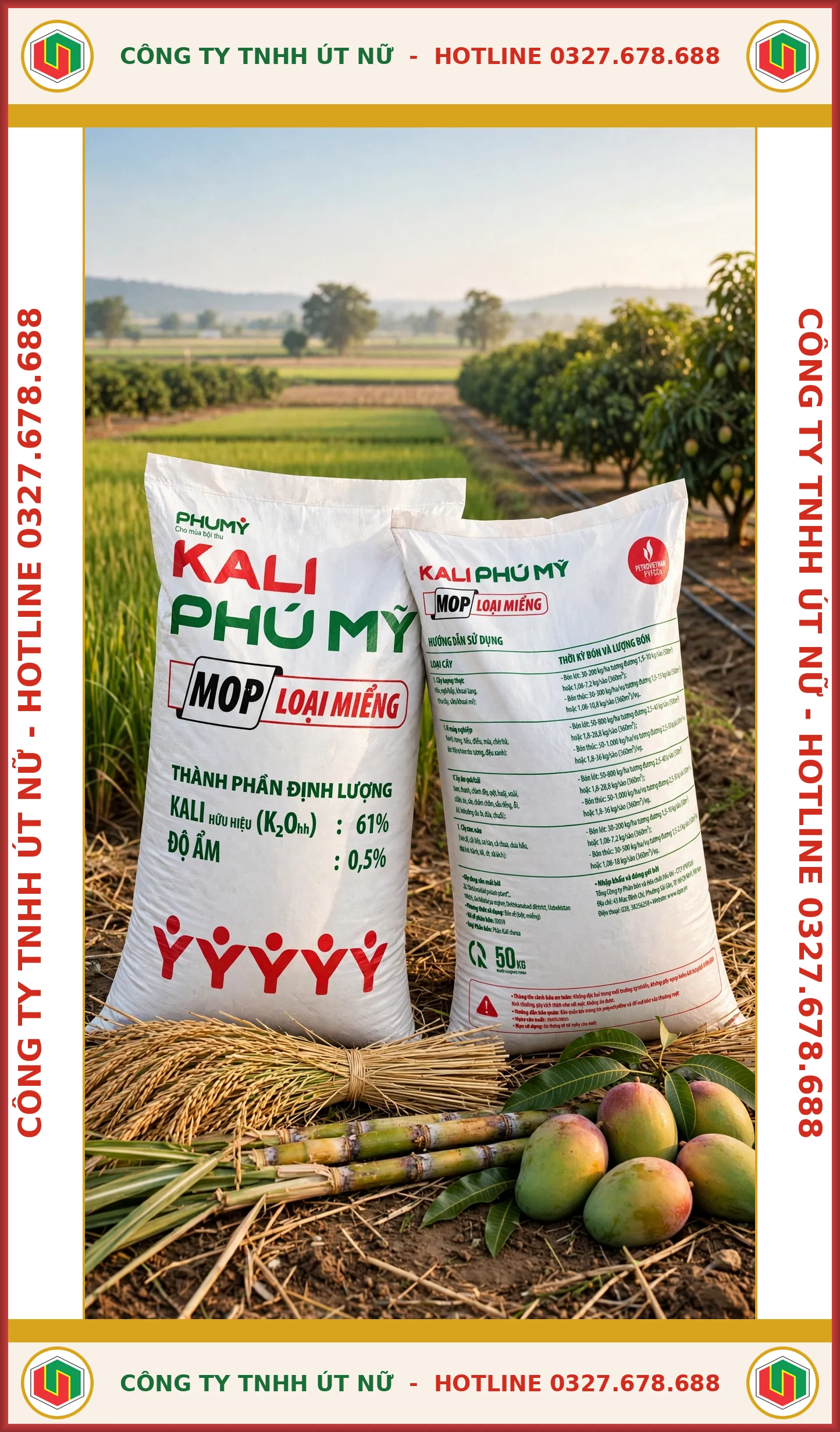
Technical Example: Phú Mỹ Granular Potash
Among basal potassium fertilizers, potassium chloride (MOP) is a popular type. According to the manufacturer's announcement, Phú Mỹ MOP Potassium has a high potassium content of 60–61 percent K2O, available in two forms: powder and granular, packed in 50 kg and 25 kg bags (PVFCCo, 2025). This is a technical example for basal potassium sources within the aforementioned solution set — farmers should refer to the dosage on the packaging and the manufacturer's instructions for each crop and growth stage.
Conclusion
The 2026–2027 dry season is forecast to bring severe drought and salinity intrusion. Fruit orchards in Vĩnh Long, Cần Thơ, and coastal areas need to prepare now by storing fresh water, mulching to retain moisture, and applying potassium proactively to make trees more robust. Potassium helps trees regulate water and better withstand salinity stress (Ziogas et al., 2021; Hasanuzzaman et al., 2018; Dasberg et al., 1991), but it cannot replace fresh water — retaining fresh water for the orchard remains the most important task.
Dosage varies depending on soil, crop variety, and plant condition. For further consultation, please call Út Nữ: 02943 882069.
References
Bakshi, P., Wali, V.K., Iqbal, M., Jasrotia, A., Kour, K., Ahmed, R. and Bakshi, M. (2015) 'Sustainable fruit production by soil moisture conservation with different mulches: A review', *African Journal of Agricultural Research*, 10(52), pp. 4718–4729. Available at: https://academicjournals.org/journal/AJAR/article-full-text/FCBD2CE56466 (Accessed: 19 October 2026).
Vĩnh Long Newspaper (2026) 'Proactively managing water sources against drought and salinity risks'. Available at: https://baovinhlong.com.vn/kinh-te/202610/chu-dong-nguon-nuoc-truoc-nguy-co-han-man-c0e0c2c/ (Accessed: 19 October 2026).
Dasberg, S., Bielorai, H., Haimowitz, A. and Erner, Y. (1991) 'The effect of saline irrigation water on 'Shamouti' orange trees', *Irrigation Science*, 12, pp. 205–211.
Hasanuzzaman, M., Bhuyan, M.H.M.B., Nahar, K., Hossain, M.S., Al Mahmud, J., Hossen, M.S., Masud, A.A.C., Moumita and Fujita, M. (2018) 'Potassium: A Vital Regulator of Plant Responses and Tolerance to Abiotic Stresses', *Agronomy*, 8(3), p. 31. doi: 10.3390/agronomy8030031.
Phụ nữ & Thời đại (2026) 'How does a very strong El Niño cause drought and water scarcity in different regions?'. Available at: https://phunuvathoidaivn.com/el-nino-rat-manh-gay-han-han-thieu-nuoc-o-vung-mien-the-nao-a209904.html (Accessed: 19 October 2026).
PVFCCo (2025) *Phu My MOP Potash has a high potassium content (60-61 percent K2O), available in two types: Phu My Potash powder and Phu My Potash granular*. Available at: https://dpm.vn/public_folder/files_upload/202512/20251117dpmpr2025pdf1764363642.pdf (Accessed: 19 October 2026).
Raza, M.A.S., Saleem, M.F., Shah, G.M., Jamil, M. and Khan, I.H. (2013) 'Potassium applied under drought improves physiological and nutrient uptake performances of wheat (*Triticum aestivum* L.)', *Journal of Soil Science and Plant Nutrition*. Available at: https://www.scielo.cl/scielo.php?script=sci_arttext&pid=S0718-95162013000100016 (Accessed: 19 October 2026).
thitruonghanghoa.com (2026) 'Salinity intrusion 'threatens' the Mekong Delta'. Available at: https://www.thitruonghanghoa.com/tin-tuc/han-man-de-doa-dbscl-355462.html (Accessed: 19 October 2026).
UNICEF (2026) 'El Niño 2026–2027 | Early Warning and Preparedness Situation Report'. Available at: https://www.unicef.org/vietnam/vi/bao-cao/tinh-hinh-canh-bao-som-va-san-sang-ung-pho (Accessed: 19 October 2026).
Ziogas, V., Tanou, G., Morianou, G. and Kourgialas, N. (2021) 'Drought and Salinity in Citriculture: Optimal Practices to Alleviate Salinity and Water Stress', *Agronomy*, 11(7), p. 1283. doi: 10.3390/agronomy11071283.
About Content and Responsibility
Content developed by Muse AI (From Meta — developed by Facebook). Út Nữ Co., Ltd and Muse AI disclaim responsibility for any damages arising from the use of information in this article. All content is for exploratory and academic purposes only, does not replace professional technical advice, official recommendations from manufacturers or state agencies, and does not constitute a commercial promise regarding yield or economic efficiency.