
Garden just drained: apply fertilizer only after seeing new roots – fruit tree recovery schedule with NPK Phú Mỹ 20-20-15+TE
Published · Út Nữ Co., Ltd
> Warning: The content of this article was created / supported by AI based on a synthesis of public documents. Út Nữ Co., Ltd disclaims responsibility for damages arising from the use of information in this article. You should cross-reference packaging, manufacturer's instructions, local seasonal calendars, and contact the hotline for advice suitable for actual conditions.
In mid-October 2026, many fruit orchards in the Mekong Delta had just endured several rounds of heavy rain and high tides. In Cần Thơ City alone, by early October, nearly 600 hectares of crops, including fruit trees and vegetables, had been waterlogged or toppled; the Cần Thơ City Hydro-Meteorological Station predicted 4–5 more high tide surges from late September to mid-November 2026 (Cảnh Kỳ, 2026). As the water recedes, orchard owners grow anxious: leaves turn yellow, trees stop growing, and many want to immediately apply fertilizer to help their trees "recover their strength."
But roots that have just been submerged are lacking oxygen, and many fine roots have been damaged. Fertilizer applied at this time has no roots to absorb it. This article follows the principle of right type – right time – right amount: amend the soil first, wait for fine roots to emerge, then apply balanced NPK, using Phú Mỹ 20-20-15+TE NPK as a technical example.
After Flooding, What Should the Orchard Do First?
The National Agricultural Extension Center under the Ministry of Agriculture (NAEC) guides the recovery of flooded gardens in the following order (NAEC, 2024):
1. Garden sanitation: remove debris from trees, wash mud off leaves to restore photosynthesis, cut off broken branches. 2. Loosen the soil crust around the base 5–10 cm deep to allow roots to breathe; sprinkle lime powder, apply fungicides as recommended (active ingredients Fosetyl Aluminium, or Metalaxyl + Mancozeb, or Dimethomorph); use root stimulant products according to manufacturer's dosage. 3. After about 7–10 days: apply well-rotted manure with Trichoderma preparations, or organic microbial fertilizer, within the canopy projection to encourage new feeder root growth. 4. When feeder roots start to recover (around 10–15 days) and are confirmed to be present, then apply balanced NPK compound fertilizer; foliar fertilizer can also be sprayed. Mulch the base with decomposed straw or other covering materials, 30–50 cm away from the trunk, and ensure adequate moisture during sunny weather.
For orchards that are still flooded, Cần Thơ's agricultural sector recommends allowing water to flow naturally over the raised beds, as the flowing water provides additional oxygen to the roots, and simultaneously pumping water out of the orchard to the lowest possible level (Cảnh Kỳ, 2026). Severely damaged trees that have lost all leaves and have root rot, with no chance of recovery, should be removed from the orchard. Lime powder should be spread and the affected soil treated to prevent disease spread (TTKNQG, 2024).
Check fine roots before fertilizing
"Seeing fibrous roots" is something farmers can do themselves:
- Select a few representative trees in different corners of the garden, gently rake away the topsoil at the edge of the canopy (where the canopy shadow falls), where roots absorb nutrients most actively.
- New feeder roots are typically white or ivory, with plump tips.
- Damaged roots are dark brown, and the root bark easily peels off when stroked.
- When most trees have new white feeder roots, switch to applying NPK. For trees that do not yet have them, continue to keep the soil aerated, wait a few more days, and then recheck.
NPK Phú Mỹ 20-20-15+TE: Key Specifications
According to the website of PetroVietnam Fertilizer and Chemicals Corporation (PVFCCo, n.d.):
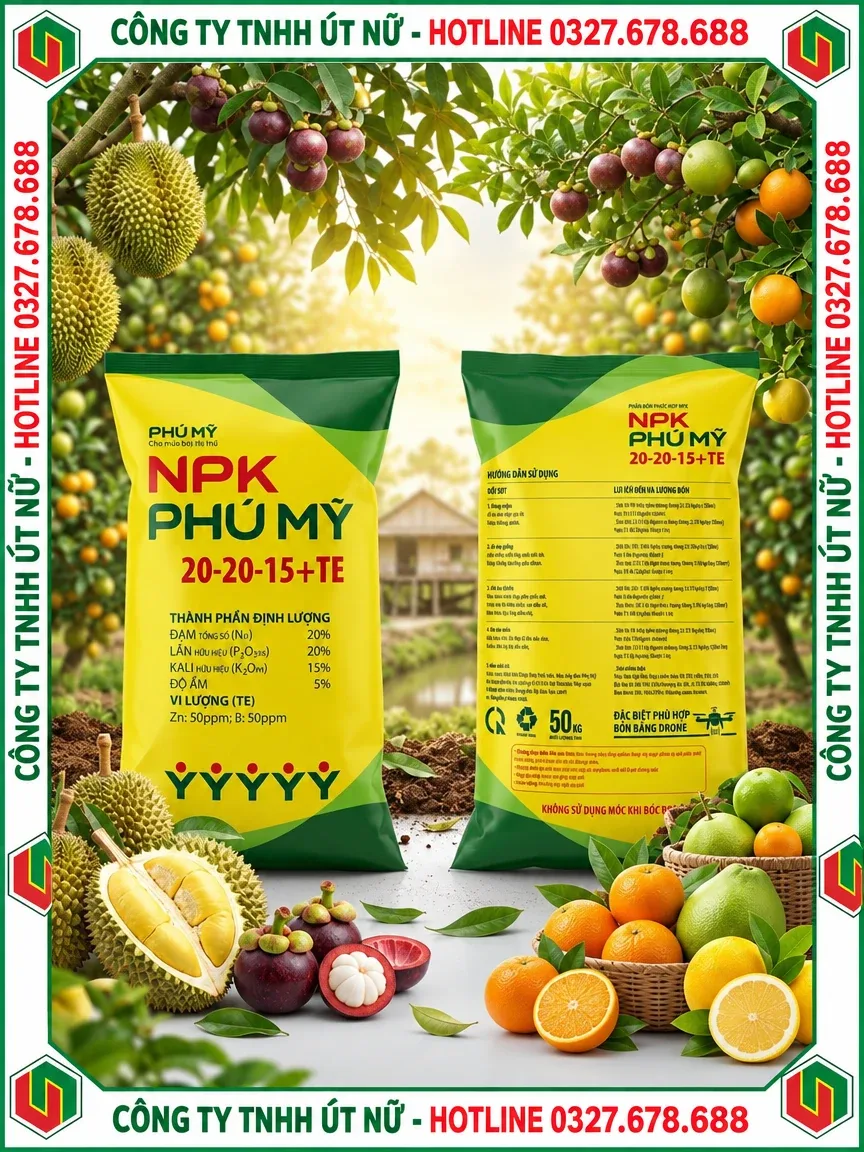
- NPK compound fertilizer, code 00149.
- Total nitrogen (Nts) 20%, available phosphorus (P₂O₅hh) 20%, available potassium (K₂Ohh) 15%.
- TE: zinc (Zn) 50 ppm, boron (B) 50 ppm; moisture 5%.
- Root application; shelf life 36 months from manufacturing date.
In short: this is a balanced NPK, with added zinc and boron. Each 10 kg of fertilizer provides approximately 2 kg N, 2 kg P₂O₅, and 1.5 kg K₂O.
How much fertilizer for a newly recovered garden?
PVFCCo's guidance for fruit trees: basal application 50–500 kg/ha; top dressing 50–800 kg/ha/crop (PVFCCo, n.d.). Converting to common units in the Mekong Delta (1 công = 1,000 m², 1 ha = 10 công):
- Basal fertilization: 5–50 kg/công.
- Top dressing: 5–80 kg/công for the entire crop cycle, divided into multiple applications.
This framework is broad because it applies to many types of plants and various ages. For orchards that have just recovered from flooding, the new roots are still young, so:
- First application at the lower end of the range, for example, about 5–10 kg/công (50–100 kg/ha), spread evenly under the canopy projection, not concentrated near the base. This is an illustrative figure within the manufacturer's recommended range; the actual amount depends on the crop type, plant age, and extent of root damage.
- Apply in small, multiple doses: only apply the next dose when the plant has produced new shoots and its leaves have turned green again; accumulate doses so that the total for the entire season remains within the 50–800 kg/ha range.
- If the soil is dry, water lightly after application to help the fertilizer dissolve gradually.
For example: for a 3 'công' garden, if you apply 8 kg/công for the first time, you will need about 24 kg of fertilizer, which is less than half of a 50 kg bag. Calculating by area like this is easier than spreading "by feel".
Common Issues After Flooding
- Spreading fertilizer immediately after the water recedes: roots have not recovered, and fertilizer is easily washed away by rain and tides.
- Applying a large amount at once: The National Agricultural Extension Center (TTKNQG) advises balanced NPK application when feeder roots have recovered (TTKNQG, 2024); applying too much when roots are still sparse means the plant cannot fully utilize it, leading to wasted fertilizer.
- Skipping the organic step: well-rotted manure and Trichoderma help plants develop new feeder roots; NPK comes after and cannot replace this step (TTKNQG, 2024).
- Forgetting to mulch and retain moisture: The Ca Mau Department of Agriculture and Environment's climate assessment indicates that the 2026 rainy season may end early, around October 25 – November 10, and January–February 2027 will have little rain (Thúy Lam, 2026). Mulching now helps retain moisture when the dry season begins.
- Not considering saline water during the dry season: The Department of Crop Production and Plant Protection recommends storing fresh water and measuring salinity before each irrigation; durian, rambutan, and mangosteen should not be irrigated with water exceeding 0.5‰ salinity (Dân Việt, 2026).
What should dealers advise farmers?
1. How long was the garden flooded, and how many days has it been since the water receded? If it just receded, do not rush to sell NPK; advise on drainage, tilling, lime, fungicides, and organic fertilizer first. 2. Have feeder roots appeared yet? Instruct farmers to scrape the soil at the canopy edge to check. 3. What type of tree, how old, is it bearing fruit? If a fruit-bearing tree has many broken branches, prune them or remove all fruit to allow the tree to recover (TTKNQG, 2024). 4. How many công is the garden? Convert kg/ha to kg/công, calculate the number of bags, and divide into applications.
For gardens with established feeder roots, a balanced NPK fertilizer with zinc and boron is needed for the recovery application. Dealers can recommend NPK Phú Mỹ 20-20-15+TE and advise farmers to start with a low dose. Út Nữ Co., Ltd distributes wholesale in Vĩnh Long – Trà Vinh – Mekong Delta. If you need to replenish stock, please call / Zalo 0294 3882069 – 02943 883791 – 02943 882837.
Conclusion
After flooding, the recommended order is: drain water – loosen soil for roots to breathe – treat fungal diseases – apply organic fertilizer and Trichoderma – only apply balanced NPK once new feeder roots are observed. Phú Mỹ NPK 20-20-15+TE contains balanced nitrogen, phosphorus, and potassium, along with zinc and boron, suitable for application once roots have recovered, provided it's started at the lower end of the recommended range and applied in multiple doses. Applying the right type, at the right time, and in the right amount helps avoid fertilizer waste and allows the plant to recover according to the root system's capacity.
References
Cảnh Kỳ (2026) 'High tides, heavy rains "submerge" nearly 600 hectares of rice and fruit trees in Can Tho', *Tien Phong Newspaper*, 6 October. Available at: https://tienphong.vn/trieu-cuong-mua-lon-nhan-chim-gan-600-ha-lua-cay-an-trai-o-can-tho-post1882507.tpo (Accessed: 8 October 2026).
Dân Việt (2026) 'Latest seasonal calendar to "avoid" El Nino-induced salinity for the 2026-2027 winter-spring crop, what does the Department of Crop Production and Plant Protection recommend?', *Dân Việt Newspaper*, 19 June. Available at: https://danviet.vn/khung-thoi-vu-moi-nhat-ne-han-man-do-el-nio-cho-vu-dong-xuan-2026-2027-cuc-trong-trot-va-bvtv-khuyen-cao-gi-d1436554.html (Accessed: 8 October 2026).
PVFCCo – PetroVietnam Fertilizer and Chemicals Corporation (n.d.) *NPK Phu My 20-20-15+TE* (code 00149). Available at: https://dpm.vn/san-pham/npk-phu-my-20-20-15te-35 (Accessed: 8 October 2026).
Thúy Lam (2026) 'Guidance on seasonal calendar and rice variety structure for the 2026–2027 Winter-Spring crop', *Cà Mau Provincial Agricultural Extension Center*, 6 October. Available at: http://khuyennongcamau.vn/thong-tin-va-truyen-thong/huong-dan-lich-thoi-vu-va-co-cau-giong-lua-vu-dong-xuan-2026-2027-85460 (Accessed: 8 October 2026).
National Agricultural Extension Center (2024) *Guide to fruit tree garden recovery after storms and floods*. 16 September. Available at: https://khuyennongvn.gov.vn/khoa-hoc-cong-nghe/khcn-trong-nuoc/huong-dan-phuc-hoi-vuon-cay-an-qua-sau-bao-lu-28257.html (Accessed: 8 October 2026).
About Content and Responsibility
Content developed by Grokbot AI. Út Nữ Co., Ltd and Grokbot AI disclaim responsibility for any damages arising from the use of information in this article. All content is for exploratory and academic purposes only, does not replace professional technical advice, official recommendations from manufacturers or state agencies, and does not constitute a commercial promise of yield or economic efficiency.