
The main Winter-Spring rice crop is entering the tillering stage: apply fertilizer for the first time at 7–10 days, and for the second time at 18–22 days after sowing.
Published · Út Nữ Co., Ltd
> Warning: The content of this article was generated / supported by AI based on publicly available information. Út Nữ Co., Ltd disclaims responsibility for damages arising from the use of information in this article. You should cross-reference packaging, manufacturer's instructions, local seasonal calendars, and contact our hotline for advice suitable for your actual conditions.
By mid-November 2026, most of the 2026–2027 Winter-Spring rice fields in the Mekong Delta are within the main planting schedule. According to the Department of Crop Production and Plant Protection, localities continue to follow the seasonal schedule guided in Official Letter No. 3920/TTTV-TTBVTV: early planting from October 10–30, 2026, in coastal, estuary, and downstream areas; main planting from November 1–30, 2026, in areas with sufficient water sources; late planting from December 1–31, 2026; the entire season strives to complete sowing before January 10, 2027 (Nhân Dân, 2026).
Fields sown in early November are now about 10–14 days old and starting to tiller; fields sown mid-month will reach this stage next week. This is a critical time for determining the number of tillers, and also when it's easy to apply fertilizer incorrectly: seeing slightly yellow rice often prompts farmers to add more nitrogen. The same article notes that the 2026–2027 dry season may experience rainfall deficits and severe salinity, with southern Măng Thít (Vĩnh Long) identified as an area requiring close monitoring, and provides guidance on balanced fertilization (Nhân Dân, 2026). The basal fertilizer application was covered in the article Main Winter-Spring crop has begun; this article continues with the two topdressing applications during the tillering stage.
The Right Type: tillering stage primarily needs nitrogen, with phosphorus as a supplement
The National Agricultural Extension Center's high-quality, low-emission rice farming process for the Mekong Delta establishes the principle of balanced fertilization at each stage: the first topdressing applies only nitrogen, and the second applies nitrogen along with potassium (National Agricultural Extension Center, 2025).
Guidelines from Assoc. Prof. Dr. Mai Thanh Phung on the National Agricultural Extension portal state more specifically: for the first application, apply urea with phosphorus, and if necessary, add potassium on gray, sandy, and dune soils; for the second application, apply urea with phosphorus (DAP); if the field has already received half the amount of phosphorus as a base application, then each top-dressing application only requires an additional one-quarter (Mai, 2019).
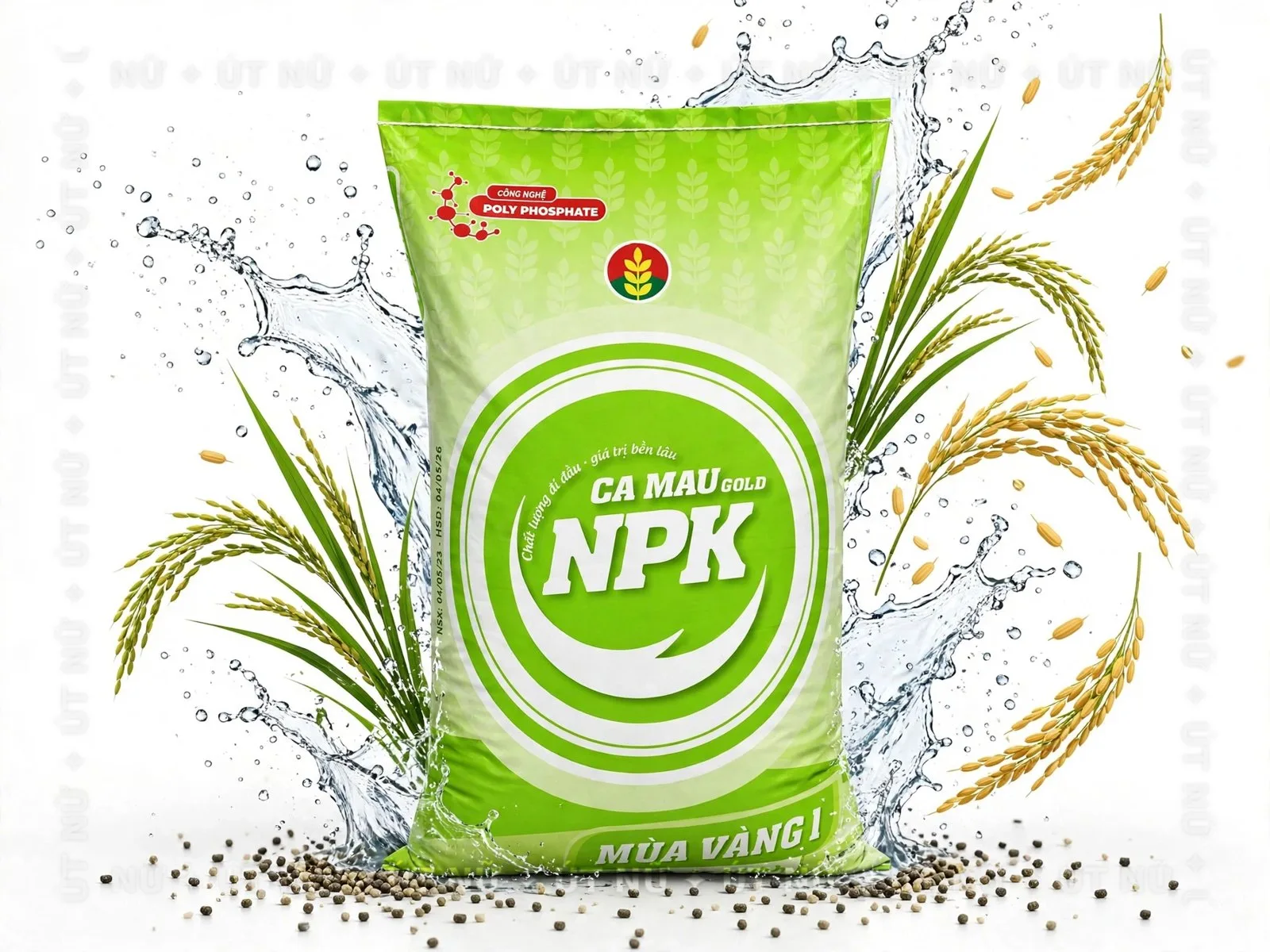
Besides single fertilizers, many households use high-nitrogen NPK for this application, for example NPK Cà Mau Gold 20-10-10 (Mùa vàng 1) from Cà Mau factory, with a 20-10-10 content. This is just an example of a fertilizer group; please read the usage amount on the bag, then compare it with the total nitrogen framework for the entire crop in the section below.
Timing: 1st application at 7–10 days, 2nd application at 18–22 days after sowing
The 2025 protocol specifies the first top-dressing application 7–10 days after sowing and the second top-dressing application 18–22 days after sowing (National Agricultural Extension Center, 2025). For example, for a field sown on November 5th: the first application would be around November 12th–15th, and the second application around November 23rd–27th.
Mai (2019) notes: if the field has no water by the fertilization day, do not broadcast fertilizer; foliar fertilizer can be temporarily sprayed, and normal fertilization should only proceed once water is available. The second application is when the rice develops effective tillers, and it is also the time to spot-fertilize poor-growing areas to ensure an even field.
Water management with fertilizer application. From tillering to before heading, the 2025 procedure guides alternating wet and dry irrigation: drain water at least twice, preferably 5–7 days after top-dressing, then reintroduce water to a depth of no more than 5 cm; in acidic or saline areas, adjust the timing of water drainage to ensure water availability for reintroduction (National Agricultural Extension Center, 2025).
Correct Quantity: split into portions throughout the crop cycle, not applied all at once
According to the above-mentioned procedure, the first top-dressing applies 40 percent of the total nitrogen for the crop; the second top-dressing applies 40 percent of the nitrogen along with 40 percent of the potassium (National Agricultural Extension Center, 2025). These two applications already account for about 80 percent of the total nitrogen for the crop — applying more would encroach on the portion reserved for panicle initiation.
Macronutrient framework for one hectare of direct-seeded rice in the Winter-Spring crop season (National Agricultural Extension Center, 2025):
Alluvial soil: 90–100 kg N, 30–40 kg P2O5 and 30–40 kg K2O. Slightly acidic soil: 80–100 kg N, 40–50 kg P2O5 and 25–30 kg K2O. Moderately acidic soil: 60–80 kg N, 50–60 kg P2O5 and 25–30 kg K2O.
Site-specific nutrient management (SSNM) research conducted by Can Tho University across eight locations over three cropping seasons (2016–2018) yielded consistent results: the recommended nitrogen dosage for acid sulfate soil and saline soil was lower than for alluvial soil, and fell close to the range of the aforementioned process (Ngo et al., 2020). This serves as a general scientific basis, not a promise of results for individual plots.
To convert to the number of bags, calculate the kilograms of nutrients based on the content stated on the bag, then refer to the table above. The process also encourages using a rice leaf color chart to adjust nitrogen levels according to the actual vigor of the rice plants (National Agricultural Extension Center, 2025); yellowing leaves early in the season are not necessarily due to nitrogen deficiency.
Tasks for These Days
For households that sowed in early November: once the rice reaches the 7–10 day mark, apply the first top-dressing when the field has water; do not wait and combine two applications into one. For households that sowed in mid-November: prepare fertilizer, keep the field adequately moist. For households that sowed in late October: the rice is currently at the stage for the second top-dressing, so visit the fields, apply supplemental fertilizer to poor-growing areas, and reserve potassium for the panicle initiation stage.
Planting and irrigation schedules for individual fields are specified by local authorities; this article does not replace pest avoidance notices, irrigation schedules, or instructions on product packaging. Please consult your commune's agricultural extension officer when calculating quantities based on soil type.
References (Harvard)
Mai, T.P. (2019) *Fertilizing Rice in the Mekong Delta*, 9 April. Available at: https://khuyennongvn.gov.vn/khoa-hoc-cong-nghe/khcn-trong-nuoc/bon-phan-cho-lua-o-dong-bang-song-cuu-long-18450.html (Accessed: 14 November 2026).
Ngô, N.H., Lý, N.T.X., Trần, N.H., Lâm, V.T., Nguyễn, B.V., Lê, P.T., Lê, V.D., Nguyễn, K.Q., Trần, V.D. and Trịnh, Q.K. (2020) ‘Using NPK for rice plants on major soil types in the Mekong Delta’, *Tạp chí Khoa học Trường Đại học Cần Thơ*, 56(Số chuyên đề: Khoa học đất), pp. 177–184. doi: 10.22144/ctu.jsi.2020.083.
Nhân Dân (2026) *Southeast and Mekong Delta regions: Proactively respond to drought and saltwater intrusion*, 6 November. Available at: https://nhandan.vn/dong-nam-bo-va-dong-bang-song-cuu-long-chu-dong-ung-pho-han-han-xam-nhap-man-post1000699.html (Accessed: 14 November 2026).
National Agricultural Extension Center (2025) *High-quality and low-emission rice cultivation techniques in the Mekong Delta*, 18 November. Available at: https://khuyennongvn.gov.vn/khoa-hoc-cong-nghe/khcn-trong-nuoc/ky-thuat-canh-tac-lua-chat-luong-cao-va-phat-thai-thap-vung-dong-bang-song-cuu-long-31656.html (Accessed: 14 November 2026).
About content & responsibilities
Content developed by Grokbot AI. Út Nữ Co., Ltd and Grokbot AI disclaim responsibility for any damages arising from the use of the information in this article. All content is for exploratory and academic purposes only, does not replace professional technical advice, official recommendations from manufacturers or state agencies, and does not constitute a commercial promise of yield or economic efficiency.