
“If rice isn't green enough, add more nitrogen”? Prepare for the tillering stage in the Winter-Spring crop with the correct amount of NPK Phú Mỹ 20-7-7+TE
Published · Út Nữ Co., Ltd
> Warning: The content of this article was created / supported by AI based on a synthesis of public documents. Út Nữ Co., Ltd disclaims responsibility for damages arising from the use of information in this article. You should cross-reference packaging, manufacturer's instructions, local seasonal calendars, and contact the hotline for advice suitable for actual conditions.
In Vĩnh Long and coastal provinces, many fields will sow the Winter-Spring 2026–2027 crop right in October: The Department of Crop Production and Plant Protection recommends that areas at risk of drought and salinity late in the season should sow early from October 10–30, the main crop from November 1–30, and prioritize short-duration varieties (Nhân Dân, 2026). With that schedule, the tillering fertilization for the early crop will fall around early to mid-November, and for the main crop from late November into December. The upcoming dry season is forecast to have low water levels, and salinity may intrude from late December (Department of Meteorology and Hydrology, 2026), making a compact rice crop with minimal fertilizer waste, right from the tillering stage, even more crucial.
At this stage, a common habit is "if the rice isn't green enough, apply more nitrogen." This article helps farmers and dealers prepare for the tillering fertilization phase according to the principles of right type – right time – right amount, using NPK Phú Mỹ 20-7-7+TE as a technical example for high-nitrogen fertilizers.
What does tillering need, and where are common mistakes made?
Tillering is when rice plants produce shoots, which also forms the basis for the number of panicles later on. According to IRRI, nitrogen deficiency often occurs precisely during the tillering and panicle initiation stages, when the plant requires a lot of nitrogen; rice plants deficient in nitrogen will tiller less, have small leaves, and appear yellowish-green (Dobermann and Fairhurst, 2000).
However, a common mistake is not the lack of fertilizer, but applying it at the wrong time:
- Too much nitrogen too early: IRRI recommends applying only a moderate amount of nitrogen during the first 21 days after sowing, when the plant's needs are still small; after that, apply according to demand, based on leaf color (IRRI, 2007a).
- Applying too much at once: IRRI recommends splitting the total nitrogen amount into 2–4 applications, only applying more than 45 kg N/ha in a single application when weather conditions are very favorable and the plants respond strongly (IRRI, 2007b).
- Densely sown rice is prone to early potassium deficiency: Densely sown rice has a high density and shallow roots, making it susceptible to potassium deficiency in the early stages (Dobermann and Fairhurst, 2000). Applying only nitrogen and forgetting potassium leads to imbalance.
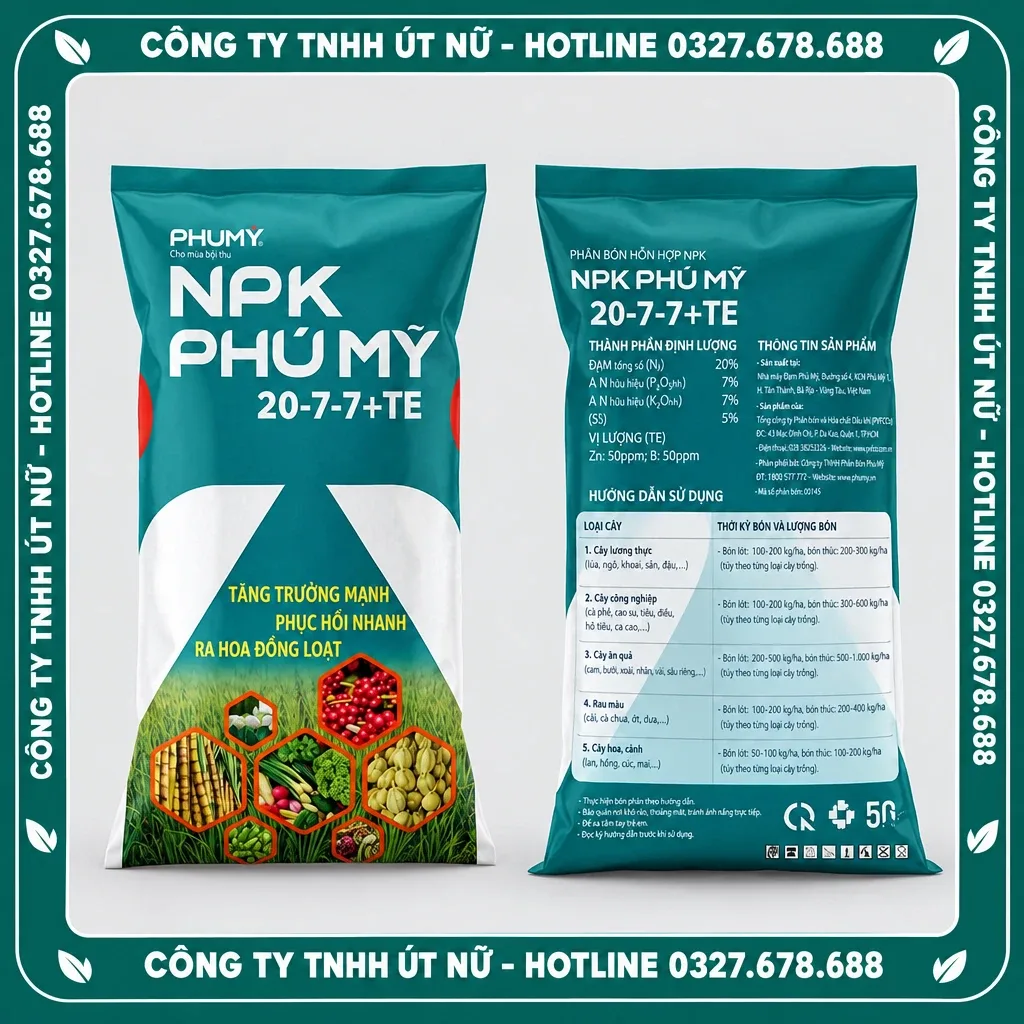
NPK Phú Mỹ 20-7-7+TE Parameters and Significance
According to PVFCCo, NPK Phú Mỹ 20-7-7+TE (code 05372) is a compound NPK fertilizer, used for root application, with a shelf life of 36 months from the manufacturing date. For food crops, the manufacturer recommends a basal application of 50–200 kg/ha and a top dressing of 50–300 kg/ha/crop (PVFCCo, n.d.).
- Nitrogen (N) 20%: main component, promotes shoot and leaf growth; this is a "high-nitrogen" formula.
- Available Phosphorus (P₂O₅) 7%: low level, only for supplementation; phosphorus should primarily be applied at the beginning of the season.
- Available Potassium (K₂O) 7%: low level; insufficient for fields prone to potassium deficiency.
- Zinc (Zn) 50 ppm and Boron (B) 50 ppm: supplemental micronutrients; zinc is directly related to the tillering ability of rice.
- Moisture 5%: a quality indicator for fertilizer granules, to be checked against the bag label.
Four Signs Your Field Is Ready for 20-7-7+TE Top-Dressing
1. Tillering fertilization, after the 3-week mark. Ca Mau Fertilizer's documents specify two fertilization applications during the seedling – tillering stage at 7–10 and 18–22 days after sowing (PVCFC, 2023a; PVCFC, 2023b). A high-nitrogen formula like 20-7-7 is suitable for the second application, around 18–25 days after sowing, when rice enters its peak tillering phase and plants begin to require more nitrogen.
2. Field already has phosphorus from the beginning of the season. IRRI recommends applying all phosphorus near the time of sowing (IRRI, 2007a). If the basal application or first topdressing already used a sufficient phosphorus formula, then for tillering, 20-7-7 can supplement nitrogen without needing to apply unnecessary additional phosphorus.
3. Leaves are yellowish-green, not yet reaching optimal color. Use a leaf color chart: select 10 hills, read the uppermost fully expanded leaf, shade from direct sunlight when reading, repeat every 7–10 days (IRRI, n.d.). IRRI notes that the leaf color threshold for nitrogen application ranges from 2 to 4 depending on the variety and planting method, so it must be adjusted according to local recommendations (IRRI, 2007b).
4. Alluvial soil with straw incorporated is less deficient in potassium. In these fields, a low potassium formula is less likely to cause imbalance.
Calculate by nutrient content. Each 100 kg of 20-7-7+TE provides 20 kg N, 7 kg P₂O₅, and 7 kg K₂O. Research by Can Tho University suggests approximately 85–95 kg N/ha for the entire crop on alluvial soils and 70–80 kg N/ha on acid sulfate soils and saline soils (Ngo Ngoc Hung et al., 2020). Thus, 100–150 kg/ha (about 10–15 kg per 1,000 m² công) for tillering provides 20–30 kg N, which is about one-quarter to one-third of the total nitrogen for the crop, and still below the 45 kg N/ha per application noted by IRRI (IRRI, 2007b). IRRI also notes that crops with more sunlight (such as Winter-Spring) generally require more nitrogen than those with less sunlight (IRRI, 2007b); however, the total amount for the entire crop should still adhere to local recommendations. This is an illustrative calculation and needs to be cumulative with previous and subsequent applications.
If you encounter these cases, temporarily set aside 20-7-7+TE
- Early top-dressing 7–10 days after sowing, especially on acid sulfate soil: rice needs phosphorus for root development. 20-7-7 is low in phosphorus; it is recommended to use a formula with sufficient phosphorus like NPK Phú Mỹ 16-16-8+13S+TE or combine with DAP Phú Mỹ 18-46-0 according to technical guidelines.
- If rice is already dark green and dense: nitrogen is sufficient; reduce or skip this nitrogen application, and continue monitoring with a leaf color chart.
- Fields with acid sulfate toxicity, organic toxicity (black roots, brown leaf spots, stunted tillering): nitrogen application at this time has little effect. IRRI recommends mid-season drainage around 25–30 days after sowing, keeping the field moist but not flooded for about 7–10 days to allow roots to get oxygen, combined with adequate potassium application (Dobermann and Fairhurst, 2000). Top-dress only after roots turn white again.
- Sandy soil, old acid sulfate soil, fields without straw incorporation: prone to potassium deficiency; 20-7-7 does not provide enough potassium. A more balanced formula like NPK Phú Mỹ 20-10-10+TE can be chosen, or potassium can be supplemented according to IRRI principles: split potassium into two applications, about half in the early season and half at panicle initiation (IRRI, 2007a).
- Fields affected by salinity early in the season: prioritize flushing out salt and maintaining fresh water; applying nitrogen to saline fields when roots are weak is likely wasteful.
- Heavy rain is expected: do not apply nitrogen top-dressing when heavy rain is forecast (IRRI, 2007b).
Notes on application
- Apply when the field has a thin layer of water; do not apply when it is raining, at midday during hot weather, or early in the morning when leaves are still wet with dew; it is best to apply in the cool afternoon (PSE, n.d.).
- Manage water using alternate wetting and drying (AWD): from tillering to panicle initiation, maintain water at 3–5 cm, then allow the field to dry gradually, which helps roots penetrate deeper and reduces organic toxicity (PVCFC, 2023a).
- Do not mix with lime; if lime has just been applied, wait at least 7–10 days before applying fertilizer (PVCFC, 2026).
- Spread evenly, do not let fertilizer accumulate in low-lying areas or along the edges of the field.
- Read the bag: check the name, ingredients, fertilizer code, and production date.
What should dealers advise?
Before introducing tillering fertilizer, dealers should ask again:
1. When was it sown, and how many days old is the crop? To determine if it's time for the first or second topdressing. 2. What was applied last time? If phosphorus hasn't been applied yet, don't immediately choose a high-nitrogen formula. 3. What do the leaves and roots look like? If leaves are dark green, reduce nitrogen; if roots are black, treat the water first. 4. Is the soil alluvial, acidic (phèn), or sandy, and was straw incorporated? To know if additional potassium is needed.
For fields at the second top-dressing, if phosphorus has been applied but leaves are not green enough, you can introduce NPK Phú Mỹ 20-7-7+TE and advise on the quantity based on nutrients, divided into applications. Út Nữ Co., Ltd distributes wholesale in Vĩnh Long – Trà Vinh – Mekong Delta; if you need to replenish stock, please call / Zalo 0294 3882069 – 02943 883791 – 02943 882837.
Conclusion
The tillering fertilization determines the number of tillers, but high nitrogen does not necessarily mean many effective tillers. The principle is to apply phosphorus from the beginning of the season, moderate nitrogen 3 weeks prior, then fertilize according to leaf color, in split applications, not a single large dose. NPK Phú Mỹ 20-7-7+TE is a high-nitrogen formula, suitable for vigorous tillering on fields that already have phosphorus and are not deficient in potassium. Acid sulfate soils need early phosphorus, sandy soils need more potassium, and intoxicated fields must be treated with water first. Applying the right type, at the right time, and in the right amount helps the Winter-Spring rice tiller compactly, healthily, and saves fertilizer in a season predicted to have water shortages.
References
Department of Meteorology and Hydrology (2026) *Water sources to the Mekong Delta in the 2026–2027 dry season may be low, with saltwater intrusion appearing from late December*. 17 September. Available at: https://vnmha.mae.gov.vn/nguon-nuoc-ve-dbscl-mua-kho-20262027-co-the-o-muc-thap-xam-nhap-man-xuat-hien-tu-cuoi-thang-12-18747.htm (Accessed: 3 October 2026).
Dobermann, A. and Fairhurst, T. (2000) *Rice: Nutrient disorders & nutrient management*. Singapore and Los Baños: PPI, PPIC and IRRI. Summarized at IRRI Rice Knowledge Bank, sections Nitrogen deficiency, Potassium deficiency and Iron toxicity. Available at: http://www.knowledgebank.irri.org/training/fact-sheets/nutrient-management/deficiencies-and-toxicities-fact-sheet (Accessed: 3 October 2026).
IRRI – International Rice Research Institute (2007a) *Nutrients for irrigated rice: SSNM* (Rice Production e-learning, Nutrient management IV.4). Available at: http://knowledgebank.irri.org/ericeproduction/IV.4_SSNM.htm (Accessed: 3 October 2026).
IRRI – International Rice Research Institute (2007b) *Nitrogen application* (Rice Production e-learning, Nutrient management). Available at: http://www.knowledgebank.irri.org/ericeproduction/pop_up_Nitrogen_application.htm (Accessed: 3 October 2026).
IRRI – International Rice Research Institute (n.d.) *Leaf Color Chart*. IRRI Rice Knowledge Bank. Available at: http://www.knowledgebank.irri.org/step-by-step-production/growth/soil-fertility/leaf-color-chart (Accessed: 3 October 2026).
Ngô Ngọc Hưng, Lý Ngọc Thanh Xuân, Trần Ngọc Hữu, Lâm Văn Thông, Nguyễn Bảo Vệ, Lê Phước Toàn, Lê Văn Dang, Nguyễn Kim Quyên, Trần Văn Dũng and Trịnh Quang Khương (2020) 'Using NPK for rice on major soil types in the Mekong Delta', *Can Tho University Journal of Science*, 56 (Special Issue on Soil Science), pp. 177–184. doi: 10.22144/ctu.jsi.2020.083.
Nhân Dân (2026) 'Proactively coping with drought and saltwater intrusion', *Báo Nhân Dân điện tử*, 27 tháng 6. Available at: https://nhandan.vn/chu-dong-ung-pho-voi-han-han-xam-nhap-man-post971920.html (Accessed: 3 October 2026).
PSE – Southeast Petrochemical and Fertilizer Joint Stock Company (n.d.) *Instructions for using Phu My Urea and Phu My NPK*. Available at: https://www.pse.vn (Business Activities – Phu My Urea section) (Accessed: 3 October 2026).
PVCFC – Cà Mau Petroleum Fertilizer Joint Stock Company (2023a) *Starting the Winter-Spring crop, choose Cà Mau Fertilizer*. Bí Kíp Vàng, 21 December. Available at: https://bikipvang.pvcfc.com.vn/2023/12/21/khoi-dong-vu-dong-xuan-chon-phan-bon-ca-mau/ (Accessed: 3 October 2026).
PVCFC – Cà Mau Petroleum Fertilizer JSC (2023b) *Sowing Winter-Spring rice, using specialized fertilizer*. Bí Kíp Vàng, 21 December. Available at: https://bikipvang.pvcfc.com.vn/2023/12/21/sa-lua-dong-xuan-bon-phan-chuyen-dung/ (Accessed: 3 October 2026).
PVCFC – Cà Mau Petroleum Fertilizer JSC (2026) *What is liming? Role and proper liming techniques*. February 25. Available at: https://www.pvcfc.com.vn/bon-voi (Accessed: 3 October 2026).
PVFCCo – PetroVietnam Fertilizer and Chemicals Corporation (n.d.) *NPK Phú Mỹ 20-7-7+TE – product information and usage instructions* (code 05372). Available at: https://dpm.vn (Product section – Phú Mỹ NPK Compound Fertilizer Group) (Accessed: 3 October 2026).
About Content and Responsibility
Content developed by Grokbot AI. Út Nữ Co., Ltd and Grokbot AI disclaim responsibility for any damages arising from the use of information in this article. All content is for exploratory and academic purposes only, does not replace professional technical advice, official recommendations from manufacturers or state agencies, and does not constitute a commercial promise of yield or economic efficiency.