
Tet market vegetables and newly sown rice: consider sulfur first, then Phú Mỹ NPK 17-17-8+13S+TE.
Published · Út Nữ Co., Ltd
> Warning: The content of this article was created / supported by AI based on a synthesis of public documents. Út Nữ Co., Ltd disclaims responsibility for damages arising from the use of information in this article. You should cross-reference packaging, manufacturer's instructions, local seasonal calendars, and contact the hotline for advice suitable for actual conditions.
From mid-October, as the water recedes, many households in Vĩnh Long and Trà Vinh begin preparing raised beds to plant year-end vegetables: cabbage, onions, melons, corn, and leafy greens for the Tết market. Simultaneously, the 2026-2027 Winter-Spring rice crop starts sowing according to schedule: early crop from October 10 to 30, main crop from November 1 to 30, and late crop from December 1 to 31. This year, specialized agencies also advise that vegetables should only be sown when water sources are balanced, prioritizing short-day, drought-tolerant varieties (Bích Hồng, 2026).
During the seedling stage, both vegetables and rice need nitrogen and phosphorus for root development and leaf growth. A common question at the store is: "Is Phú Mỹ NPK 17-17-8+13S+TE, which contains 13% sulfur, suitable for vegetables and rice at the beginning of the season?" This article helps you understand the formula on the bag, especially the sulfur content, to apply the right type – at the right time – in the right amount.
The Reality: Sulfur is good, but not all soils are deficient
Sulfur (S) is considered the fourth most important nutrient after nitrogen, phosphorus, and potassium. S participates in the formation of amino acids, proteins, and compounds that create the characteristic flavors of vegetables and onions (Bình Điền, n.d.). However:
- Flooded paddy soils, acid sulfate soils, saline soils usually have sufficient or excess sulfur, especially acid sulfate soils.
- Sandy soils, gray soils, low organic matter soils, long-term upland cultivation soils are more prone to deficiency.
- Prolonged over-application of S can further acidify the soil (Bình Điền, n.d.).
Therefore, for the same bag of fertilizer with 13% S, some soil types are very suitable, while others should choose a different type.
Product Specifications and the Significance of Each Component
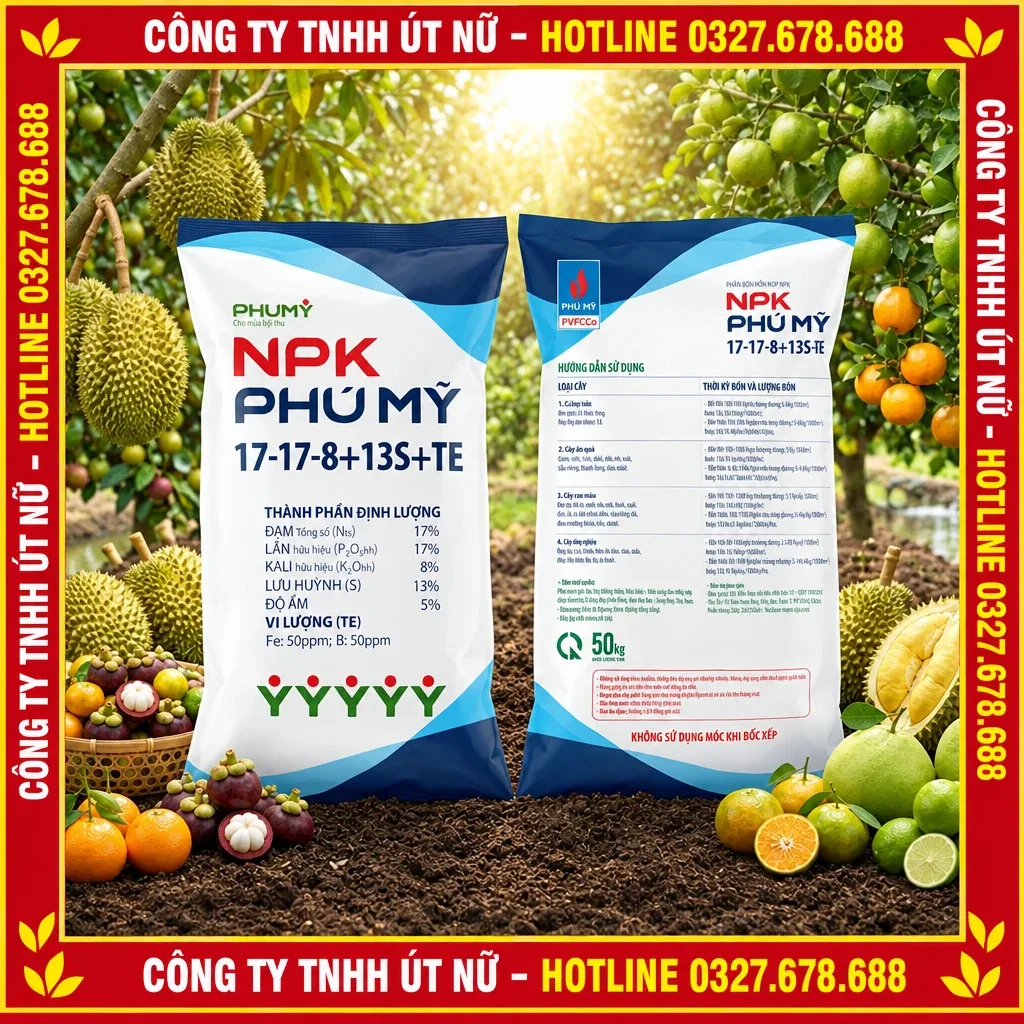
According to PetroVietnam Fertilizer and Chemicals Corporation (PVFCCo), NPK Phú Mỹ 17-17-8+13S+TE, code 05356, is for root application (basal and top dressing), with a shelf life of 36 months; used for food crops, industrial crops, fruit trees, and vegetables. Recommended dosage: food crops 100–400 kg/ha for basal application, 100–500 kg/ha/crop for top dressing; vegetables 50–400 kg/ha for basal application, 50–500 kg/ha/crop for top dressing (PVFCCo, n.d.).
- Nitrogen 17%: helps seedlings produce leaves and tiller.
- Phosphorus 17%: equal to nitrogen, supports early root establishment.
- Potassium 8% (low): not enough for the tuber, fruit, or panicle development stages.
- Sulfur 13%: a prominent part of the formula, useful in S-deficient soils.
- Micronutrients (zinc 50 ppm, boron 50 ppm): small amounts, supplementary.
- Moisture 5%: storage indicator.
Calculate sulfur content before bagging
Each 100 kg of 17-17-8+13S fertilizer provides 17 kg N, 17 kg P2O5, 8 kg K2O, and 13 kg S.
According to Bình Điền's recommendations, flooded rice fields in the Mekong Delta are rarely deficient in S; each rice crop of about 5 tons only removes 5–7 kg of S, so the total additional S applied should not exceed 10–15 kg S/ha; heavily acidic soil should not be fertilized with high S content; for vegetable and flower growing areas, additional S should not exceed 20 kg S/ha (Bình Điền, n.d.).
Compared to:
- Rice: only about 100 kg/ha of this fertilizer is needed to reach the recommended S level for the entire crop.
- Vegetables: approximately 100–150 kg/ha for 13–19.5 kg of S, still within the 20 kg S/ha range.
This means the maximum dose on the package is a broad range for many crop types, but for rice fields and vegetables in the Mekong Delta, it should generally only be used at a low to moderate level, with the remainder using NPK without S.
For vegetables and crops: when is it suitable?
Combined for basal fertilization and seedling stage, especially:
- Cruciferous vegetables, onions, chives, and other plants that require Sulfur (S) for flavor development.
- Sandy beds, raised beds, soils with low organic matter.
- Rice fields converted to vegetable beds, after many seasons of only applying urea, DAP, and potash.
Things to consider when:
- Long-term vegetable growing soil already rich in phosphorus: studies on vegetable soil in Cần Thơ, An Giang, Vĩnh Long, Trà Vinh show that the soil's phosphorus release capacity is very high, and plants respond little to phosphorus fertilizer on soils with medium to high available phosphorus (Nguyễn Mỹ Hoa and Phạm Thị Phương Thúy, 2015). At this time, the amount can be reduced or a formula with less phosphorus can be chosen.
- Root and fruit vegetables (melons, pumpkins, radishes) entering the fruit/root development stage: 8% potassium is not enough, it is necessary to switch to a high-potassium formula.
- Beds are still wet, roots have not recovered after flooding: wait for the soil to dry, loosen it, then fertilize.
For rice in the early stage: one application is enough
The nutritional framework for rice in the Mekong Delta is approximately 85–95 kg N/ha on alluvial soil, 70–80 kg N/ha on acid sulfate soil, saline-affected soil; 30–45 kg P2O5/ha of phosphorus and 25–35 kg K2O/ha of potassium when straw is incorporated (Ngo Ngoc Hung et al., 2020). A single application of 100 kg/ha of this formula provides about one-fifth of the nitrogen and from more than one-third to more than half of the phosphorus for the entire crop, which is very suitable for basal application or the first topdressing 7–10 days after sowing, when rice needs phosphorus for root establishment.
In subsequent applications, rice needs more nitrogen during tillering and more potassium during panicle initiation, so switch to a formula without S and with less phosphorus.
According to IRRI, sulfur deficiency is not common in irrigated rice; it is more frequently found in sandy soils and soils low in organic matter. Symptoms of sulfur deficiency (pale yellow plants, yellow young leaves) are very similar to nitrogen deficiency, so soil and plant analysis is needed for confirmation; incorporating straw instead of burning it also helps return sulfur to the soil (IRRI, n.d.). Do not immediately assume yellow rice indicates a need for sulfur fertilizer.
Acid sulfate soil: should not choose fertilizers high in S (Bình Điền, n.d.); prioritize NPK without S, along with acid leaching and lime application according to local guidelines.
Notes on application
- First, determine the soil type: alluvial, acidic (alum), sandy, or long-term cultivated soil; if conditions permit, conduct soil analysis.
- Vegetables: apply as a base fertilizer, mixing evenly into the topsoil when ridging, covering with soil, and watering to keep moist; for topdressing, spread around the base of plants, avoiding contact with young leaves.
- Rice: apply when the field has a thin layer of water, avoiding heavy rain.
- Cumulative nutrients: calculate the total nitrogen, phosphorus, potassium, and sulfur from all fertilizers applied, including SA and superphosphate (which also contain S).
- Read the bag: check the ingredients, fertilizer code, manufacturing date, and expiration date.
What should dealers advise?
When farmers ask about 17-17-8+13S fertilizer, dealers should ask: what crop – what soil – have SA, superphosphate been applied yet. From there:
- Cabbage, onions on sandy beds, low organic matter soil: can recommend NPK Phú Mỹ 17-17-8+13S+TE for basal application, seedling stage, reminding to keep total S around 20 kg/ha.
- Rice in early stage on alluvial soil: use once for basal or early topdressing; subsequent applications switch to NPK without S such as NPK Phú Mỹ 20-20-15+TE or NPK Phú Mỹ 16-16-16+TE.
- Acid sulfate soil (phèn field): recommend using NPK without S, along with Vôi Phú Mỹ according to local guidelines.
- Root vegetables, fruiting vegetables during development stage: switch to high potassium formulas like NPK Phú Mỹ 15-5-20+TE.
Út Nữ Co., Ltd provides wholesale distribution in the Vĩnh Long – Trà Vinh – Mekong Delta region. If you need to replenish your stock, you can call / Zalo 0294 3882069 – 02943 883791 – 02943 882837.
Conclusion
NPK Phú Mỹ 17-17-8+13S+TE is a formula with balanced nitrogen and phosphorus, low potassium, and high sulfur. It is best suited for basal application and the seedling stage of vegetables, especially cruciferous vegetables and onions, on sandy soils and soils with low organic matter. For rice, this formula is suitable for one basal application or early top-dressing, then switching to another formula. For alum soils and soils already high in sulfur, choose NPK without S. Calculating the amount based on nutrients, accumulating both sulfur and supplementing potassium at the right stage is the way for the fertilizer bag to fulfill its proper role.
References
Bich Hong (2026) 'Proactively responding to El Nino… ensuring production for the 2026-2027 Winter-Spring crop', *VietnamPlus*, 22 September. Available at: https://www.vietnamplus.vn/chu-dong-ung-pho-el-nino-bao-dam-san-xuat-vu-dong-xuan-2026-2027-post1137647.vnp (Accessed: 3 October 2026).
Bình Điền – Bình Điền Fertilizer JSC (n.d.) *Sulfur, familiar yet strange*. Smart Farming Program. Available at: https://binhdien.com/dong-hanh-cung-nha-nong/chuong-trinh-canh-tac-thong-minh/luu-huynh-quen-nhung-van-la.html (Accessed: 3 October 2026).
IRRI – International Rice Research Institute (n.d.) *Sulfur deficiency*. IRRI Rice Knowledge Bank (based on Dobermann, A. and Fairhurst, T., 2000, *Rice: Nutrient disorders & nutrient management*). Available at: http://www.knowledgebank.irri.org/training/fact-sheets/nutrient-management/deficiencies-and-toxicities-fact-sheet/item/sulfur-deficiency (Accessed: 3 October 2026).
Ngô Ngọc Hưng, Lý Ngọc Thanh Xuân, Trần Ngọc Hữu, Lâm Văn Thông, Nguyễn Bảo Vệ, Lê Phước Toàn, Lê Văn Dang, Nguyễn Kim Quyên, Trần Văn Dũng and Trịnh Quang Khương (2020) 'Using NPK for rice on major soil types in the Mekong Delta', *Can Tho University Journal of Science*, 56 (Special Issue on Soil Science), pp. 177–184. doi: 10.22144/ctu.jsi.2020.083.
Nguyễn Mỹ Hoa and Phạm Thị Phương Thúy (2015) 'Phosphorus composition and phosphorus release capacity of key vegetable-crop soils in the Mekong Delta', in *National Workshop: Effective Use of Van Dien Fertilizer in Vietnam*, Ho Chi Minh City, 28 May, pp. 207–220. Available at: https://qldiem.ctu.edu.vn/ql/docgia/tacgia-5526/baibao-30808.html (Accessed: 3 October 2026).
PVFCCo – PetroVietnam Fertilizer and Chemicals Corporation (n.d.) *Phu My NPK 17-17-8+13S+TE – product information and usage instructions* (Phu My NPK Compound Fertilizer Group section on the official website). Available at: https://dpm.vn (Accessed: 3 October 2026).
About Content and Responsibility
Content developed by Grokbot AI. Út Nữ Co., Ltd and Grokbot AI disclaim responsibility for any damages arising from the use of information in this article. All content is for exploratory and academic purposes only, does not replace professional technical advice, official recommendations from manufacturers or state agencies, and does not constitute a commercial promise of yield or economic efficiency.