
Young grapefruit orchards 1–3 years old entering the dry season: prioritize water management and canopy development, apply fertilizer in small doses according to new shoot flushes.
Published · Út Nữ Co., Ltd
> Warning: The content of this article was generated/supported by AI based on publicly available information. Út Nữ Co., Ltd disclaims responsibility for damages arising from the use of information in this article. We recommend that you cross-reference product packaging, manufacturer's instructions, local seasonal calendars, and contact our hotline for advice tailored to your specific conditions.
Mid-November 2026, the 2026–2027 dry season in the Mekong Delta is approaching, and young grapefruit orchards aged one to three years are the most easily overlooked group because they are not yet bearing fruit. According to the draft water resource scenario reported by Nhân Dân Newspaper, this dry season (from November 2026 to May 2027) is likely to have insufficient rainfall due to El Nino, and saltwater intrusion could be as severe as the 2019–2020 dry season, with a high risk of serious water shortages concentrated from February to May 2027 (Nhân Dân, 2026).
For fruit trees, the Department of Crop Production and Plant Protection recommends prioritizing the protection of existing garden areas, actively storing fresh water in ponds, ditches, and reservoirs, practicing water-saving irrigation, mulching to retain moisture, and always checking salinity before watering; at the same time, it does not encourage new planting or expansion of areas where there is insufficient water for the entire cycle (Nhân Dân, 2026). For young grapefruit orchards that have already been planted, the necessary task is to ensure the trees survive the dry season with healthy root systems and canopies. Information on new planting and replanting is available in the article Water recedes, early dry season new planting, replanting fruit trees.
The Right Type: Young plants need an organic base, phosphorus, lime, and balanced NPK
The VietGAP pomelo cultivation handbook, compiled by the Department of Crop Production, divides the basic construction period (one to three years after planting, before the tree bears fruit) into two parts: annual base fertilization, which includes all well-rotted manure, phosphorus, and lime; and annual topdressing, with approximately seven-tenths being organic microbial fertilizer and three-tenths NPK fertilizer, applied alternately in several rounds (Department of Crop Production, n.d.).
The experience of the Ben Tre Agricultural Extension Center with young green-skinned pomelo also prioritizes canopy formation: pinching the top, selecting three strong primary branches, pulling branches to create angles, and pruning water sprouts; when pruning to form the canopy, apply fertilizer rich in nitrogen and phosphorus combined with organic fertilizer to promote strong shoot growth (National Agricultural Extension Center, 2018). Experiments on Nam Roi pomelo in Chau Thanh alluvial soil showed that the soil only supplies about half of the nitrogen absorbed by the tree, with the remainder needing to come from fertilizer (Tran et al., 2024) — thus, young trees still require nitrogen, but in smaller, split applications.
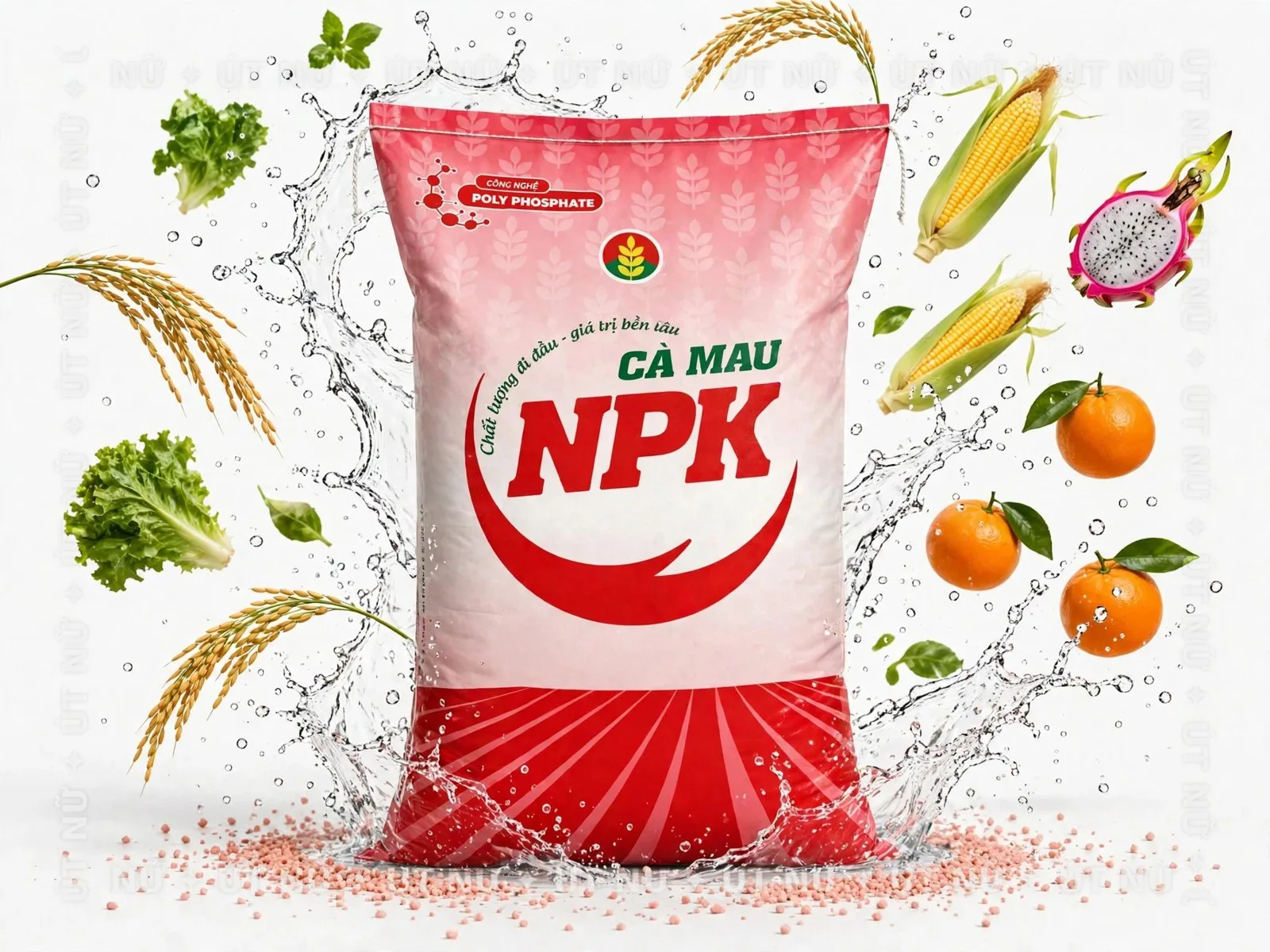
In the balanced NPK group for young plants, an example is NPK Cà Mau 16-16-10 from the Cà Mau factory, with a 16-16-10 content, meaning equal nitrogen and phosphorus, and moderate potassium. This is just an example of the fertilizer group; please refer to the usage instructions on the bag and cross-reference the recommended rates based on plant age in the section below.
Timely Application: basal application at year-end, top-dressing according to flush cycles
The Department of Crop Production's handbook sets the annual basal fertilization time for young, developing grapefruit trees from November to December (Cục Trồng trọt, n.d.) — precisely these weeks. Application method: dig trenches along the canopy projection, allow two to three days for the root ends to dry before applying farmyard manure, phosphorus, and lime, to limit fungal diseases from entering through severed roots; for organic microbial fertilizer and NPK, make shallow trenches around the canopy and then cover with soil (Cục Trồng trọt, n.d.).
Top-dressing should follow the plant's shoot flush cycle and only be applied when the soil is sufficiently moist: the handbook reminds that each application requires adequate watering before and after fertilization (Department of Crop Production, n.d.). In the dry season, this depends on freshwater sources. The ditch-and-ridge water storage model for pomelo in Tiền Giang during the 2023–2024 dry season significantly increased available water, providing enough irrigation for an additional two to three months during drought and salinity intrusion (Trần et al., 2025).
Correct Quantity: according to plant age, divided into many small applications
The Department of Crop Production's handbook provides a table of fertilizer quantities per tree per year, increasing gradually from the first to the third year, including farmyard manure, phosphorus, lime, microbial organic fertilizer, and NPK (Department of Crop Production, n.d.). You should use that table as a framework based on the age of your orchard, then divide the annual NPK portion into multiple smaller applications according to flush cycles, instead of applying it all at once.
To determine the number of bags, calculate the amount of nitrogen, phosphorus, and potassium from the nutrient content stated on the bag, then compare it with the recommended rates based on the plant's age. For young plants grown on newly mounded beds, sandy soil, or easily drying soil, it is even more advisable to divide the application into smaller doses, as the roots of young plants have not yet spread widely. The aforementioned research serves as a general scientific basis and is not a promise of results for individual farms.
Tasks for These Days
Check ditches: how much fresh water is left, whether sluices and embankments are secure; plan ahead for water storage during dry months. Mulch the base with straw, dry grass, or coconut leaves to retain moisture. In November–December, if the soil is sufficiently moist, apply well-rotted manure, phosphorus, and lime as a base fertilizer under the canopy projection, as per the instruction manual.
Prune water sprouts and branches growing inwards; Ben Tre Agricultural Extension recommends opening up the canopy and training branches to create a large canopy at the beginning of the rainy season (National Agricultural Extension Center, 2018). For each new flush of shoots, apply a small top-dressing when the soil is moist. When salinity has entered the canals, stop irrigating with that water. How to prepare potassium and fresh water for the entire garden is detailed in the article Salinity intrusion threatens the 2026–2027 dry season.
References (Harvard)
Department of Crop Production (n.d.) *Technical handbook for farmers on VietGAP-standard pomelo cultivation*. Available at: https://apictt.tuyenquang.gov.vn/uploads/attachments/2-so-tay-tofcay-buoivietgap.pdf (Accessed: 14 November 2026).
Nhân Dân (2026) *Southeast and Mekong Delta regions: Proactively respond to drought and saltwater intrusion*, 6 November. Available at: https://nhandan.vn/dong-nam-bo-va-dong-bang-song-cuu-long-chu-dong-ung-pho-han-han-xam-nhap-man-post1000699.html (Accessed: 14 November 2026).
Tran, E.H., Le, Q.N., Ngo, N.P., Le, M.T.H. and Ngo, H.N. (2024) ‘Evaluation of nitrogen use efficiency and N-supplying capacity on pomelo (Citrus grandis L. Osbeck) grown on alluvial soil in the Cuu Long Delta’, *The Journal of Agriculture and Development*, 23(5), pp. 12–21. doi: 10.52997/jad.5.02.2024.
Trần, T.H., Trần, M.T., Ninh, V.B., Nguyễn, V.T., Huỳnh, N.T., Lê, V.T., Nguyễn, H.M.L. and Lê, T.Q.A. (2025) ‘Research on applying the ditch-and-ridge water storage model for pomelo orchard irrigation adapting to drought and salinity conditions in the Mekong Delta’, *Vietnam Journal of Science, Technology and Engineering – Part B*, 67(12B). doi: 10.31276/vjst.2024.3099.
National Agricultural Extension Center (2018) *Ben Tre: Heart-shaped pruning method helps improve yield and quality of Da xanh grapefruit*, 3 May. Available at: https://khuyennongvn.gov.vn/khoa-hoc-cong-nghe/khcn-trong-nuoc/ben-tre-phuong-phap-tao-hinh-khai-tam-giup-nang-cao-nang-suat-chat-luong-buoi-da-xanh-16832.html (Accessed: 14 November 2026).
About Content & Responsibilities
Content developed by Grokbot AI. Út Nữ Co., Ltd and Grokbot AI disclaim responsibility for any damages arising from the use of information in this article. All content is for exploratory and academic purposes only, does not replace professional technical advice, official recommendations from manufacturers or state agencies, and does not constitute a commercial promise of yield or economic efficiency.