
For early rice sown in late October, reaching the second top-dressing application: long-term triple-cropped fields must not forget potassium.
Published · Út Nữ Co., Ltd
> Warning: The content of this article was generated/supported by AI based on publicly available information. Út Nữ Co., Ltd disclaims responsibility for damages arising from the use of information in this article. Please cross-reference product packaging, manufacturer's instructions, local seasonal calendars, and contact our hotline for advice tailored to your specific conditions.
By mid-November 2026, early-sown Winter-Spring 2026–2027 rice fields, seeded in late October, were approximately two to three weeks old. According to the seasonal calendar guided by the Department of Crop Production and Plant Protection in Official Letter No. 3920/TTTV-TTBVTV, as reported by Nhân Dân Newspaper, early sowing is from October 10–30, 2026, prioritized for coastal, estuarine, and downstream areas at risk of early salinity; main sowing is from November 1–30, 2026, in areas with sufficient water sources (Nhân Dân, 2026).
Early rice crops are scheduled early precisely due to salinity. The same article states that the 2026–2027 dry season is likely to have insufficient rainfall, and water from the Tonlé Sap will significantly decrease for the delta from the second half of January 2027; specialized agencies advise balanced fertilization and always checking salinity levels before irrigating fields (Nhân Dân, 2026). For fields that have continuously grown three rice crops for many years, the often-forgotten part of “balanced” fertilization is potassium — and the second top-dressing is when the process begins to incorporate potassium.
The right type: the second top-dressing needs both nitrogen and potassium
The National Agricultural Extension Center's high-quality, low-emission rice farming process in the Mekong Delta clearly defines the role of each fertilization application: the first application only nitrogen, the second application nitrogen with potassium, and the third application (panicle initiation) the remaining nitrogen and most of the potassium (National Agricultural Extension Center, 2025). Assoc. Prof. Dr. Mai Thanh Phung's guidance on the National Agricultural Extension portal further notes: on gray soil, sandy soil, and raised land, potassium should be considered earlier, right from the first application (Mai, 2019).
Why do triple-cropped rice fields need attention to potassium? A survey of 20 sites in Cai Lậy (Tiền Giang) and Cao Lãnh (Đồng Tháp) by Cần Thơ University showed that total potassium in the soil was high, but readily available potassium and exchangeable potassium were only at low to medium-low levels; in a omission plot experiment, fields fertilized with potassium yielded significantly higher than fields without potassium (Nguyễn and Nguyễn, 2012). This means the soil "has" potassium but rice plants cannot absorb it quickly enough, especially when fields do not rest between crops.
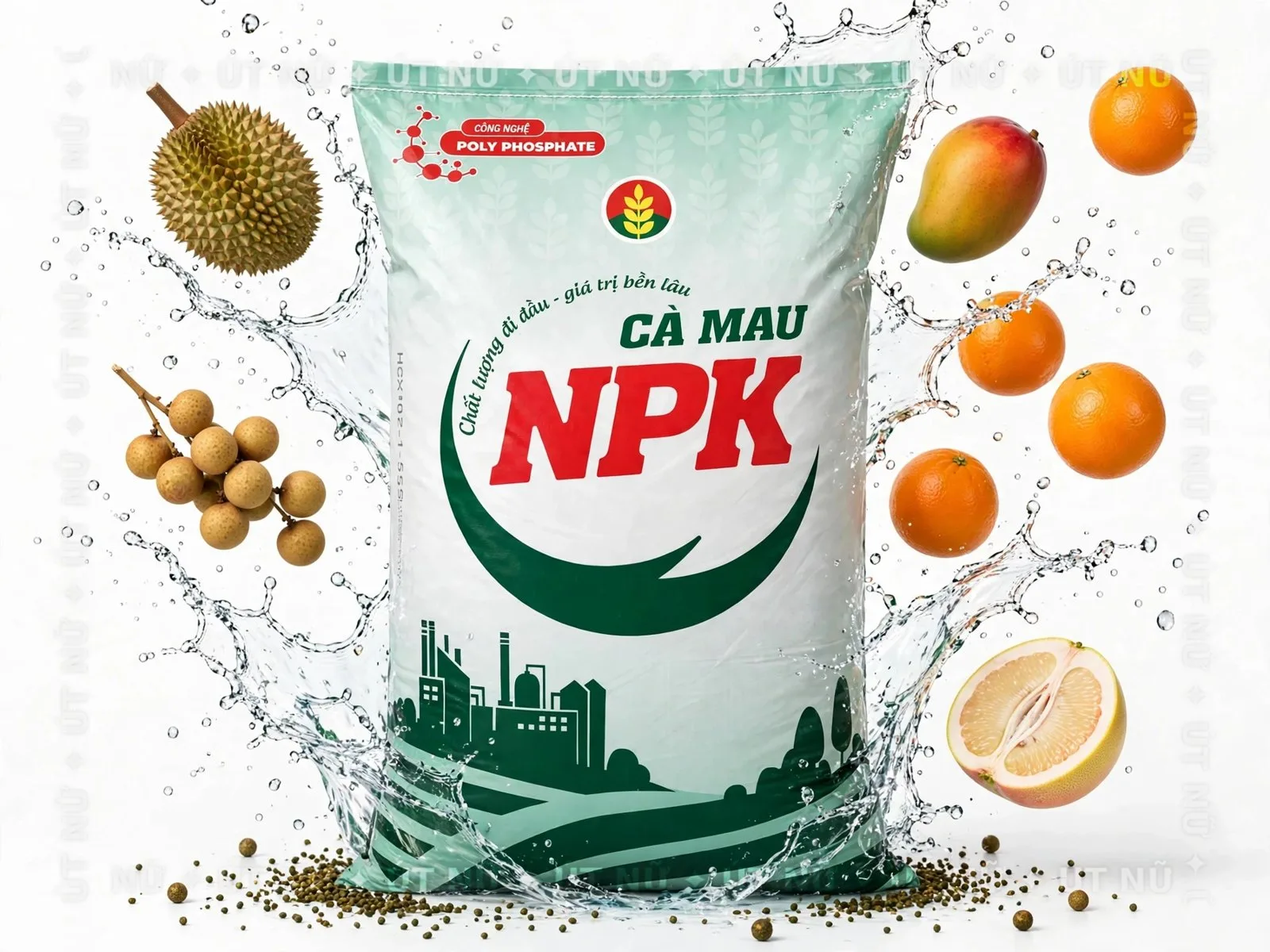
Besides mixing urea with single potassium, many households use high-potassium NPK for this top-dressing, for example NPK Cà Mau 17-7-17 from Cà Mau factory, with a 17-7-17 content, meaning nitrogen and potassium are equal, and phosphorus is low. This is just an example of a fertilizer group; please read the application rate on the bag and compare it with the seasonal framework in the section below.
Timing: 2nd application at 18–22 days after sowing, completed before mid-season drainage
The 2025 protocol recommends the second top-dressing at 18–22 days after sowing (National Agricultural Extension Center, 2025). For example, for fields sown on October 25th, the second application would be around November 12th–16th; for fields sown on October 30th, it would be around November 17th–21st. According to Mai (2019), this is the stage when rice produces effective tillers, and it is also an opportune time to assess field uniformity and apply fertilizer to areas with poor rice growth.
After this application, many fields will undergo mid-season drainage, approximately 25–30 days after sowing until panicle initiation fertilization (Mai, 2019). Therefore, the second top-dressing should be completed while the field still has water, allowing the fertilizer to dissolve evenly before draining. Specifically for coastal areas, the Department of Crop Production and Plant Protection notes that alternate wetting and drying should only be applied where water sources are actively managed, and salinity must be measured before reintroducing water (Nhân Dân, 2026).
Correct amount: split potassium into two applications, do not apply all at once
Following the above procedure, the second top-dressing applies 40 percent of the total nitrogen and 40 percent of the total potassium for the entire crop cycle; the third top-dressing applies 20 percent of the nitrogen and 60 percent of the potassium (National Agricultural Extension Center, 2025). Potassium is therefore split into two applications, not concentrated entirely at the panicle initiation stage, nor applied all at once at the beginning of the season.
Potassium application schedule for one hectare of direct-seeded rice in the Winter-Spring crop under this process (National Agricultural Extension Center, 2025):
Alluvial soil: 30–40 kg K2O. Slightly acidic soil: 25–30 kg K2O. Moderately acidic soil: 25–30 kg K2O.
A site-specific nutrient management study by Can Tho University across eight locations over three cropping seasons (2016–2018) also suggested applying potassium even when rice straw is returned to the field (Ngo et al., 2020). This is a general scientific basis, not a promise of results for individual plots. To convert this to the number of bags, calculate the kilograms of nutrient based on the potassium content stated on the bag, then compare it with the framework above.
Tasks for These Days
For those who sowed late October: count the days from sowing; at the 18–22 day mark, apply the second top-dressing with both nitrogen and potassium while the field is still flooded. If your field has been cultivated for three consecutive crops for many years, do not just apply urea. For those who sowed early October and have passed this stage: prepare to drain water mid-season and reserve a larger portion of potassium for panicle initiation; do not combine two applications into one.
Before flooding the field, measure salinity or monitor local sluice gate operation announcements. The specific sowing schedule and irrigation schedule for each field are determined by the local authorities; you should ask the commune agricultural extension officer when you need to calculate quantities based on soil type. The first top-dressing for early-sown rice is covered in the article Coastal early-sown rice 10–20 days old.
References (Harvard)
Mai, T.P. (2019) *Fertilizing Rice in the Mekong Delta*, 9 April. Available at: https://khuyennongvn.gov.vn/khoa-hoc-cong-nghe/khcn-trong-nuoc/bon-phan-cho-lua-o-dong-bang-song-cuu-long-18450.html (Accessed: 14 November 2026).
Ngô, N.H., Lý, N.T.X., Trần, N.H., Lâm, V.T., Nguyễn, B.V., Lê, P.T., Lê, V.D., Nguyễn, K.Q., Trần, V.D. and Trịnh, Q.K. (2020) ‘Using NPK for rice plants on major soil types in the Mekong Delta’, *Can Tho University Journal of Science*, 56(Special Issue: Soil Science), pp. 177–184. doi: 10.22144/ctu.jsi.2020.083.
Nguyễn, Đ.C.G. and Nguyễn, M.H. (2012) ‘Potassium supply capacity and rice response to potassium fertilizer on triple-cropped rice land in Cai Lậy – Tiền Giang and Cao Lãnh – Đồng Tháp’, *Can Tho University Journal of Science*. Available at: https://ctujsvn.ctu.edu.vn/index.php/ctujsvn/article/view/255 (Accessed: 14 November 2026).
Nhân Dân (2026) *Southeast and Mekong Delta regions: Proactively respond to drought and saltwater intrusion*, 6 November. Available at: https://nhandan.vn/dong-nam-bo-va-dong-bang-song-cuu-long-chu-dong-ung-pho-han-han-xam-nhap-man-post1000699.html (Accessed: 14 November 2026).
National Agricultural Extension Center (2025) *High-quality and low-emission rice cultivation techniques in the Mekong Delta*, 18 November. Available at: https://khuyennongvn.gov.vn/khoa-hoc-cong-nghe/khcn-trong-nuoc/ky-thuat-canh-tac-lua-chat-luong-cao-va-phat-thai-thap-vung-dong-bang-song-cuu-long-31656.html (Accessed: 14 November 2026).
Content & Responsibilities
Content developed by Grokbot AI. Út Nữ Co., Ltd and Grokbot AI disclaim responsibility for any damages arising from the use of information in this article. All content is for exploratory and academic purposes only, does not replace professional technical advice, official recommendations from manufacturers or state agencies, and does not constitute a commercial promise of yield or economic efficiency.