
Early direct-sown rice in coastal areas, 10-20 days old: How to apply the first topdressing for strong tillering?
Published · Út Nữ Co., Ltd
> Warning: The content of this article was created / supported by AI based on a synthesis of public documents. Út Nữ Co., Ltd disclaims responsibility for damages arising from the use of information in this article. You should cross-reference packaging, manufacturer's instructions, local seasonal calendars, and contact the hotline for advice suitable for actual conditions.
In early November, the early-sown 2026–2027 Winter-Spring rice fields in the coastal areas of North Ben Tre and Tra Vinh — sown from October 10–30 to avoid salinity according to the seasonal schedule of the Department of Crop Production and Plant Protection (Dân Việt, 2026a) — are now 10–20 days old and entering the peak tillering stage. At the same time, a very strong El Nino (98 percent probability) is forecast to extend into early 2027, with dry season salinity intrusion potentially comparable to the 2015–2016 dry season, beginning to affect from late December 2026 (Dân Việt, 2026b; thitruonghanghoa.com, 2026). The healthier the rice is from the beginning of the season, the more resilient it will be when salinity arrives — and top dressing 1 is the crucial application that determines the number of effective tillers, which is the "framework" of the entire rice field later on.
The goal of this article is concise: to help farmers apply top dressing 1 correctly — at the right time, with the right nutritional role, using the right technique — using NPK Cà Mau 20.15.7+1Mg+TE as a technical example for this application.
Why does the first topdressing determine the "framework" of the rice field?
According to technical guidelines, tillering fertilization is usually carried out approximately 7–12 days after sowing, when the plants have 2–3 true leaves and begin to tiller (Bio Việt Nam, 2025; AgriDrone, n.d.). Fertilizing at this correct time contributes to increasing the number of effective tillers, helping leaves stay green and healthy, and stems become robust. If applied too late, after the plant has passed its most vigorous tillering period, the fertilizer will not be able to fully exert its effect; if applied too early when the roots are still weak, the plant cannot absorb it quickly enough, leading to easy loss.
The tillering stage is also when plants need a special "menu": a large amount of nitrogen for leaf and stem development, phosphorus to continue nourishing roots and effectively support tillering — the number of panicles per rice clump later on is largely determined here (ECOMCO, 2025). Farmers often say "heavy at the beginning, light at the end" for a reason: concentrating nutrients during the vegetative growth stage for stems, leaves, and roots makes subsequent applications less burdensome.
More than just Nitrogen: The role of Phosphorus, Magnesium, and Micronutrients in the first top-dressing
Nitrogen is the main nutrient that helps plants tiller strongly; accompanying potassium helps stems become strong and leaves thick (Bio Việt Nam, 2025). However, the first top-dressing is not just about "adding nitrogen":
- Phosphorus (P): if nitrogen helps plants "grow tall," phosphorus helps them "root deep" — vital for the root system in the early stages, serving as a prerequisite for early and concentrated tillering (ECOMCO, 2025). Cà Mau Fertilizer also describes phosphorus as contributing to building a strong, deep-rooted system (PVCFC, 2025).
- Magnesium (Mg): is the central atom of the chlorophyll molecule — without magnesium, rice leaves cannot photosynthesize to create "food"; magnesium deficiency causes older leaves to turn yellow in a very characteristic V-shape (ECOMCO, 2025). Research on 3 rice varieties in the Winter-Spring crop showed that magnesium application increased the number of tillers, effective tiller ratio, and chlorophyll content (Nguyễn Đình Thi et al., 2024). On the ST25 variety, supplementing with magnesium silicate also helped increase chlorophyll a, b content and root length (Phạm Huyền Linh và Phạm Phước Nhẫn, 2024). A meta-analysis of 99 field studies worldwide recorded that magnesium application increased crop yield by an average of 8.5 percent (cereal crops 8.2 percent), with the most significant effect on acidic soils with pH below 6.5 (Wang et al., 2020) — this is a general scientific research result, not a yield promise for any specific product.
- Micronutrients (TE): zinc is a typical example — rice lacking zinc often shows symptoms 2–4 weeks after sowing: stunted plants, young leaves with white-yellow stripes, very poor tillering (ECOMCO, 2025). Plants only need micronutrients in grams per hectare, but a deficiency can cause significant damage.
An equally important counter-note: over-fertilizing with nitrogen makes plants leggy, leaves thin and weak, prone to lodging, and susceptible to blast disease and brown planthoppers — a study by the Vietnam Academy of Agricultural Sciences recorded that fields over-fertilized with nitrogen had a blast infection rate up to 40 percent higher than fields with balanced fertilization (cited by ECOMCO, 2025). The correct dose and type are more important than applying too much.
Technical Example: NPK Cà Mau 20.15.7+1Mg+TE
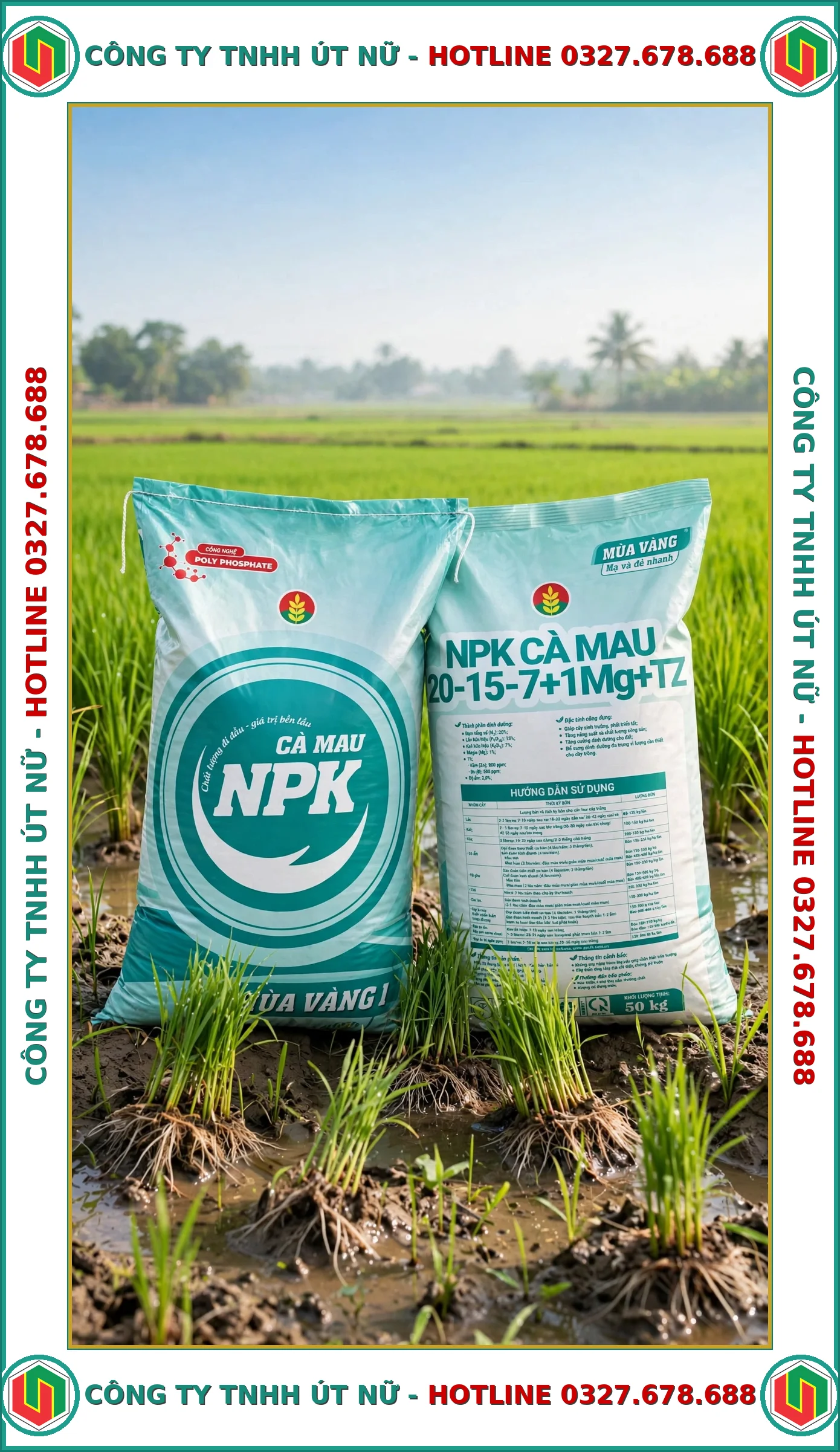
Cà Mau NPK 20.15.7+1Mg+TE is a single-granule NPK formula from Cà Mau Fertilizer. According to the formula printed on the packaging: 20 percent nitrogen, 15 percent available phosphorus, 7 percent available potassium, 1 percent magnesium, supplemented with trace elements (TE). The high nitrogen and phosphorus content in this formula meets the needs of rice during the tillering stage — nitrogen promotes shoot development, phosphorus nourishes roots; the accompanying magnesium and trace elements contribute to supporting leaf photosynthesis, consistent with the roles of the nutrients mentioned above.
Transparency note: detailed dosage tables for each crop type for this formula are on the pvcfc.com.vn page — the page is not recorded. Therefore, farmers and dealers should directly cross-reference the dosage printed on the product packaging and consult a technical dealer before application; this article only outlines the general technical framework for the first top-dressing.
It should also be noted: NPK Cà Mau was recently honored for the first time as a Vietnamese National Brand in 2026, along with Đạm Cà Mau (Kinh tế & Du lịch, 2026) — this is reference information about product reputation, not a promise of yield.
First Top-Dressing Technique for Early Sown Coastal Rice
A few technical points farmers should remember at this stage, according to general recommendations:
- Timely application: approximately 7–12 days after sowing, when rice plants begin to tiller. For fields sown between October 20–30, early November is the right time (Bio Việt Nam, 2025).
- Water management: before application, let the field surface dry to mud, then spread fertilizer when the water level is shallow at 2–3 cm. Maintain this water level for 3–5 days to allow the fertilizer to dissolve and roots to absorb nutrients better — plants absorb fertilizer more effectively, reducing loss (AgriDrone, n.d.; Bio Việt Nam, 2025).
- Even spreading: with NPK granular fertilizer, each granule contains all necessary components, so even spreading ensures uniform nutrient distribution across the field.
- Observe weather and soil conditions: avoid applying during intense sunlight or when heavy rain is forecast, which can cause fertilizer runoff; for saline-alkaline soil in coastal areas, monitor pH and consult local agricultural extension officers. This season, salinity is predicted to arrive early and strongly, so coastal farmers should take advantage of the remaining freshwater to care for their rice plants to ensure they are strong (Dân Việt, 2026b).
Conclusion
The first fertilization for early-sown Winter-Spring rice in coastal areas is encapsulated in three key principles: timely application (7–12 days after sowing), appropriate role (nitrogen and phosphorus for tillering, along with magnesium and micronutrients to nourish photosynthetic leaves), and correct method (apply when mud is dry, maintain shallow water after fertilization). Successfully managing this application will provide the rice field with a strong "framework" to facilitate subsequent fertilizations and adequately prepare it to face the anticipated severe salinity season ahead.
Dosage varies depending on soil, crop variety, and plant condition. For further consultation, please call Út Nữ: 02943 882069.
References
AgriDrone (n.d.) 'How to Fertilize Rice Correctly for Good Development'. Available at: https://agridrone.vn/bon-phan-cho-lua/ (Accessed: 19 October 2026).
Bio Vietnam (2025) '[TIPS] Fertilization Guide for Seasonal Rice to Achieve HIGH YIELD'. Available at: https://biovietnam.com.vn/bi-quyet-huong-dan-bon-phan-cho-lua-mua-dat-nang-suat-cao/ (Accessed: 19 October 2026).
Dân Việt (2026a) 'Latest seasonal calendar to "avoid" saltwater intrusion due to El Nino for the 2026-2027 Winter-Spring crop, what does the Department of Crop Production and Plant Protection recommend?', *Dân Việt Newspaper*, 19 June. Available at: https://danviet.vn/khung-thoi-vu-moi-nhat-ne-han-man-do-el-nio-cho-vu-dong-xuan-2026-2027-cuc-trong-trot-va-bvtv-khuyen-cao-gi-d1436554.html (Accessed: 19 October 2026).
Dân Việt (2026b) 'El Nino forecast to be very strong, 98 percent probability, Ministry of Agriculture and Rural Development proposes 7 response solutions', *Dân Việt Newspaper*, 8 October. Available at: https://danviet.vn/el-nino-du-bao-cuong-do-rat-manh-xac-suat-98-bo-nnmt-de-xuat-7-giai-phap-ung-pho-d1465601.html (Accessed: 19 October 2026).
ECOMCO (2025) 'Rice Nutrient Deficiency: The A-Z Encyclopedia for Identification & Remediation'. Available at: https://ecomco.vn/lua-thieu-dinh-duong-bach-khoa-toan-thu-a-z/ (Accessed: 19 October 2026).
Economy & Tourism (2026) 'Cà Mau Fertilizer named National Brand 7 consecutive times', October 16. Available at: https://kinhtevadulich.vn/phan-bon-ca-mau-7-lan-lien-tiep-dat-thuong-hieu-quoc-gia-a392999.html (Accessed: 19 October 2026).
Nguyễn Đình Thi, Trần Xuân Hạnh, Lê Khắc Phúc, Phạm Thị Cầm, Lê Duy Cường and Hồ Thị Diễm (2024) 'Research on the effect of magnesium (Mg) fertilizer on some rice varieties in Thừa Thiên Huế', *Journal of Agricultural Science and Technology*, 8(1), pp. 3965–3972. doi: 10.46826/huafjasat.v8n1y2024.1075.
Pham Huyen Linh and Pham Phuoc Nhan (2024) 'Effect of magnesium silicate and calcium silicate on drought tolerance in ST25 rice at seedling stage', *Can Tho University Journal of Science*, 60(3), pp. 180–189. Available at: https://qldiem.ctu.edu.vn/ql/docgia/tacgia-87102/baibao-87361.html (Accessed: 19 October 2026).
PVCFC (2025) 'What is fertilizer? Uses and proper technical application of fertilizer'. Available at: https://www.pvcfc.com.vn/phan-bon-la-gi (Accessed: 19 October 2026).
thitruonghanghoa.com (2026) 'Salinity intrusion 'threatens' the Mekong Delta', 10 October. Available at: https://www.thitruonghanghoa.com/tin-tuc/han-man-de-doa-dbscl-355462.html (Accessed: 19 October 2026).
Wang, Z., Hassan, M.U., Nadeem, F., Wu, L., Zhang, F. and Li, X. (2020) 'Magnesium Fertilization Improves Crop Yield in Most Production Systems: A Meta-Analysis', *Frontiers in Plant Science*, 10, 1727. doi: 10.3389/fpls.2019.01727. Available at: https://pmc.ncbi.nlm.nih.gov/articles/PMC6992656/ (Accessed: 19 October 2026).
About Content & Responsibilities
Content developed by Muse AI (From Meta — developed by Facebook). Út Nữ Co., Ltd and Muse AI disclaim responsibility for any damages arising from the use of information in this article. All content is for exploratory and academic purposes only, does not replace professional technical advice, official recommendations from manufacturers or state agencies, and does not constitute a commercial promise regarding yield or economic efficiency.