
At the start of the Winter-Spring crop season: apply an organic fertilizer layer to loosen the soil and retain water through the saline season?
Published · Út Nữ Co., Ltd
> Warning: The content of this article was created / supported by AI based on a synthesis of public documents. Út Nữ Co., Ltd disclaims responsibility for damages arising from the use of information in this article. You should cross-reference packaging, manufacturer's instructions, local seasonal calendars, and contact the hotline for advice suitable for actual conditions.
Start of the Winter-Spring Crop Season: Apply a base layer of organic fertilizer to loosen the soil and retain water through the saline season?
In November, the freshwater inland areas of Vĩnh Long and Cần Thơ enter the main sowing season for the 2026–2027 Winter-Spring rice crop. According to the seasonal calendar of the Department of Crop Production and Plant Protection, the sowing period from November 01–30, 2026 is the main season for all three regions: upper, middle, and coastal, accounting for approximately 675,000 ha (53 percent of the planned area), after the coastal region sowed early to avoid salinity from October 10–30 (Dân Việt, 2026). This year brings an additional major concern: El Niño is forecast to extend into early 2027, and the 2026–2027 dry season salinity intrusion could be comparable to the 2015–2016 dry season, beginning to affect areas from late December 2026 and peaking in January–April 2027 (thitruonghanghoa.com, 2026).
This article aims for proper fertilization at the start of the season: first, apply organic fertilizer to amend the soil, creating a loose, porous soil base that retains water and nutrients better, before considering inorganic top-dressing in subsequent applications. The product mentioned below is merely a technical example; farmers can apply the general principle with any suitable organic fertilizer. Notably, the Department of Crop Production and Plant Protection itself recommends "increasing the use of organic fertilizers to help soil become loose and retain moisture better" in the context of avoiding salinity intrusion this year (Dân Việt, 2026).
Why Apply Organic Fertilizer as a Basal Application at the Start of the Season?
Soil is the "storehouse" for water and nutrients in the field. Soil rich in humus and loose in texture retains water and fertilizer well; hard, infertile soil allows fertilizer to easily wash away or leach, no matter how much is applied. Scientifically, the link between soil organic matter and water retention has long been established: a study by Hudson (1994) on US soils showed that when organic matter content increased from 0.5 percent to 3 percent, the soil's effective water holding capacity more than doubled; each additional 1 percent of organic matter helped the soil retain approximately 3.7 percent more effective water (Hudson, 1994).
However, it is also important to clarify: a meta-analysis of 60 studies and over 50,000 data points globally shows that the increase in soil organic carbon from farming only modestly improves effective water holding capacity, averaging about 1.16 percent for every 1 percent increase in soil organic carbon (Minasny and McBratney, 2018). In other words, organic fertilization contributes positively to soil improvement, but it is not a "miracle cure" overnight — consistent application over many seasons is needed to see clear changes in the soil.
From a broader perspective, restoring organic matter to cultivated land is also considered a strategy that both improves soil health and contributes to food security: degraded agricultural land, if its organic carbon is restored, can increase crop yields, with organic fertilization (manuring) being one of the mentioned measures (Lal, 2004). With this year's Winter-Spring crop facing the risk of drought and salinity, loose, humus-rich soil will help fields retain water better during saline intrusions — that is the most practical significance of applying organic fertilizer at the beginning of the season.
Trichoderma and microorganisms: the "army" in organic fertilizers
Many types of organic microbial fertilizers are currently supplemented with Trichoderma fungi. Scientifically, Trichoderma is a group of fungi symbiotic with plants: they live around the root zone, both competing with and parasitizing pathogenic fungi, and stimulating plant growth and increasing resistance (Harman et al., 2004). This is the general scientific basis for using Trichoderma in agriculture, not a specific test result for any commercial product.
Right in the Mekong Delta, a research group from Can Tho University tested composted rice straw treated with Trichoderma fungus on 3 rice varieties – MTL392, OM4900, and Jasmine85 – over two consecutive seasons. Results showed that applying 10 tons/ha of rice straw compost as a basal fertilizer increased rice yield in the Autumn-Winter season by 10.4 percent compared to the unfertilized control; applying 5 tons/ha continuously for two seasons helped increase tillering and yield of the Jasmine85 variety in the Winter-Spring season (Nguyen Thanh Hoi et al., 2014). This is a result from an experimental model using homemade rice straw compost; farmers can refer to it as evidence for the role of Trichoderma, but should not infer equivalent effectiveness for packaged products.
Besides Trichoderma, microbial organic fertilizers often include a group of phosphate-solubilizing microorganisms. The scientific basis: phosphate-solubilizing bacteria, when used as a preparation, help plants increase phosphorus uptake and improve yield; the main mechanism is that they secrete organic acids that dissolve insoluble phosphorus in the soil into a form that plants can absorb (Rodríguez and Fraga, 1999). For many rice-growing areas in the Mekong Delta where phosphorus fixation is common, this is a noteworthy advantage of microbial organic fertilizer when applied as a basal dressing.
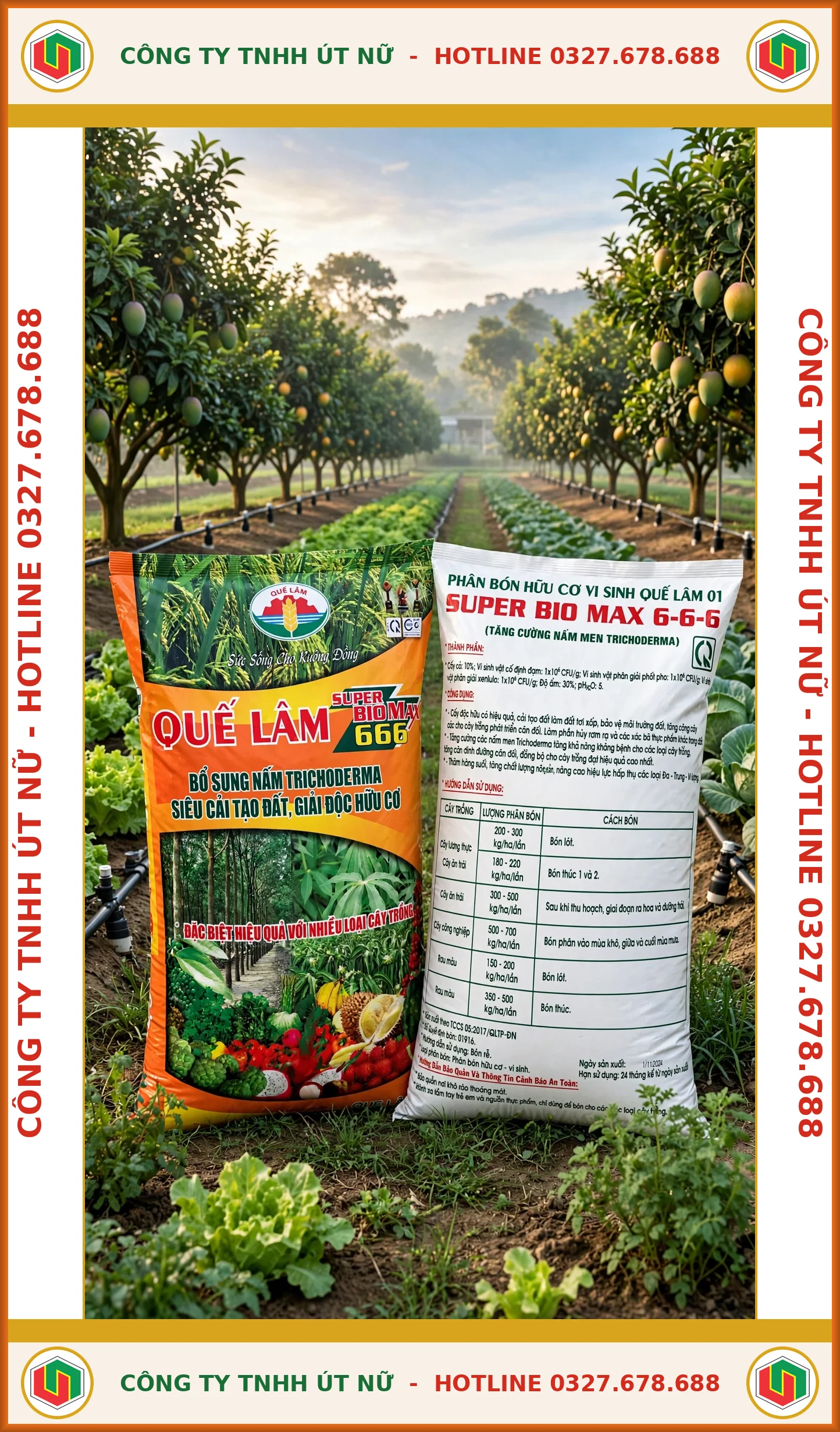
Technical example: microbial organic fertilizer Quế Lâm Super Biomax 666
On the packaging, the manufacturer declares this to be an organic microbial fertilizer, supplemented with Trichoderma fungi, with the orientation of "super soil improvement, organic detoxification" (Quế Lâm, n.d.). The listed ingredients include: nitrogen-fixing microorganisms 1×10⁶ CFU/g, phosphorus-solubilizing microorganisms 1×10⁶ CFU/g, cellulose-decomposing microorganisms 1×10⁶ CFU/g, moisture 30 percent, pH 5.
Regarding its uses, as announced by the manufacturer on the packaging: the product contributes to improving soil structure, making it loose and aerated, protecting the soil environment, decomposing straw and plant residues in the soil; the increased Trichoderma fungi are announced to contribute to enhancing disease resistance for crops (Quế Lâm, n.d.). Farmers and dealers should note that this information is announced by the manufacturer and is not yet the result of independent trials on rice fields in the Mekong Delta.
Regarding the brand, Quế Lâm organic microbial fertilizer is introduced as a product line that prioritizes safety for crops and the environment; according to an introductory article, Quế Lâm fertilizer supplements the organic matter deficiency in the soil, improves its physicochemical properties, makes the soil more friable and fertile, and significantly improves the condition of depleted soil caused by the overuse of inorganic fertilizers (My Garden, 2020).
Regarding dosage for rice (a food crop), packaging instructions state: 200 to 300 kg per hectare per application, for basal fertilization (Quế Lâm, n.d.). Converting to a familiar unit: 1 hectare = 10 công (1,000 m²/công), which is approximately 20 to 30 kg per công for one basal application at the beginning of the season. The application method is to spread evenly before the final harrowing or before sowing, allowing the fertilizer to mix thoroughly into the topsoil.
How to Properly Combine with Inorganic Fertilizers
The principle of proper fertilization here is role division: organic fertilizers take care of the "soil foundation" (looseness, water retention, microbial nourishment), while inorganic fertilizers provide "immediate nutrition" for plants (nitrogen, phosphorus, potassium at each application). Farmers still apply inorganic phosphorus or DAP as a basal fertilizer according to local practices for newly sown rice that needs phosphorus for root development; the accompanying organic application helps the soil retain that nutrition better, limiting leaching during late-season rains.
One point to remember: organic fertilizers decompose slowly, so they must be applied as a basal dressing from the beginning of the season. If applied only during the top-dressing stage, they will not have enough time to take effect. For fields that have just been harvested and still have a lot of straw, applying organic fertilizer with cellulose-decomposing microorganisms also helps straw decompose faster, preventing young rice roots from being choked — exactly as stated by the manufacturer regarding its straw decomposition function (Quế Lâm, n.d.). In fact, studies in the Mekong Delta have also noted that fresh, undecomposed straw incorporated into the soil can be toxic to rice roots under submerged conditions, so treating straw with Trichoderma before incorporation is a recommended practice (Nguyễn Thành Hối et al., 2014).
Conclusion
At the beginning of the 2026–2027 Winter-Spring crop, as the freshwater areas of Vĩnh Long and Cần Thơ begin their main planting season with salinity intrusion looming, applying an organic base fertilizer is a "solid" way to prepare the soil, following the principle of proper fertilization: if the soil is loose and retains water well, subsequent fertilizer applications will be fully effective. Farmers can choose any organic product, as long as it is clearly sourced and used at the correct dosage according to package instructions.
Dosage varies depending on soil, crop variety, and plant condition. For further consultation, please call Út Nữ: 02943 882069.
References
Dân Việt (2026) 'Latest seasonal calendar to avoid drought and salinity caused by El Nino for the 2026-2027 Winter-Spring crop, what does the Department of Crop Production and Plant Protection recommend?'. Available at: https://danviet.vn/khung-thoi-vu-moi-nhat-ne-han-man-do-el-nio-cho-vu-dong-xuan-2026-2027-cuc-trong-trot-va-bvtv-khuyen-cao-gi-d1436554.html (Accessed: 19 October 2026).
Harman, G.E. (2004) 'Trichoderma species — opportunistic, avirulent plant symbionts', *Nature Reviews Microbiology*, 2, pp. 43–56. doi: 10.1038/nrmicro797.
Hudson, B.D. (1994) 'Soil organic matter and available water capacity', *Journal of Soil and Water Conservation*, 49(2), pp. 189–194.
Lal, R. (2004) 'Soil carbon sequestration impacts on global climate change and food security', *Science*, 304(5677), pp. 1623–1627.
Minasny, B. and McBratney, A.B. (2018) 'Limited effect of organic matter on soil available water capacity', *European Journal of Soil Science*, 69(1), pp. 39–47. Available at: https://bsssjournals.onlinelibrary.wiley.com/doi/10.1111/ejss.12475 (Accessed: 19 October 2026).
My Garden (2020) 'Quế Lâm organic microbial fertilizer supports crop development'. Available at: https://mygarden.vn/phan-bon-huu-co-vi-sinh-que-lam/ (Accessed: 19 October 2026).
Nguyễn Thành Hối, Mai Vũ Duy, Lê Vĩnh Thúc, Nguyễn Hồng Phú, Vương Ngọc Đăng Khoa (2014) 'Effect of composted rice straw treated with Trichoderma on the growth and yield of 3 high-yielding rice varieties MTL392, OM4900 and Jasmine85', *Journal of Science and Development*, 12(4), pp. 510–515. Available at: http://vie.vjas.vn/index.php/vjasvn/article/download/126/126/126 (Accessed: 19 October 2026).
Quế Lâm (n.d.) *Quế Lâm Super Biomax 666 Organic Microbial Fertilizer (enhanced with Trichoderma fungus)* [product packaging].
Rodríguez, H. and Fraga, R. (1999) 'Phosphate solubilizing bacteria and their role in plant growth promotion', *Biotechnology Advances*, 17(4–5), pp. 319–339. Available at: https://www.sciencedirect.com/science/article/pii/S0734975099000142 (Accessed: 19 October 2026).
thitruonghanghoa.com (2026) 'Salinity intrusion 'threatens' the Mekong Delta'. Available at: https://www.thitruonghanghoa.com/tin-tuc/han-man-de-doa-dbscl-355462.html (Accessed: 19 October 2026).
About Content & Responsibilities
Content developed by Muse AI (From Meta — developed by Facebook). Út Nữ Co., Ltd and Muse AI disclaim responsibility for any damages arising from the use of information in this article. All content is for exploratory and academic purposes only, does not replace professional technical advice, official recommendations from manufacturers or state agencies, and does not constitute a commercial promise regarding yield or economic efficiency.