
Oranges and grapefruits developing fruit for the Tết season: supplement calcium at the right time to ensure firm fruit and limit cracking.
Published · Út Nữ Co., Ltd
> Warning: The content of this article was created / supported by AI based on a synthesis of public documents. Út Nữ Co., Ltd disclaims responsibility for damages arising from the use of information in this article. You should cross-reference packaging, manufacturer's instructions, local seasonal calendars, and contact the hotline for advice suitable for actual conditions.
Oranges and Pomelos developing fruit for Tet: timely calcium supplementation for firm fruit, reducing cracking
In early November, tangerine and green-skin pomelo orchards in Vĩnh Long and Cần Thơ are in the fruit development stage for the Tết harvest. The fruit is growing rapidly day by day — but this is also when many farmers are most anxious: cracked peels, premature fruit drop, and soft, loose fruit. Among the causes of fruit cracking, calcium deficiency at the critical time of fruit development is a common reason farmers often overlook.
This article follows the principle of proper fertilization — the right type, at the right time, in the right amount: it explains why fruit cracks, what calcium can do for fruit peel, and uses calcium nitrate as a technical example in the process. The product is just an example, not the whole story.
What causes fruit cracking?
According to the technical summary by AQ Biological Products Center (2024), fruit cracking in citrus trees is typically caused by three main groups of reasons. The first is water shock: prolonged drought followed by heavy rain or sudden heavy irrigation causes the fruit pulp to expand faster than the peel can keep up. The second is deficiency of secondary and micronutrients, especially calcium, boron, and magnesium — substances that help form new cells, strengthen the peel, and limit cracking. The third is fruit fly stinging and sucking which creates open wounds; when it rains, these cracks widen (AQ, 2024). This article focuses on the second group of causes: calcium.
Indeed, many orchards here show the same pattern: applying nitrogen heavily for fast fruit growth while forgetting to supplement calcium, leading to the skin being unable to withstand the pressure when the fruit enters the rapid expansion phase (AQ, 2024).
What does Calcium do for fruit skin?
Fruit peel firmness depends on the cell wall. When pectin in the cell wall is demethylated, Ca²⁺ ions form cross-bridges between pectin chains, creating an "egg-box" structure — a three-dimensional network that strengthens the cell wall and resists enzymes that soften fruit. Research on loquat fruit has directly demonstrated that wherever pectin cross-links with Ca²⁺ to form an egg-box structure, fruit firmness increases (Huang et al., 2023). In simple terms: calcium acts like staples holding pectin fibers together, making the fruit peel tougher and more elastic as the flesh inside expands.
Experimental evidence on citrus trees is quite clear. On Hongjiang oranges, spraying calcium nitrate at a 0.5 percent concentration during the rapid fruit expansion stage increased calcium content in the peel and significantly reduced the incidence of cracking and splitting compared to the unsprayed control (Huai et al., 2022). On the Okitsu No.58 mandarin variety, which is prone to cracking, applying calcium fertilizer during the young fruit stage helped calcium accumulate in the peel, reduced the activity of the pectin-degrading enzyme polygalacturonase (PG), and simultaneously increased the activity of the antioxidant enzyme SOD — resulting in tougher peels and a reduced cracking rate (Wang et al., 2024). On Lane Late oranges, chelated calcium treatment also significantly reduced the cracking rate and increased peel toughness by limiting the degradation of pectin and cellulose (Shi et al., 2024).
It's important to clarify: these are studies conducted abroad, on citrus varieties different from our Sành oranges and Da Xanh pomelos — serving as a general scientific basis for the role of calcium, not specific test results for individual products in gardens in the Mekong Delta.
Even on other fruit trees, the role of calcium in fruit firmness is also recognized: among the tested calcium preparations, calcium nitrate contributes to maintaining fruit firmness and limiting pectin degradation (Sun et al., 2025).
How to apply calcium correctly?
The right type: Calcium nitrate (Ca(NO₃)₂) provides both calcium and nitrate nitrogen — a form of nitrogen that plants absorb quickly to nourish fruits during periods of high nutrient demand. Nutritional guidelines for citrus also classify calcium as a nutrient requiring regular supplementation: for example, UF/IFAS documents recommend supplementing approximately 40 lb calcium/acre/year for citrus groves (UF/IFAS, 2026).
Optimal timing: The fruit's rapid growth stage is when the peel needs the most calcium. The aforementioned studies all introduced calcium from the young fruit stage to the rapid growth stage—meaning proactive application. If treatment is delayed until the fruit has already cracked, the cracks cannot heal (AQ, 2024).
Correct method, correct amount: Can be applied to the roots or foliar sprayed depending on the orchard's condition. Many domestic technical documents also agree on this approach: supplementing calcium (with magnesium) via root application or foliar spray helps grapefruit become firm and reduces cracking (Khang Nguyên, 2025); combining balanced potassium and micronutrients for good orange development, limiting cracking and premature fruit drop (AgriDrone, n.d.).
Don't forget water: Water consistently, maintain stable moisture; avoid prolonged drought followed by sudden heavy watering — water shock is the leading cause of fruit cracking, and irregular watering reduces the effectiveness of calcium application (AQ, 2024).
Technical Example: CCV Canibo Calcium Nitrate
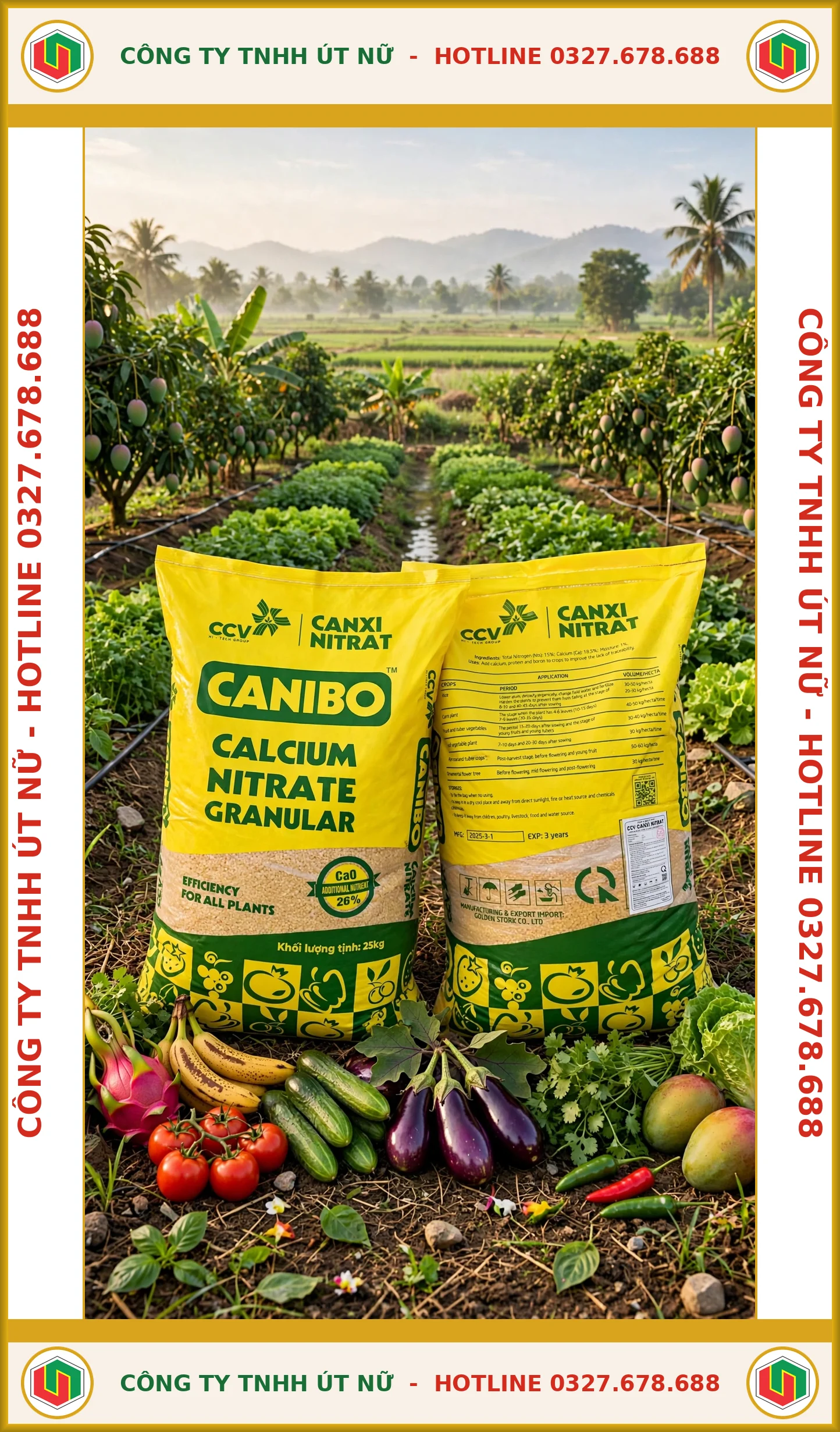
Taking a technical example from the product packaging of CCV Canibo Calcium Nitrate (granular form, 25 kg bag, from CCV Hi-Tech Group, manufactured by Golden Stork Co., Ltd.): according to the declaration on the packaging, the composition includes 15 percent total nitrogen (Nts), 18.5 percent calcium (Ca), 1 percent moisture, along with a CaO 26 percent emblem as a supplementary nutrient (CCV Hi-Tech Group, n.d.). These figures are the manufacturer's declarations on the packaging.
Regarding usage, packaging provides dosage instructions by crop group — for example, fruiting vegetables and root crops: 30 to 40 kg per hectare per application at 15–20 days after sowing and during the young fruit stage; tuber crops: 50 to 60 kg per hectare after harvest, before flowering, and during the young fruit stage (CCV Hi-Tech Group, n.d.).
An honest note: the packaging does not specify separate dosages for oranges and pomelos that are currently bearing fruit. For oranges and pomelos cultivated for Tết, farmers should refer to the closest plant group on the packaging and consult with their dealer or local agricultural extension officer to select an appropriate amount based on the plant's age and garden condition — strictly following the manufacturer's recommendations, do not arbitrarily increase the dosage excessively.
Conclusion
Calcium contributes to strong fruit peels, reducing fruit cracking during the Tết fruit growing season — through the mechanism of pectin binding in cell walls, as noted by many studies (Huai et al., 2022; Wang et al., 2024; Shi et al., 2024; Huang et al., 2023). Applying the right type, at the right time, in the right amount, combined with consistent watering — and always referring to the packaging and manufacturer's instructions — is the safest approach for your orange and pomelo orchards this season.
Dosage varies depending on soil, crop variety, and plant condition. For further consultation, please call Út Nữ: 02943 882069.
References
AgriDrone (n.d.) *How Long Does It Take for an Orange Tree to Bear Fruit? Correct Tree Care Time*. Available at: https://agridrone.vn/trong-cay-cam-bao-lau-co-trai/ (Accessed: 19 October 2026). [Page with no publication date.]
AQ (2024) *Effective and safe methods for preventing and treating fruit cracking in citrus trees*. Available at: https://nguyenlieusinhhoc.com/nut-trai-tren-cay-co-mui/ (Accessed: 19 October 2026).
CCV Hi-Tech Group (n.d.) *CCV Canibo Calcium Nitrate Granular* [ingredient information and usage instructions printed on product packaging, 25 kg bag; manufactured by: Golden Stork Co., Ltd.].
Huai, B. et al. (2022) 'Effects of calcium on cell wall metabolism enzymes and expression of related genes associated with peel creasing in *Citrus* fruits', *PeerJ*, 10, e14574. doi: 10.7717/peerj.14574.
Huang, W. et al. (2023) 'The calcium-mediated homogalacturonan pectin complexation in cell walls contributes the firmness increase in loquat fruit during postharvest storage', *Journal of Advanced Research*. Available at: https://pmc.ncbi.nlm.nih.gov/articles/PMC10334242/ (Accessed: 19 October 2026).
Khang Nguyên (2025) *Fertilizing Secrets for Pomelo Trees: High Yield, High Quality*. Available at: https://abkhangnguyen.com/bon-phan-cho-cay-buoi-nang-sat/ (Accessed: 19 October 2026).
Shi, G. et al. (2024) 'The physiological and molecular mechanisms of fruit cracking alleviation by exogenous calcium and GA3 in the Lane Late navel orange', *Agronomy*, 10(12), 1283. doi: 10.3390/agronomy10121283.
Sun, M. et al. (2025) 'Effects of different calcium preparations on fresh-cut quality and storage quality of Starkrimson apple', *Plants*, 14(9), 1293. doi: 10.33540/plants14091293.
UF/IFAS (2026) *2026–2029 Florida Citrus Production Guide: Nutrition Management for Citrus Trees* (CMG13/CG091). Available at: https://ask.ifas.ufl.edu/publication/CG091 (Accessed: 19 October 2026).
Wang, T. et al. (2024) 'Mitigating citrus fruit cracking: the efficacy of chelated calcium or silicon foliar fertilizers in ‘Okitsu no. 58’ citrus fruit', *Frontiers in Plant Science*, 15, 1402945. doi: 10.3389/fpls.2024.1402945.
About Content & Responsibilities
Content developed by Muse AI (From Meta — developed by Facebook). Út Nữ Co., Ltd and Muse AI disclaim responsibility for any damages arising from the use of information in this article. All content is for exploratory and academic purposes only, does not replace professional technical advice, official recommendations from manufacturers or state agencies, and does not constitute a commercial promise regarding yield or economic efficiency.