
Acid sulfate soil after the wet season: when and how much lime to apply before sowing the Winter-Spring crop?
Published · Út Nữ Co., Ltd
> Warning: The content of this article was created / supported by AI based on a synthesis of public documents. Út Nữ Co., Ltd disclaims responsibility for damages arising from the use of information in this article. You should cross-reference packaging, manufacturer's instructions, local seasonal calendars, and contact the hotline for advice suitable for actual conditions.
In October, many fields in Vĩnh Long, Trà Vinh have just finished harvesting the Autumn-Winter crop or are waiting for the water to recede for land preparation. This year's Winter-Spring 2026–2027 schedule is early: The Department of Crop Production and Plant Protection recommends that coastal areas at risk of drought late in the season, including Vĩnh Long (comprising the former Bến Tre, Trà Vinh areas), sow seeds early from October 10–30; the main crop should be sown from November 1–30 (Nhân Dân, 2026). The upcoming dry season is also forecast to have low water levels, and salinity may appear from late December 2026 in the Cái Lớn – Cái Bé region (Department of Meteorology and Hydrology, 2026).
This means the "soil amendment" time between two crops this year is short. On acidic-saline fields, a common question is: "Do I need to apply lime, when should I apply it, and how many bags per công (1000m²)?". This article follows the principle of the right type – the right time – the right amount for liming, using Phú Mỹ Lime as a technical example.
What problems do acid sulfate soil fields face at the beginning of the crop?
Acid sulfate soil has low pH; when the soil dries out and then gets re-flooded, aluminum and iron dissolve in large quantities, causing toxicity to young rice roots.
- Aluminum toxicity: according to IRRI, aluminum toxicity occurs in acid sulfate soils, especially when fields are left dry for several weeks before re-flooding, or in flooded soils with pH below 4. Rice affected by aluminum toxicity is stunted, has deformed roots, and orange-yellow leaves between veins (Dobermann and Fairhurst, 2000).
- Iron toxicity: old leaves have small brown spots spreading from the tip downwards, rice tillers very poorly, roots are sparse, with a dark brown layer adhering to the roots (Dobermann and Fairhurst, 2000).
- Ineffective fertilizer: acidic soil causes phosphorus to be fixed, making it difficult for plants to absorb; proper liming helps reduce nitrogen, phosphorus, and potassium losses (PVCFC, 2026).
In the Mekong Delta, a study by Can Tho University in a greenhouse on saline-acidic soil showed that applying lime (500 kg CaCO₃/ha) combined with organic fertilizer helped increase soil pH, reduce exchangeable aluminum, decrease the sodium ratio on soil colloids, and increase available nitrogen and phosphorus (Lê Văn Dũng et al., 2018). A field experiment in Long Mỹ (Hậu Giang) during the Summer-Autumn 2016 season recorded that lime application increased exchangeable calcium, reduced salinity, and exchangeable sodium in the topsoil; the authors recommended applying 1 ton of CaO/ha on saline-acidic soil in this locality (Lê Văn Dang, Ngô Ngọc Hưng, and Trần Ngọc Hữu, 2018). This is a general scientific basis, not a specific experiment for any particular lime brand.
Phú Mỹ Lime and the Significance of Each Lime Type
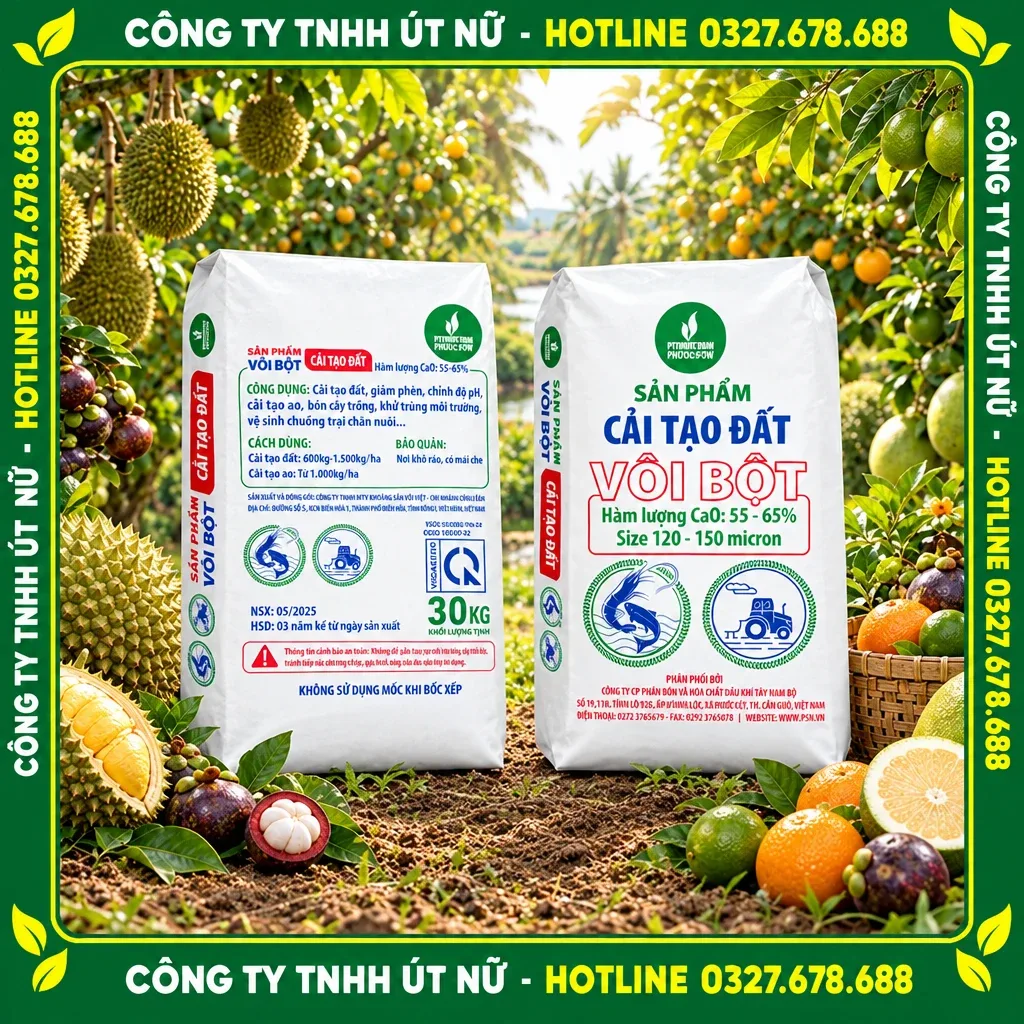
In Út Nữ's catalog, Phú Mỹ Lime is a soil amendment lime, packed in 30 kg bags, used for neutralizing acidity, reducing alum, and supplementing calcium. For the specific type of lime and calcium content, please refer to the packaging, as each type of lime has a different application method (PVCFC, 2026):
- Quicklime, burnt lime (CaO): strong alkali, fast-acting. Apply only when the field is bare, at least 20–30 days before sowing, mix thoroughly with soil, do not mix with other fertilizers.
- Limestone powder (CaCO₃): slow-acting, stable, less likely to shock roots; suitable for mildly to moderately acidic soils and for basal application before the season.
- Slaked lime (Ca(OH)₂): strong alkali but milder than quicklime, reacts quickly; should not be used continuously for many seasons.
- Dolomite (CaMg(CO₃)₂): contains both calcium and magnesium, slow but long-lasting effect; suitable for magnesium-deficient soils.
- Calcium (Ca): neutralizes acidity, helps reduce toxic aluminum activity around roots.
- Magnesium (Mg), if present: participates in photosynthesis; for acidic soils, leached soils, or deficient soils.
Timely fertilization: calculate backward from sowing date
PVCFC recommends liming 10–30 days before planting; for quicklime, at least 20–30 days are needed (PVCFC, 2026). Applying this to this year's schedule:
- Early October sown fields: if you want to use quicklime, it must be spread at the beginning of October. If there's not enough time, choose a slow-acting lime that causes less root shock, or reduce the amount and consult with agricultural extension officers.
- Main November sown fields: there is still enough time. This is a favorable time to clear straw, prepare the soil, and spread lime.
A step many people overlook: IRRI recommends drying the soil after harvest so that iron oxidizes during the fallow period, and in fields with iron toxicity, wait at least 10–20 days after flooding before sowing or transplanting, to allow the peak of soluble iron to pass (Dobermann and Fairhurst, 2000). Lime and water must go together.
Apply the Right Amount: Measure pH First, Then Calculate Bags
According to PVCFC (2026), soil samples should be taken from 0–20 cm depth at multiple points, mixed thoroughly, and then pH measured. Do not measure immediately after fertilizing or heavy rain. Reference framework:
- pH below 4.5 (very acidic): approximately 1,500–2,000 kg lime/ha, split into 2 applications, preferably applied before the crop season.
- pH 4.5–5.5: approximately 800–1,200 kg/ha.
- pH above 5.5: approximately 300–500 kg/ha or no application needed.
- Specifically for rice, PVCFC recommends a common dosage of 400–800 kg/ha, applied after harvest or before land preparation (PVCFC, 2026).
IRRI also stated a rate of 1–3 tons of lime/ha to raise pH on aluminum-toxic soils, but emphasized that the exact amount must be based on soil lime requirement analysis (Dobermann and Fairhurst, 2000).
Conversion to 30 kg bags: 500 kg/ha is equivalent to approximately 17 bags/ha, or nearly 1.7 bags per 1,000 m² công. 1 ton/ha is equivalent to approximately 33 bags/ha, or more than 3 bags per công. This is a unit conversion; the final number depends on pH, soil type, and the form of lime in the bag.
When not to apply lime, or when to do otherwise?
- Sweet alluvial soil, pH already above 5.5–6.5: usually not needed or only a small amount is needed. Over-liming can cause zinc deficiency in rice; IRRI lists "excessive liming" as a cause of zinc deficiency (Dobermann and Fairhurst, 2000).
- Fields already sown, rice emerging: do not use quicklime (PVCFC, 2026).
- Saline soil without acidity: lime cannot replace flushing salinity with fresh water. It is necessary to monitor salinity levels and local sluice gate operation schedules, and consult technical staff about suitable calcium sources.
- Light soil, sandy soil: use a lower amount, do not apply too much at once (PVCFC, 2026).
- Fields with a lot of fresh straw recently plowed under, poor drainage: IRRI notes not to incorporate too much organic matter into iron-rich, poorly drained soil (Dobermann and Fairhurst, 2000). It is necessary to prepare the soil early, allow the straw to decompose, and change the water.
Notes on application
- Separate lime from fertilizer: do not mix lime with urea fertilizer or fresh organic fertilizer; apply lime at least 7–10 days before or after chemical fertilizers (PVCFC, 2026).
- Spread evenly, mix into soil: spread evenly over the field, then plow or harrow to mix the lime into the topsoil (PVCFC, 2026).
- Do not spread during heavy rain: lime can easily be washed away (PVCFC, 2026).
- Occupational safety: when handling quicklime, applicators must wear gloves, masks, and protective eyewear (PVCFC, 2026).
- Not necessary to apply every season: PVCFC suggests applying once every 1–2 years, depending on soil acidity and rainfall (PVCFC, 2026).
- Lime does not replace fertilizer: lime improves soil, but does not provide sufficient nitrogen, phosphorus, or potassium (PVCFC, 2026). After the soil foundation is stable, NPK must still be applied according to the growth stage.
What should dealers advise?
When farmers inquire about buying lime, dealers should ask back:
1. When was the field sown? To choose the appropriate lime type for the isolation period. 2. How acidic is the soil? Farmers are encouraged to measure pH, or at least recall if the rice was yellow, tillered poorly, or had black roots at the beginning of previous seasons. 3. Is the field saline? If so, remember the schedule for salt leaching and water monitoring, as lime cannot do this job.
Then calculate the number of bags based on the area, remind them of the 7–10 day interval between lime and fertilizer, and schedule farmers to return for advice on basal fertilization and early-season top-dressing. You can introduce Phú Mỹ Lime (30 kg bag) for acidic, alum-affected fields that need pre-season improvement. Út Nữ Co., Ltd distributes wholesale in Vĩnh Long – Trà Vinh – Mekong Delta; if you need to replenish stock, you can call / Zalo 0294 3882069 – 02943 883791 – 02943 882837.
Conclusion
This year's Winter-Spring crop was sown early, with a short interval between two seasons, so lime application needs to be planned even more carefully. In acidic or alum-affected fields, lime helps raise pH, reduce aluminum and iron toxicity, and allows fertilizers to perform better, but only when using the correct type of lime, at the right time before sowing, and in the correct amount according to soil pH. If the field is not acidic, there's no need to apply much; for saline fields, securing fresh water is the priority. Test the soil first, spread lime evenly, 7–10 days before fertilizer application, combined with land preparation and water management, this forms the foundation for good root establishment for the Winter-Spring rice crop.
References
Department of Meteorology and Hydrology (2026) *Water sources to the Mekong Delta in the 2026–2027 dry season may be low, with saltwater intrusion appearing from late December*. 17 September. Available at: https://vnmha.mae.gov.vn/nguon-nuoc-ve-dbscl-mua-kho-20262027-co-the-o-muc-thap-xam-nhap-man-xuat-hien-tu-cuoi-thang-12-18747.htm (Accessed: 3 October 2026).
Dobermann, A. and Fairhurst, T. (2000) *Rice: Nutrient disorders & nutrient management*. Singapore and Los Baños: PPI, PPIC and IRRI. Summarized at IRRI Rice Knowledge Bank, sections Aluminum toxicity, Iron toxicity and Zinc deficiency. Available at: http://www.knowledgebank.irri.org/training/fact-sheets/nutrient-management/deficiencies-and-toxicities-fact-sheet (Accessed: 3 October 2026).
Le Van Dang, Ngo Ngoc Hung and Tran Ngoc Huu (2018) 'Effects of liming on changes in exchangeable calcium, sodium, and rice yield grown on saline-acid sulfate soil', *Vietnam Journal of Agricultural Sciences*, 16(1), pp. 46–53.
Lê Văn Dũng, Võ Thị Gương, Nguyễn Duy Linh and Tất Anh Thư (2018) 'Improving adverse characteristics of saline-acid sulfate soil and rice yield through the use of organic fertilizer and lime under greenhouse conditions', *Can Tho University Journal of Science*, 54 (Special Issue on Agriculture), pp. 65–74. doi: 10.22144/ctu.jsi.2018.067.
Nhân Dân (2026) 'Proactively coping with drought and saltwater intrusion', *Báo Nhân Dân điện tử*, 27 tháng 6. Available at: https://nhandan.vn/chu-dong-ung-pho-voi-han-han-xam-nhap-man-post971920.html (Accessed: 3 October 2026).
PVCFC – Cà Mau Petroleum Fertilizer JSC (2026) *What is liming? Role and proper liming techniques*. February 25. Available at: https://www.pvcfc.com.vn/bon-voi (Accessed: 3 October 2026).
About Content and Responsibility
Content developed by Grokbot AI. Út Nữ Co., Ltd and Grokbot AI disclaim responsibility for any damages arising from the use of information in this article. All content is for exploratory and academic purposes only, does not replace professional technical advice, official recommendations from manufacturers or state agencies, and does not constitute a commercial promise of yield or economic efficiency.