
Fruits have set and are growing for Tet sales: divide 2–4 applications to nourish the fruits with NPK Cà Mau 20-10-15.
Published · Út Nữ Co., Ltd
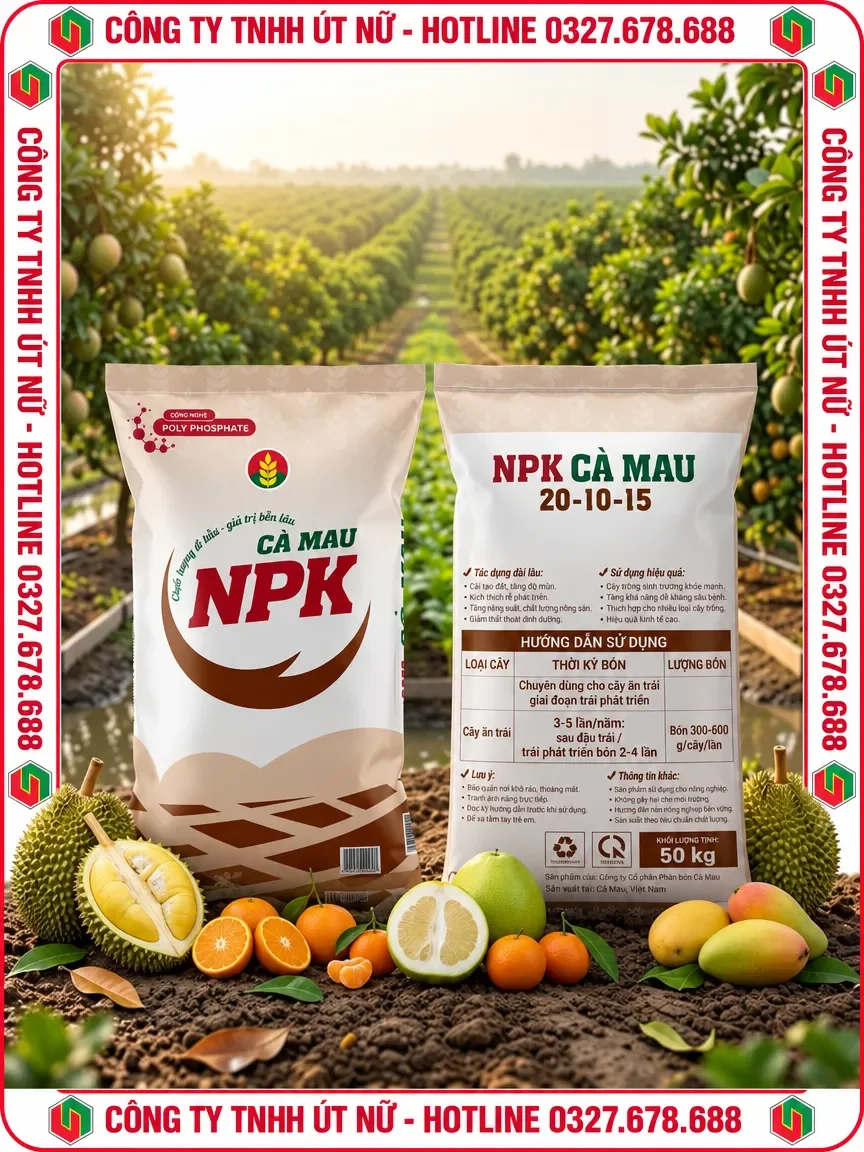
> Warning: The content of this article is generated/supported by AI based on publicly available documents. Út Nữ Co., Ltd disclaims responsibility for damages arising from the use of information in this article. Farmers and dealers should cross-reference packaging, manufacturer's instructions, local seasonal calendars, and contact the hotline for advice suitable for actual conditions. There are about three and a half months left until Tết. Many mango, longan, pomelo, and rambutan orchards in the Mekong Delta have already set fruit and are entering the fruit development stage for a year-end harvest. This is when farmers often ask: what to fertilize with, how much per tree, and how many times to fertilize. This article follows the principles of right type – right time – right amount, using NPK Cà Mau 20-10-15 as an example because the manufacturer clearly states that this fertilizer is specifically for the fruit development stage. NPK Cà Mau 20-10-15: What does the manufacturer state? According to the product page of Cà Mau Petroleum Fertilizer Joint Stock Company (PVCFC, n.d.):
- NPK compound fertilizer “NPK Cà Mau 20-10-15”, standard type, without added Mg and TE (different from the 20-10-15+1Mg+TE line); formula 20-10-15 according to the product name and basic standard number 47 attached to the page.
- The page includes the basic standard, conformity certification, and Circulation Decision No. 86/QĐ-BVTV-PB dated January 16, 2023.
- 2-layer bag (outer PP, inner PE); shelf life 36 months from the manufacturing date; manufacturing date printed on the bag.
- Instructions: “Specifically for fruit trees during the fruit development stage: apply 300–600 g/tree/application (3–5 applications/year: after fruit set/fruit development, apply 2–4 times)”.
Reading the formula: every 10 kg of fertilizer contains approximately 2 kg N, 1 kg P₂O₅, and 1.5 kg K₂O. Nitrogen and potassium are both high, phosphorus is low, suitable for when the tree needs to nourish both leaves and fruit simultaneously. Since this is a type without accompanying secondary and micronutrients, if the orchard lacks magnesium or micronutrients, supplement them separately according to technical recommendations; do not assume this fertilizer already contains them. Divide applications according to fruit development PVCFC's instructions are summarized into an easy-to-remember schedule: 1. Immediately after fruit set: first application, 300–600 g/tree depending on canopy size and number of fruits. 2. During fruit development: apply an additional 2–4 times, spaced according to tree vigor and fruit density. Illustrative example: a medium-canopy mango tree, apply 400 g after fruit set; apply 2 more times during fruit enlargement, 400–500 g each time. The entire schedule is about 1.2–1.4 kg/tree, within the manufacturer's range. For an orchard of 100 trees, each application requires about 40–50 kg, nearly one bag. These figures are for estimation only; for smaller trees with fewer fruits, use the lower end of the range. How to apply for effective absorption
- Spread according to the canopy projection, where there are many absorbent roots, not concentrated near the base.
- Lightly loosen the soil or cover thinly, and water sufficiently after application. In the early dry season, if the soil is dry, the fertilizer remains on the surface, making it difficult for the tree to absorb.
- Divide into smaller applications instead of one large application: developing fruits need consistent nutrition, not a sudden surge.
- Monitor the weather: the rainy season is forecast to end early, around October 25 – November 10 (Thúy Lam, 2026), so mulch the base to retain moisture from now on.
- Coastal orchards: The Department of Crop Production and Plant Protection advises storing fresh water and measuring salinity before irrigation (Dân Việt, 2026).
Which trees are covered by the instructions? PVCFC's page currently states generally for fruit trees during the fruit development stage; some other product lines from the company provide examples such as mango, longan, pomelo, and rambutan. For other trees, please read the instructions printed on the bag carefully before use. Dealer's advice to farmers 1. What type of tree, its age, and how long since fruit set. 2. Number of trees to calculate the amount in kg per application. 3. How many applications have been made since fruit set, to ensure the total schedule does not exceed the manufacturer's range. 4. Identify the correct 20-10-15 standard type bag, not to be confused with bags labeled +1Mg+TE. Product reference page: NPK Cà Mau 20-10-15. Út Nữ Co., Ltd distributes wholesale in Vĩnh Long – Trà Vinh – Mekong Delta region; if you need to replenish stock, please call / Zalo 0294 3882069 – 02943 883791 – 02943 882837. Conclusion Once fruit has set, nourish consistently: NPK Cà Mau 20-10-15 is recommended by PVCFC at 300–600 g/tree/application, applied after fruit set and 2–4 times during fruit development. Spreading according to the canopy, watering to maintain moisture, and dividing into smaller applications are the correct ways to fertilize with the right type, at the right time, and in the right amount for orchards growing fruit for Tết sales. References Dân Việt (2026) 'Latest seasonal calendar to “avoid” salinity intrusion due to El Nino for the 2026-2027 Winter-Spring crop, what does the Department of Crop Production and Plant Protection recommend?', *Dân Việt Newspaper*, June 19. Available at: https://danviet.vn/khung-thoi-vu-moi-nhat-ne-han-man-do-el-nio-cho-vu-dong-xuan-2026-2027-cuc-trong-trot-va-bvtv-khuyen-cao-gi-d1436554.html (Accessed: October 8, 2026). PVCFC – Cà Mau Petroleum Fertilizer Joint Stock Company (n.d.) *NPK Cà Mau 20-10-15* (with Basic Standard 47, conformity certification, Circulation Decision No. 86/QĐ-BVTV-PB dated January 16, 2023). Available at: https://www.pvcfc.com.vn/npk-ca-maubr20-10-15 (Accessed: October 10, 2026). Thúy Lam (2026) 'Guidance on seasonal calendar and rice variety structure for the 2026–2027 Winter-Spring crop', *Cà Mau Provincial Agricultural Extension Center*, October 6. Available at: http://khuyennongcamau.vn/thong-tin-va-truyen-thong/huong-dan-lich-thoi-vu-va-co-cau-giong-lua-vu-dong-xuan-2026-2027-85460 (Accessed: October 8, 2026). About Content and Responsibility Content developed by Grokbot AI. Út Nữ Co., Ltd and Grokbot AI disclaim responsibility for any damages arising from the use of information in this article. All content is for exploratory and academic purposes only, does not replace professional technical advice, official recommendations from manufacturers or state agencies, and does not constitute a commercial promise of yield or economic efficiency.