
Main sowing in November: apply DAP as a base fertilizer for Winter-Spring rice to ensure quick root establishment from day one.
Published · Út Nữ Co., Ltd
> Warning: The content of this article was generated / assisted by AI based on publicly available information. Út Nữ Co., Ltd disclaims responsibility for damages arising from the use of information in this article. You should cross-reference packaging, manufacturer's instructions, local seasonal calendars, and contact our hotline for advice suitable for your actual conditions.
In early November, the freshwater inland areas of Vĩnh Long and Cần Thơ entered the main sowing period for the 2026–2027 Winter-Spring rice crop. According to the seasonal calendar of the Department of Crop Production and Plant Protection, the main sowing period from November 1st to November 30th, 2026 accounts for approximately 53 percent of the total planned area for the entire region; meanwhile, coastal areas (Northern Bến Tre, Trà Vinh, the former Sóc Trăng area belonging to Cần Thơ) had already sown early from October 10th-30th to avoid salinity intrusion (Dân Việt, 2026). After land preparation, the first question from farmers in the freshwater region is: what fertilizer should be applied as a base to help young rice seedlings root quickly and tiller early?
This year's context is even more critical: El Nino is forecast to reach very strong intensity in Q4/2026 and extend into early 2027, posing a risk of widespread drought and salinity intrusion in the Mekong Delta from November 2026 to May 2027, with approximately 85,800 ha of Winter-Spring rice and 45,000 ha of coastal fruit trees located in the high-risk zone (Nông Thôn Việt, 2026). Rice plants with strong roots from the beginning of the season will better withstand dry conditions later in the season — and those roots start with the basal application.
The goal of this article is very simple: to apply basal fertilizer correctly — the right type, at the right time, in the right amount — so that rice plants have a "food reserve" readily available from the very first day of sowing.
Why is the basal application crucial for the entire crop cycle?
Many farmers maintain the habit of "feeding when hungry": waiting for rice plants to turn green before applying fertilizer. However, the seedling stage (0–15 days after sowing) is when rice plants prioritize root development over leaf development. Basal fertilization is a technique of applying fertilizer to the cultivated layer before the plant has its highest demand, creating a readily available nutrient source for newly emerging young roots (ECOMCO, 2026).
Official recommendations also align with this approach: The Technical Process for High-Quality and Low-Emission Rice Production in the Mekong Delta (issued with Decision 145/QĐ-TT-CLT dated March 27, 2024, by the Department of Crop Production) clearly states that 100 percent of phosphorus fertilizer along with all organic fertilizer and lime should be applied as a basal dressing before sowing; for highly acidic and alum soils (pHKCl < 4.0), 30 percent of the phosphorus amount should be reserved for the first topdressing (Department of Crop Production, 2024).
Scientifically, phosphorus is the least mobile nutrient in the soil but the most essential for the early stages: phosphorus directly participates in root cell development; without phosphorus, roots cannot extend, and the plant remains "stuck" in one place no matter how much nitrogen is applied (ECOMCO, 2026). Haifa Group's rice nutrition document also emphasizes: phosphorus promotes tillering, root development, and early flowering; rice deficient in phosphorus is often stunted, has abnormally dark green leaves, poor tillering, and underdeveloped root systems (Haifa Group, n.d.). As farmers commonly say: nitrogen makes plants grow tall, phosphorus makes plants root deep.
DAP 18-46-0: concentrated phosphorus for basal application
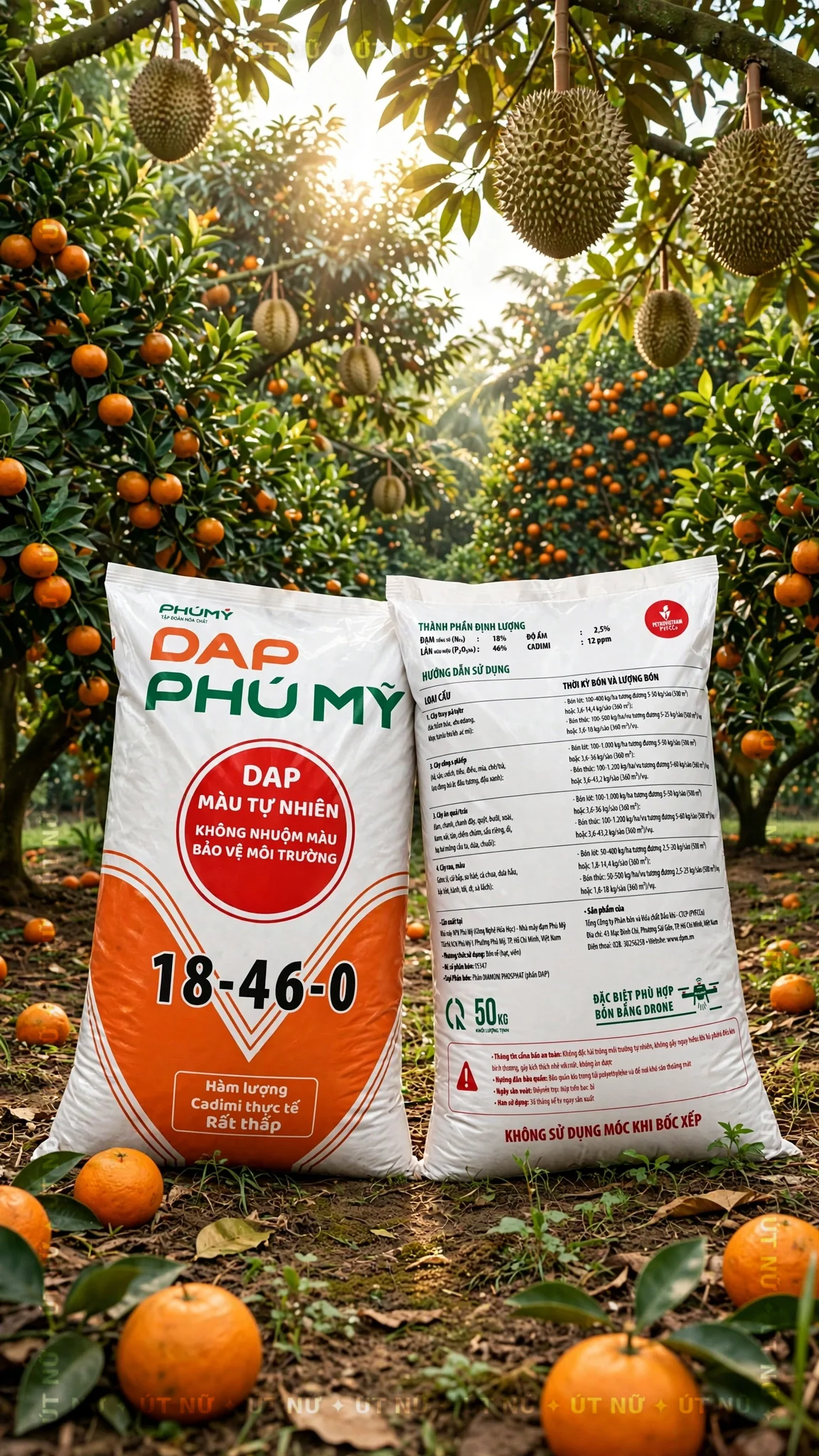
DAP (diammonium phosphate) is a complex fertilizer with a high concentration of phosphorus. For Phú Mỹ DAP, the packaging states: total nitrogen (Nts) 18 percent, effective phosphorus (P2O5hh) 46 percent, moisture 2.5 percent, cadmium 12 ppm, net weight 50 kg; a product of PetroVietnam Fertilizer and Chemicals Corporation – JSC (PVFCCo), fertilizer code 05347 (PVFCCo, n.d.).
A notable point is the cadmium content. According to the manufacturer's announcement at the launch event, the analysis results of the first production batch reached approximately 0.25 ppm (VnBusiness, 2025). For comparison: The National Technical Regulation on Fertilizer Quality (Circular 09/2019/TT-BNNPTNT) stipulates a maximum cadmium limit for diammonium phosphate fertilizer of 12 mg/kg (i.e., 12 ppm) (Ministry of Agriculture and Rural Development, 2019) — which matches the 12 ppm printed on the packaging. The Phú Mỹ NPK factory was also introduced as the only factory in Vietnam currently capable of producing DAP (VnBusiness, 2025).
According to the manufacturer, the fertilizer granules are naturally colored, undyed, dissolve quickly and completely in sufficiently moist conditions, helping crops absorb nutrients rapidly and develop strong root systems (VnBusiness, 2025). The packaging also states "especially suitable for drone application" (PVFCCo, n.d.) — aligning with the trend of mechanization: agricultural drones can now perform tasks such as spraying pesticides, fertilizing, and seeding, with the Mekong Delta being one of the pioneering regions for their application (Airnano Việt Nam, 2025).
How to use: DAP is a base fertilizer — spread evenly before or immediately after sowing, then harrow to incorporate it into the cultivated soil layer so that young roots meet nutrients as soon as they emerge (ECOMCO, 2026). For specific dosages for each crop, farmers should refer to the "Application Period and Dosage" table printed on the packaging and cross-reference with the manufacturer's instructions; this article does not provide specific numbers in place of the manufacturer.
Beyond Rice: King Oranges, Durians, and Lemons Also Need Phosphorus
Besides rice, DAP is also good for fruit trees. For durian after harvest, phosphorus is an essential element to stimulate root recovery after a prolonged fruiting period, helping the tree absorb nutrients from the soil better, preparing for the next season (Kỹ Thuật Trồng Cây, n.d.). For King orange and lemon trees that are bearing fruit, a healthy root system is also the foundation for the tree to absorb water and nutrients to nourish the fruit.
This is even more noteworthy in the current context: approximately 45,000 hectares of coastal fruit trees in Vĩnh Long, Đồng Tháp, Cần Thơ, and Tây Ninh are in areas at risk of being affected by salinity intrusion during the 2026–2027 dry season (Nông Thôn Việt, 2026). While fruit farmers are concerned about storing fresh water and mulching to retain moisture as recommended by specialized agencies (Dân Việt, 2026), applying a concentrated phosphorus fertilizer to strengthen the root system of their orchards is something to consider early, before the salinity arrives.
Conclusion
The early November basal application is the starting point for the entire Winter-Spring crop: the soil has been thoroughly prepared, water is sufficient, all that's needed is timely phosphorus to promote strong root development from day one. DAP 18-46-0 is a technical example for this application — concentrated phosphorus with "starter" nitrogen. Applying according to package instructions, at the correct planting time for each region, is a favorable start to the crop season.
Dosage varies depending on soil, crop variety, and plant condition. For further consultation, please call Út Nữ at: 02943 882069.
References
Airnano Vietnam (2025) 'Current status of agricultural drone application in Vietnam', *airnano.vn*. Available at: https://airnano.vn/?p=29220 (Accessed: 19 October 2026). [Date updated according to page information: 20/04/2025]
Ministry of Agriculture and Rural Development (2019) *Circular 09/2019/TT-BNNPTNT: National technical regulation on fertilizer quality*. Available at: https://thuvienphapluat.vn/van-ban/linh-vuc-khac/thong-tu-09-2019-tt-bnnptnt-quy-chuan-ky-thuat-quoc-gia-ve-chat-luong-phan-bon-424062.aspx (Accessed: 19 October 2026).
Department of Crop Production (2024) *Decision 145/QD-TT-CLT dated March 27, 2024: Technical process for high-quality and low-emission rice production in the Mekong Delta* (with accompanying Handbook). Available at: https://tailieu.vn/doc/so-tay-huong-dan-quy-trinh-san-xuat-lua-chat-luong-cao-va-phat-thai-thap-vung-dong-bang-song-cuu-long-2985724.html (Accessed: 19 October 2026).
Dân Việt (2026) 'Latest seasonal calendar to "avoid" saltwater intrusion due to El Nino for the 2026-2027 winter-spring crop, what does the Department of Crop Production and Plant Protection recommend?', *Báo Dân Việt*, 19 June. Available at: https://danviet.vn/khung-thoi-vu-moi-nhat-ne-han-man-do-el-nio-cho-vu-dong-xuan-2026-2027-cuc-trong-trot-va-bvtv-khuyen-cao-gi-d1436554.html (Accessed: 19 October 2026).
ECOMCO (2026) 'Rice basal fertilization techniques: The secret to using Lime & Phosphorus to reduce alum and effectively detoxify salinity', *ecomco.vn*, 13 January. Available at: https://ecomco.vn/ky-thuat-bon-lot-cho-lua-bi-quyet-dung-voi-lan-ha-phen/ (Accessed: 19 October 2026).
Haifa Group (n.d.) 'Crop Guide: Rice Nutrition', *haifa-group.com*. Available at: https://www.haifa-group.com/node/615 (Accessed: 19 October 2026).
Kỹ Thuật Trồng Cây (n.d.) 'Fertilizing helps durian recover strongly after harvest', *kythuattrongcay.vn*. Available at: https://kythuattrongcay.vn/5-loai-phan-bon-giup-phuc-hoi-manh-me-cho-sau-rieng-sau-khi-thu-hoach/ (Accessed: 19 October 2026). [Page notes "19 Th12" but no year — cited n.d.]
Nông Thôn Việt (2026) 'Extremely Strong El Nino: Ministry of Agriculture and Rural Development Requests Urgent Response Deployment', *nongthonviet.vn*. Available at: https://nongthonviet.vn/el-nino-cuc-manh-bo-nn-mt-yeu-cau-trien-khai-khan-cap-ung-pho-46272.html (Accessed: 19 October 2026). [Content confirmed for 2026; article image posted October 2026]
PVFCCo (n.d.) *DAP Phú Mỹ 18-46-0* [product packaging]. PetroVietnam Fertilizer and Chemicals Corporation – JSC. Available at: https://www.dpm.vn (Accessed: 19 October 2026).
VnBusiness (2025) 'PVFCCo – Phú Mỹ officially launches DAP Phú Mỹ, expanding its product portfolio and supplying high-quality fertilizers to the market', *VnBusiness*, 5 December. Available at: https://vnbusiness.vn/pvfcco-phu-my-chinh-thuc-ra-mat-dap-phu-my-mo-rong-danh-muc-san-pham-va-cung-ung-nguon-phan-bon-chat-luong-cao-cho-thi-truong.html (Accessed: 19 October 2026).
Content & Responsibility
Content developed by Muse AI (From Meta — developed by Facebook). Út Nữ Co., Ltd and Muse AI disclaim all liability for any damages arising from the use of information in this article. All content is for exploratory and academic purposes only, does not replace professional technical advice, official recommendations from manufacturers or state agencies, and does not constitute a commercial promise regarding yield or economic efficiency.