
Main sowing in November: prioritize root development for uniform tillering.
Published · Út Nữ Co., Ltd
> Warning: The content of this article is generated / supported by AI based on publicly available information. Út Nữ Co., Ltd disclaims responsibility for damages arising from the use of information in this article. You should cross-reference packaging, manufacturer's instructions, local seasonal calendars, and contact our hotline for advice suitable for your actual conditions.
Main November Sowing: Prioritize Root Development for Even Tillering
This November, the freshwater inland areas of Vĩnh Long and Cần Thơ are entering the main sowing period for the 2026–2027 Winter-Spring rice crop: the sowing period from November 1st to November 30th, 2026 accounts for approximately 53 percent of the total planned area for the region, while coastal areas like Bến Tre and Trà Vinh have already sown early from October 10th-30th to avoid salinity (Dân Việt, 2026). At the same time, El Nino is forecast to extend into early 2027, with saline intrusion potentially comparable to the 2015–2016 dry season and beginning to affect areas from late December 2026 (thitruonghanghoa.com, 2026). The early stage is when young rice plants are most vulnerable — this article aims for proper fertilization: prioritizing root care, combining basal fertilizers with biological products at the right time, to ensure even tillering.
Understand the Young Rice Root System for Proper Care
Farmers often say "first water, second fertilizer", but for newly sown rice, there's something even more important than fertilizer: the root system. According to IRRI's Rice Knowledge Bank, phosphorus is an essential nutrient for rice root development and tillering, and phosphorus fertilizer should be applied as a basal dressing before the final harrowing or broadcast within 10–15 days after direct seeding (IRRI, n.d.). Structurally, rice roots consist of the radicle growing from the seed and the fibrous root system growing from the stem nodes; from the 4-leaf stage onwards, the fibrous roots gradually take over the main role of absorbing water and nutrients, while also forming the foundation for tillering (ICL, 2026).
In Mekong Delta fields, the biggest enemies of young roots at the beginning of the season are acidity (phèn) and organic toxicity. Roots poisoned by acidity are often short, abnormally thick, with black or twisted tips, and no new white roots; aluminum toxicity causes roots to stunt, unable to absorb water and phosphorus, leading to short plants with dark green or purple upright leaves due to phosphorus deficiency (ECOMCO, 2026). A quick way to check: pull up a few clumps 10–15 days after sowing — long white roots indicate good health, while yellowish-brown roots or a foul smell mean the soil has problems and needs treatment before top-dressing. (Source note: ECOMCO is a technical blog of an agricultural supply company — this article only uses general agronomic knowledge, not their product advertising content.)
Timely Fertilization: The First Two Applications Determine Tillering
According to Assoc. Prof. Dr. Mai Thanh Phung, the first fertilizer application should be done early, 7–10 days after sowing, with high phosphorus and high nitrogen to help rice plants develop roots and tiller effectively; the second application should be done 18–22 days after sowing — applying fertilizer too late will result in many ineffective tillers later on, which become breeding grounds for pests and diseases (Mai Thanh Phung, n.d.). [The publication year of this document could not be verified, hence n.d. is noted.] Sharing this view, ECOMCO (2026) emphasizes: the seedling stage is when rice plants prioritize root development over shoots and leaves, and providing sufficient nutrients from the start helps plants tiller 3–5 days earlier — early tillers are often effective tillers that produce large panicles, while late tillers resulting from delayed top-dressing are usually ineffective tillers.
In other words, "timely" for newly sown rice means don't let the plants starve in the first 2–3 weeks. Basal fertilization creates a readily available "reserve" of nutrients as soon as roots emerge; top dressing 1, applied at the right time 7–10 days after sowing, boosts the first tillering phase.
What the manufacturer states about Đầu Trâu Bio Lúa 1
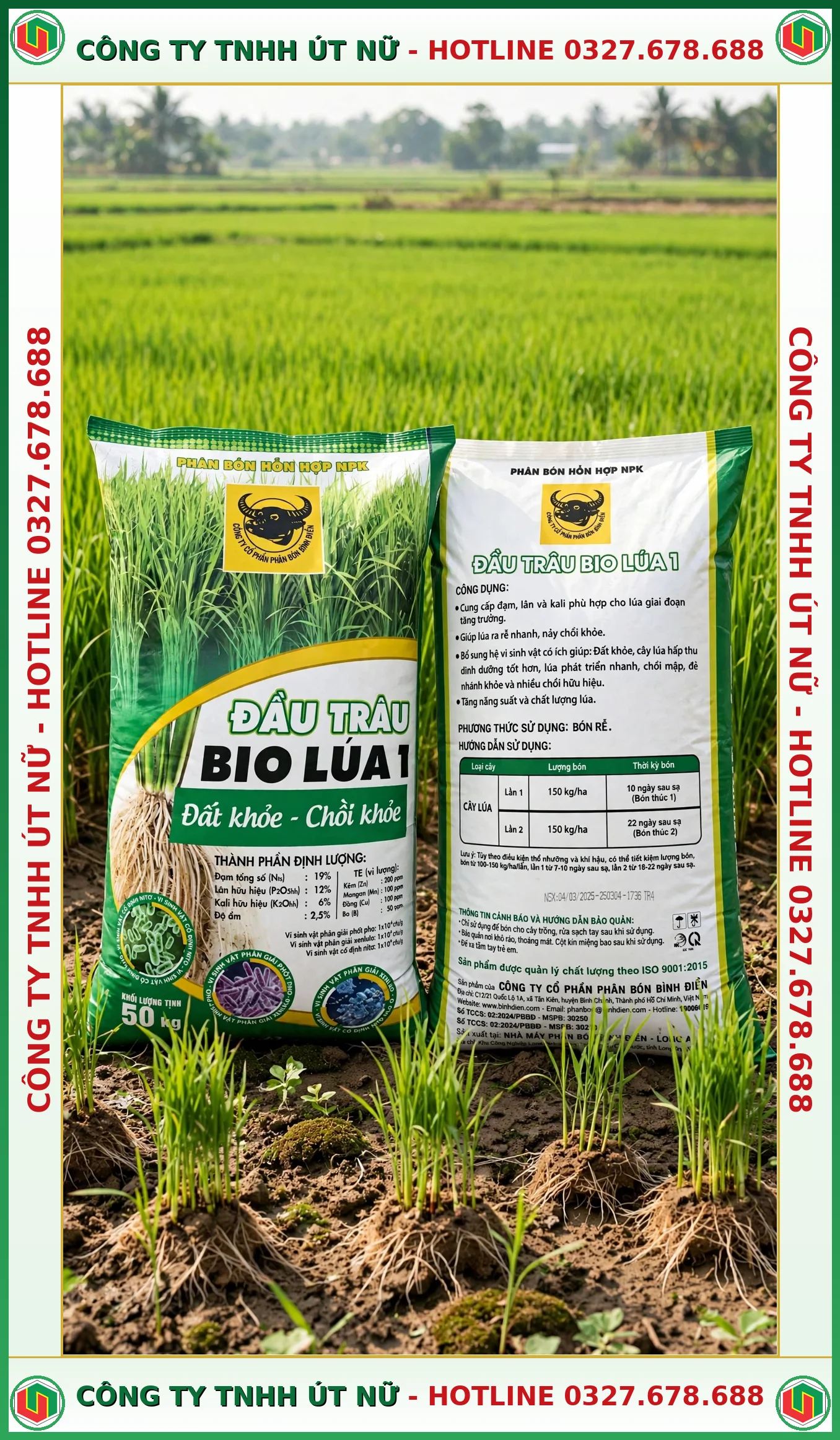
According to Bình Điền Fertilizer Joint Stock Company, Đầu Trâu Bio Lúa 1 is a product that "supplements beneficial microorganisms, helping rice plants be healthy and increasing their resistance" (Bình Điền, n.d.a). Bình Điền's Bio product line applies spore-encapsulated microorganism technology to ensure microbial survival in paddy fields (Tạp chí Việt Nam Hương Sắc, 2025). Also according to the manufacturer, the microbial system in the Bio product set includes groups that decompose cellulose, fix nitrogen, and solubilize phosphorus, along with macro, secondary, and micronutrients (Bình Điền, n.d.b).
Farmers and dealers should note: this is a biological product used in combination with basal fertilizers, not a complete replacement for inorganic fertilizers. Regarding the quantitative composition and detailed dosage printed on the packaging: Bình Điền's official website currently does not publish this information (the page does not state it) — farmers and dealers should read directly on the packaging; this article only uses content Bình Điền has publicly disclosed and does not invent numbers.
What was observed in the demonstration plots
In An Giang, within the "Green Journey" program, farmers applied Đầu Trâu Bio Lúa 1 in two applications: 7–10 days and 18–22 days after sowing — coinciding with the aforementioned 1st and 2nd application windows. Observations showed "an increase in effective tillers" and "uniform tillering ability", with daughter tillers developing almost identically to the mother plant (nongnghiephuuco.vn, 2026). Also at the model in An Giang, reported results included improved soil pH, a reduction of approximately 35 kg of nitrogen per hectare in nitrogen usage, a yield increase of 550 kg per hectare, and an average profit higher by eight point five million VND per hectare (Tạp chí Việt Nam Hương Sắc, 2025).
Farmers and dealers, please note: the above figures are the results of demonstration models under specific conditions (soil, varieties, and accompanying procedures), not a promise for every field. To find out if it's suitable for your field, the best way is still to try it on a few plots and compare it with a control plot nearby.
What Science Says About Beneficial Microorganisms for Rice Roots
In general scientific literature (not specific tests for individual product batches), international reviews show that plant growth-promoting rhizobacteria (PGPR) produce auxin — a plant hormone — which helps plants increase the number of root hairs and lateral roots, meaning a better "anchoring" root system; simultaneously, some strains also fix atmospheric nitrogen and solubilize insoluble phosphorus into forms absorbable by plants (Gómez-Godínez et al., 2023). A new study on rice seedlings shows that PGPR supplementation significantly increases root length, plant height, and dry biomass compared to controls, while also enhancing the activity of antioxidant enzymes in roots and leaves — meaning seedlings tolerate stress better (Wang et al., 2025).
To help farmers easily visualize: beneficial microorganisms are like "construction workers" around the roots, both loosening the soil and preparing nutrients for the roots to absorb. This is the general scientific basis for understanding why biological root care can contribute to healthier rice plants in the early season—it doesn't mean that all biological products will yield the same results on all soil types.
How to Use Correctly
- Timely application: According to practices at the demonstration model, Bio Lúa 1 is applied in two rounds 7–10 days and 18–22 days after sowing, coinciding with the 1st and 2nd topdressing for rice (nongnghiephuuco.vn, 2026; Mai Thành Phụng, n.d.). Exact dosage should follow instructions on the packaging of each batch.
- Correct combination: Use in conjunction with recommended basal fertilizers (pre-sowing + topdressing); do not completely cut inorganic fertilizers without technical consultation. Especially on acid sulfate soils, phosphorus should be prioritized for basal application as it both nourishes roots and contributes to "sacrificing some phosphorus to wash away acidity" (ECOMCO, 2026; IRRI, n.d.).
- Appropriate soil: For fields that have just been harvested with a lot of straw remaining, straw management and soil improvement before sowing are indispensable steps — microorganisms only thrive on well-aerated soil. This early season also brings concerns about salinity from late December (thitruonghanghoa.com, 2026), so keeping fields free of acidity and ensuring strong roots early on is also a way to prepare plants for better resilience later.
Dosage varies depending on soil, crop variety, and plant condition. For further advice, please call Út Nữ: 02943 882069.