
Early sown fields with newly emerged seedlings: divide Đạm Phú Mỹ by days after sowing, convert dosage from kg/ha to kg/công.
Published · Út Nữ Co., Ltd
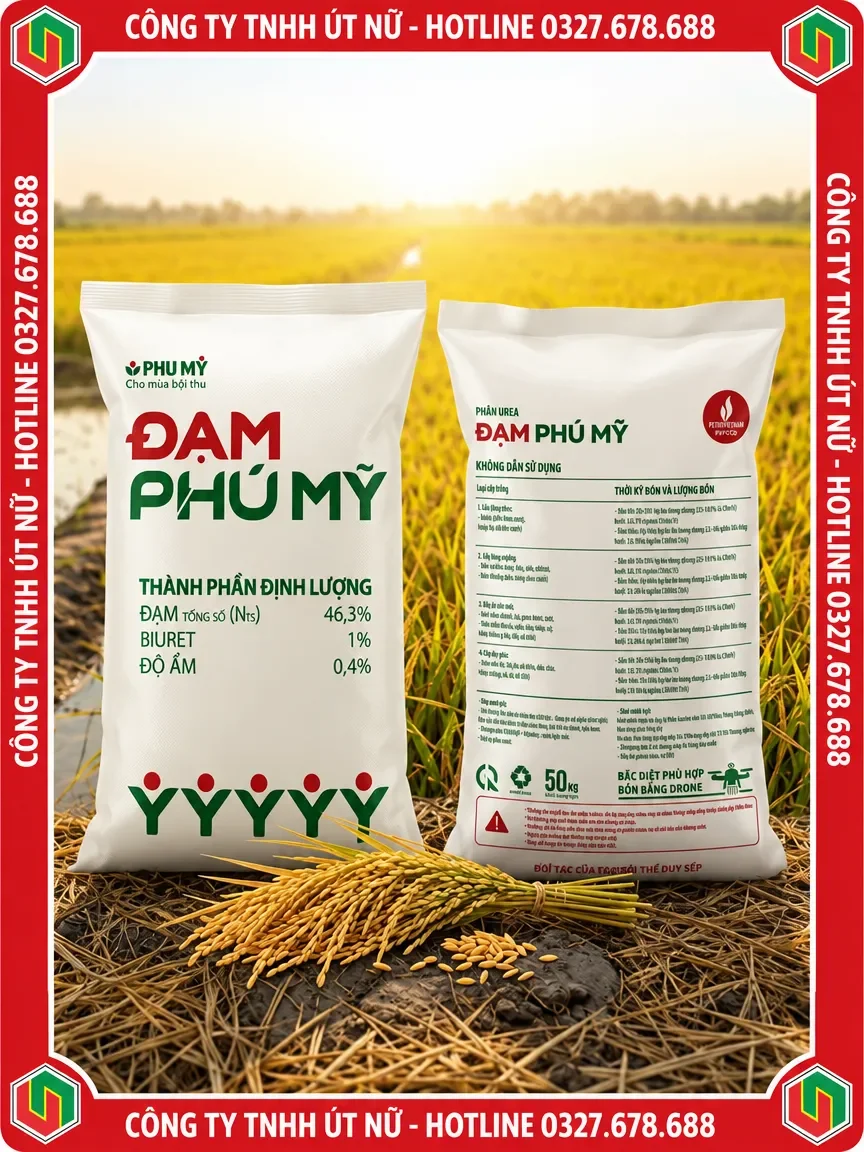
> Warning: The content of this article is generated/supported by AI based on publicly available documents. Út Nữ Co., Ltd disclaims responsibility for damages arising from the use of information in this article. Farmers and dealers should cross-reference packaging, manufacturer's instructions, local seasonal calendars, and contact the hotline for advice tailored to actual conditions. By late October 2026, many fields in the coastal areas of Vĩnh Long (formerly Bến Tre, Trà Vinh) had already sown early Winter-Spring rice. The Department of Crop Production and Plant Protection recommends that areas at risk of drought and salinity at the end of the season sow early from October 10–30, 2026; the main sowing period in freshwater areas is from November 1–30 (Dân Việt, 2026). For fields sown from October 10, the first top-dressing application would be around October 17–22, and the next application needs to be planned in advance. Nitrogen is what farmers are most accustomed to, and also what is easiest to over-apply. This article follows the principle of right type – right time – right amount: using Đạm Phú Mỹ as an example, we divide the nitrogen amount by days after sowing and convert the manufacturer's kg/ha framework to kg/công for easier calculation. Đạm Phú Mỹ: What does the manufacturer state? According to the website of PetroVietnam Fertilizer and Chemicals Corporation (PVFCCo, n.d.):
- Urea fertilizer, code 00056.
- Total Nitrogen (Nts) 46.3%; biuret 1%; moisture 0.4%.
- For root application; shelf life 36 months from manufacturing date; 50 kg bag.
- Clear granular form, uniform particle size, dissolves quickly.
Calculated from the label: a 50 kg bag contains approximately 23 kg of N (50 × 46.3%). Every 1 kg of urea applied is nearly half a kilogram of pure nitrogen, so a difference of a few kilograms per công is already significant. Dosage framework for rice and conversion to kg/công PVFCCo instructs for food crops: basal application 50–200 kg/ha, top-dressing 50–300 kg/ha/crop (PVFCCo, n.d.). With 1 công = 1,000 m², 1 ha = 10 công:
- Basal application: 5–20 kg/công.
- Top-dressing: 5–30 kg/công for the entire crop, not for a single application.
Correct understanding: the total of all top-dressing applications during the crop should be within 5–30 kg/công. If divided into 3 applications, the average per application is only a few kilograms to about 10 kg/công, depending on soil and leaf color. Dividing by days after sowing Rice top-dressing schedules in the Mekong Delta usually revolve around 7–10, 18–22, and 38–42 days after sowing; these are also the milestones PVCFC prints in its urea application guide for rice (PVCFC, n.d.). Applying this to early-sown fields: 1. First top-dressing (7–10 days after sowing): seedlings are small, roots are few, apply a light amount, keep the field shallowly flooded. 2. Second top-dressing (18–22 days): rice enters tillering stage, this application requires more nitrogen during the early phase. 3. Panicle initiation top-dressing (38–42 days): decide the amount based on leaf color; reduce if leaves are still dark green. Illustrative example: a 5-công field, planning a total top-dressing of about 20 kg urea/công for the entire crop, divided into 5 – 9 – 6 kg/công for three applications. The first application needs 25 kg, which is half a bag. A total of 20 kg/công is still within the manufacturer's 5–30 kg/công framework. This is a number to practice calculation; the actual amount depends on variety, soil, and leaf color. Common mistakes with early-season nitrogen
- Applying nitrogen when the field is dry and cracked or right before heavy rain: nitrogen is easily lost. It should be applied when the field has a thin layer of water, and water should be retained for a few days after application.
- Concentrating nitrogen in the first application for "quick greening": densely sown rice can become too lush, with soft leaves, making it prone to pests and diseases.
- Continuously applying single nitrogen fertilizer while neglecting phosphorus and potassium: nitrogen is only one part; basal and other applications still require balanced phosphorus and potassium.
- Not measuring salinity when taking water: The Department of Crop Production and Plant Protection advises measuring salinity before taking water into fields in coastal areas (Dân Việt, 2026).
The Cà Mau Agricultural Extension Center also cited an assessment that the 2026 rainy season might end early, around October 25–November 10 (Thúy Lam, 2026). Early-sown fields should utilize existing freshwater for initial applications. Advice from dealers to farmers 1. Ask for the sowing date to know which stage the field is in. 2. Ask for the area in công, then convert to kilograms per application, do not sell "by the bag" for round numbers. 3. Remind them to divide applications, and observe leaf color before the panicle initiation application. Product reference page: Đạm Phú Mỹ. Út Nữ Co., Ltd distributes wholesale in Vĩnh Long – Trà Vinh – Mekong Delta region; if you need to replenish stock, please call / Zalo 0294 3882069 – 02943 883791 – 02943 882837. Conclusion Đạm Phú Mỹ contains 46.3% nitrogen; a 50 kg bag contains approximately 23 kg of N. The manufacturer's framework for rice is 5–30 kg/công for the entire top-dressing crop. Dividing by days after sowing, applying when the field has water, and observing leaf color before increasing the amount is the correct way to use nitrogen – right type, right time, right amount – for early-sown Winter-Spring fields. References Dân Việt (2026) 'Khung thời vụ mới nhất “né” hạn mặn do El Nino cho vụ đông xuân 2026-2027, Cục Trồng trọt và BVTV khuyến cáo gì?', *Báo Dân Việt*, 19 tháng 6. Available at: https://danviet.vn/khung-thoi-vu-moi-nhat-ne-han-man-do-el-nio-cho-vu-dong-xuan-2026-2027-cuc-trong-trot-va-bvtv-khuyen-cao-gi-d1436554.html (Accessed: 8 October 2026). PVCFC – Công ty Cổ phần Tổng công ty Phân bón Dầu khí Cà Mau (n.d.) *Urê hạt đục*. Available at: https://www.pvcfc.com.vn/ure-hat-duc (Accessed: 10 October 2026). PVFCCo – Tổng công ty Phân bón và Hóa chất Dầu khí (n.d.) *Đạm Phú Mỹ* (mã số 00056). Available at: https://dpm.vn/san-pham/dam-phu-my-28 (Accessed: 10 October 2026). Thúy Lam (2026) 'Hướng dẫn lịch thời vụ và cơ cấu giống lúa vụ Đông Xuân 2026–2027', *Trung tâm Khuyến nông tỉnh Cà Mau*, 6 tháng 10. Available at: http://khuyennongcamau.vn/thong-tin-va-truyen-thong/huong-dan-lich-thoi-vu-va-co-cau-giong-lua-vu-dong-xuan-2026-2027-85460 (Accessed: 8 October 2026). About content and responsibility Content developed by Grokbot AI. Út Nữ Co., Ltd and Grokbot AI disclaim responsibility for any damages arising from the use of information in this article. The entire content is for exploratory and academic purposes only, does not replace professional technical advice, official recommendations from manufacturers or state agencies, and does not constitute a commercial promise of yield or economic efficiency.