
Tet vegetables just rooted: read the 20-10-10+TE formula and convert Phú Mỹ NPK dosage for vegetables to kg/công
Published · Út Nữ Co., Ltd
> Warning: The content of this article is generated/supported by AI based on publicly available documents. Út Nữ Co., Ltd disclaims responsibility for damages arising from the use of information in this article. Farmers and dealers should cross-reference packaging, manufacturer's instructions, local seasonal calendars, and contact the hotline for advice suitable for actual conditions. In late October, many farmers in the Mekong Delta begin planting vegetables for harvest during the year-end and Tet holidays. Once vegetables establish roots, they need nitrogen for leaf development, but short-day vegetables are also the most susceptible to over-fertilization with nitrogen. This article follows the principle of right type – right time – right amount: read the NPK Phú Mỹ 20-10-10+TE formula, convert the manufacturer's dosage range to kg/công, and divide the applications for vegetables. Distinguish before buying NPK Phú Mỹ 20-10-10+TE differs from other manufacturers' 20-10-10 products: it's from a different brand and includes TE (zinc, boron). Look carefully at the brand name and the “+TE” symbol on the bag. What does the manufacturer state? According to PetroVietnam Fertilizer and Chemicals Corporation (PVFCCo, n.d.):
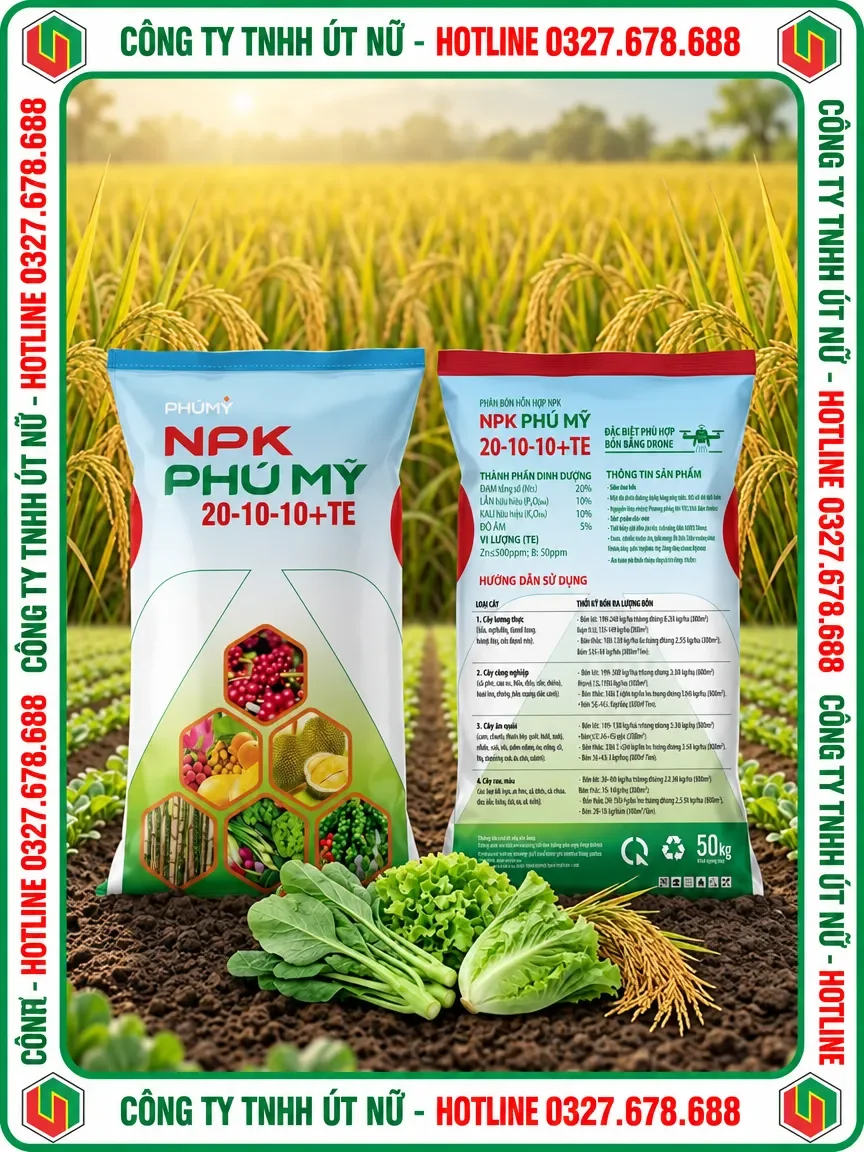
- NPK fertilizer with trace elements, code 00146.
- Total nitrogen (Nts) 20%; effective phosphorus (P₂O₅hh) 10%; effective potassium (K₂Ohh) 10%.
- TE: zinc (Zn) 50 ppm, boron (B) 50 ppm; moisture 5%.
- For root application; shelf life 36 months from manufacturing date.
Reading the formula: a 50 kg bag contains approximately 10 kg N, 5 kg P₂O₅, and 5 kg K₂O. The 2:1:1 ratio, with dominant nitrogen, is suitable for the vegetative growth stage of vegetables. Dosage range for vegetables and conversion to kg/công PVFCCo instructs for vegetables: basal application 50–400 kg/ha; top dressing 50–500 kg/ha/crop (PVFCCo, n.d.). Converted to:
- Basal application: 5–40 kg/công.
- Top dressing: 5–50 kg/công for the entire crop, divided into multiple applications.
The range is wide because it applies to many types of vegetables, from short-day leafy greens to long-day fruiting vegetables. Short-day leafy greens typically fall into the lower range; multi-harvest fruiting vegetables fall into the higher range. Illustrative example: a 2-công plot of leafy greens, after the plants establish roots, apply top dressing 3 times, 5 kg/công each time. Total 15 kg/công for the entire crop, requiring 10 kg of fertilizer each time. These figures are for calculation practice only; actual amounts depend on the type of vegetable and soil. Applying to vegetables: a few things to remember 1. Wait for plants to establish roots before top dressing; for newly planted seedlings, if roots haven't taken hold, fertilizer can easily cause wilting. 2. Dilute or apply away from the base, water after application; do not apply fertilizer directly onto leaves. 3. Divide into small, frequent applications instead of a single large application. 4. Stop nitrogen application before harvest according to the withholding period stated in the instructions and local recommendations, especially for leafy greens. Early-sown Winter-Spring rice can also use it PVFCCo also provides instructions for food crops: basal application 100–400 kg/ha, top dressing 100–500 kg/ha/crop (PVFCCo, n.d.), which is 10–40 and 10–50 kg/công. Winter-Spring rice fields sown early from October 10–30 as recommended by the Department of Crop Production and Plant Protection (Dân Việt, 2026) are reaching the tillering stage and can use this high-nitrogen type, provided the total amount for the crop falls within the recommended range. Dealer's advice to farmers 1. What vegetables are being grown, how many công, how many days since planting. 2. Convert kg/ha to kg/công, divide the number of applications. 3. Remind about the withholding period before harvest. Product reference page: NPK Phú Mỹ 20-10-10+TE. Út Nữ Co., Ltd distributes wholesale in Vĩnh Long – Trà Vinh – Mekong Delta; if you need to replenish stock, please call / Zalo 0294 3882069 – 02943 883791 – 02943 882837. Conclusion NPK Phú Mỹ 20-10-10+TE has a 2:1:1 ratio with zinc and boron; a 50 kg bag contains approximately 10 kg N. For vegetables, the manufacturer's range is 5–40 kg/công for basal application and 5–50 kg/công for top dressing for the entire crop. Waiting for plants to establish roots, dividing applications into smaller amounts, and stopping application at the right time before harvest are the correct ways to apply the right type, at the right time, and in the right amount for Tet vegetables. References Dân Việt (2026) 'Latest seasonal framework to "avoid" drought and salinity due to El Nino for the 2026-2027 Winter-Spring crop, what does the Department of Crop Production and Plant Protection recommend?', *Dân Việt Newspaper*, June 19. Available at: https://danviet.vn/khung-thoi-vu-moi-nhat-ne-han-man-do-el-nio-cho-vu-dong-xuan-2026-2027-cuc-trong-trot-va-bvtv-khuyen-cao-gi-d1436554.html (Accessed: October 8, 2026). PVFCCo – PetroVietnam Fertilizer and Chemicals Corporation (n.d.) *NPK Phú Mỹ 20-10-10+TE* (code 00146). Available at: https://dpm.vn/san-pham/npk-phu-my-20-10-10te-39 (Accessed: October 10, 2026). About content and responsibility Content developed by Grokbot AI. Út Nữ Co., Ltd and Grokbot AI disclaim responsibility for any damages arising from the use of information in this article. All content is for exploratory and academic purposes only, does not replace professional technical advice, official recommendations from manufacturers or state agencies, and does not constitute a commercial promise of yield or economic efficiency.