
Before Winter-Spring: if the soil isn't ready to absorb nutrients, don't rush to apply nitrogen — fertilize correctly right from the land preparation stage.
Published · Út Nữ Co., Ltd
> Warning: The content of this article was created / supported by AI based on a synthesis of public documents. Út Nữ Co., Ltd disclaims responsibility for damages arising from the use of information in this article. You should cross-reference packaging, manufacturer's instructions, local seasonal calendars, and contact the hotline for advice suitable for actual conditions.
In late September and early October, many fields in the Mekong Delta have just finished the Summer-Autumn / Autumn-Winter harvest. Farmers are now clearing straw, plowing it under, leaching alum and saline, and preparing for the Winter-Spring sowing. According to regional seasonal recommendations, the early sowing period usually concentrates around mid-to-late October in areas needing to avoid late-season drought and salinity, followed by the main batches in November-December (Can Tho Online Newspaper, 2025; Agriculture and Environment, 2024). At this time, a common mistake is not a lack of fertilizer, but applying nitrogen too early when the soil is still compacted, roots have not penetrated deeply, and water-alum conditions are not yet stable.
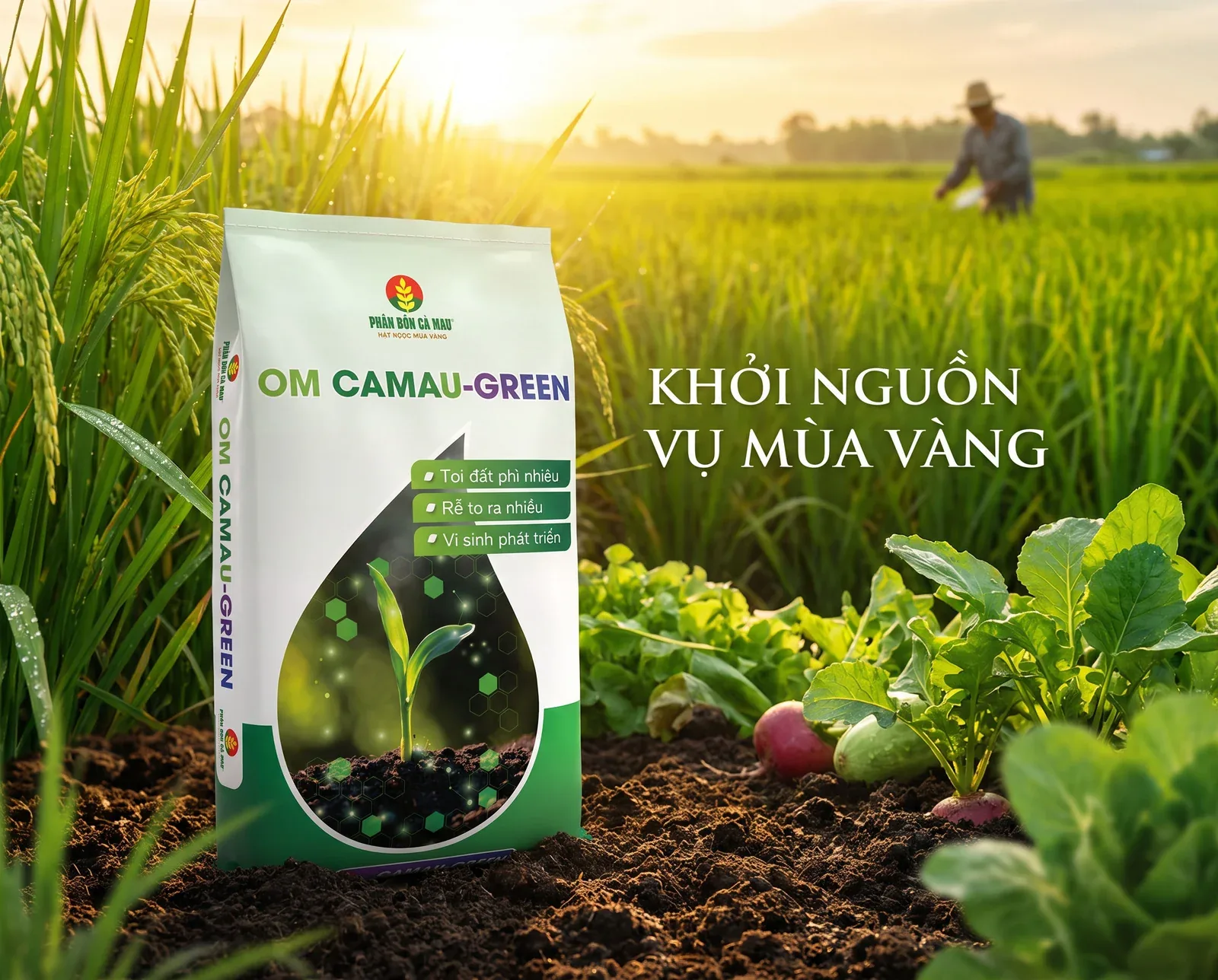
This article does not aim to promise yield. The clearer goal: to encourage dealers and farmers to use the right type – at the right time – in the right amount of fertilizer, starting with basal application / soil improvement, and then top-dressing according to the plant's growth stage. In this, organic pellets like OM CAMAU-GREEN (Cà Mau Fertilizer – PVCFC) are merely a technical option when soil loosening and root-microorganism environment support are needed, rather than replacing the entire NPK set (PVCFC, n.d.).
What does the crop season demand from land preparation?
Technical recommendations before the Winter-Spring crop often emphasize: early residue treatment, thorough land preparation, leveling, digging drainage ditches, and checking for acidity-salinity before selecting basal fertilizer (Bình Điền, 2023). The key point: basal fertilization is the time to amend the foundation, not to force immediate plant greening. Alluvial soil needs deep roots; acid-saline soil needs washing and adjustment before young roots encounter toxins. If this step is overlooked and nitrogen is applied too early, plants may appear green above ground but have weak roots, leading to poorer drought-salinity tolerance late in the season.
From a scientific perspective in the Mekong Delta, long-term organic matter application has been noted to make soil softer (reducing penetration resistance) and help maintain rice yields when partially reducing chemical fertilizers in rice straw compost experiments (Watanabe et al., 2009). Maintaining compost with appropriate mineral fertilizers is also linked to the trend of soil carbon accumulation in double-cropping rice systems (Watanabe et al., 2017). For saline soils, research on microbial/organic products shows they can improve some available nutrient and soil biological indicators, but yields are not always significantly different after just one short crop (Nguyễn Khởi Nghĩa et al., 2021; Đặng Duy Minh et al., 2020). In short: soil foundation improvement is the right direction, but it requires persistence and must be integrated with water management and land preparation schedules, it's not a one-bag solution.
Proper Application: Three Principles Dealers Should Remind Farmers
1) Timely application. Organic matter / soil amendment should be applied during land preparation, before or close to the sowing schedule as per package instructions — do not wait until rice leaves have yellowed to apply. PVCFC publishes reference guidelines for OM CAMAU-GREEN: for rice and food crops, apply a basal dose of approximately 400–600 kg/ha 5–7 days before sowing; apply a top dressing of approximately 500–600 kg/ha 20–25 days after sowing; for vegetables, approximately 500–700 kg/ha; for fruit trees in the production phase, approximately 0.3–0.6 kg/plant/application, 2–3 times/year (PVCFC, n.d.). These are manufacturer guidelines; specific soil conditions require adjustment according to local agricultural extension recommendations.
2) Correct role. Publicly available information often states that OM CAMAU-GREEN belongs to the pelleted organic fertilizer group with organic matter around 65%, total nitrogen around 3.8%, effective potassium around 3.2%, C/N ratio around 12, pH H₂O around 5, and moisture content around 20% (Vinh Hoàng, n.d.; Nông nghiệp Phú Thứ, n.d.). This means the product is oriented towards soil foundation and root environment, not to completely replace mineral nitrogen-phosphorus-potassium. Báo Công Thương (2021) describes the Smart Ferti formula as incorporating humic, fulvic, and amino acids to support loose soil and microorganisms — this is a brand interpretation; actual field results still depend on varieties, water, and how mineral fertilizers are combined.
3) Correct combination. Once the soil foundation is stable, then consider DAP / NPK according to the tillering, panicle initiation, and grain filling stages. The correct way for dealers to sell is to offer seasonal sets, not to encourage using one type for all times. The organic-microbial studies mentioned above are also not separate experiments for each bag of OM at Út Nữ's warehouse; they only reinforce the principle: organic matter has its place when soil is managed correctly, rather than being a miracle substitute for a scientific fertilization schedule.
OM CAMAU-GREEN in the Early Season Package — A Dealer's Perspective
When farmers inquire about compacted soil, poor root development, and want to improve it before the Winter-Spring crop, dealers can correctly recommend: the familiar Cà Mau pelleted organic fertilizer, whose benefits highlighted on the packaging include loosening soil – promoting roots – fostering microorganisms, and which is easy to combine with DAP / NPK at the start of the season (PVCFC, n.d.). Út Nữ Co., Ltd distributes wholesale in the Vĩnh Long – Trà Vinh – Mekong Delta region; if you need to replenish stock according to the cropping schedule, you can call / Zalo 0294 3882069 – 02943 883791 – 02943 882837. More important than quantity is timely advice on application and not promising absolute yields.
Conclusion
The Đông Xuân (Winter-Spring) preparation season is the best time to talk about proper fertilization: soil preparation – foundation improvement – then top-dressing according to the plant's needs. Granular organic fertilizers like OM CAMAU-GREEN are only truly effective when these steps are followed correctly, based on manufacturer's instructions and local seasonal schedules (PVCFC, n.d.; Báo Cần Thơ Online, 2025). Soil science in the Mekong Delta supports the role of organic matter in soil structure and biology for long-term management (Watanabe et al., 2009, 2017; Nguyễn Khởi Nghĩa et al., 2021). Dealers who sell with proper technical guidance contribute to maintaining professional reputation and protecting farmers from the habit of over-applying nitrogen for peace of mind.
References (Harvard)
Can Tho Online Newspaper (2025) *Ensuring safety for the 2025-2026 Winter-Spring rice production*. Available at: https://baocantho.com.vn/dam-bao-an-toan-san-xuat-lua-dong-xuan-2025-2026-a191568.html (Accessed: 20 September 2026).
Báo Công Thương (2021) *OM CAMAU Premium Organic Fertilizer – A Solution for Organic Agriculture*, 13 December. Available at: https://congthuong.vn/phan-bon-huu-co-cao-cap-om-camau-giai-phap-cho-nong-nghiep-huu-co-169066.html (Accessed: 20 September 2026).
Bình Điền (2023) *Notes on sowing and transplanting winter-spring rice in the Mekong Delta*. Available at: https://binhdien.com/dong-hanh-cung-nha-nong/chuong-trinh-canh-tac-thong-minh/nhung-luu-y-khi-gieo-sa-lua-dong-xuan-2023-2024-o-dong-bang-song-cuu-long.html (Accessed: 20 September 2026).
Đặng, D.M., Trần, B.L., Trần, A.Đ. and Châu, M.K. (2020) 'Effectiveness of soil amendment products in improving soil characteristics and rice growth in saline soil conditions', STI/VISTA.
Nguyễn, K.N. et al. (2021) 'Effectiveness of NPISi salt-tolerant microbial product on growth, rice yield, and soil characteristics in a shrimp-rice model in Phước Long district, Bạc Liêu province', *Can Tho University Journal of Science*. Available at: https://doi.org/10.22144/ctu.jvn.2021.186 (Accessed: 20 September 2026).
Agriculture and Environment (2024) *Adhering to the seasonal calendar will determine the success of the Winter-Spring crop in the Mekong Delta*. Available at: https://nongnghiepmoitruong.vn/tuan-thu-lich-thoi-vu-se-quyet-dinh-thang-loi-vu-dong-xuan-d413193.html (Accessed: 20 September 2026).
Nông nghiệp Phú Thứ (n.d.) *OM Cà Mau Green 25 kg Expanded Organic Pellets*. Available at: https://nongnghiepphuthu.vn/huu-co-vien-no-om-ca-mau-green-25-kg/ (Accessed: 20 September 2026).
PVCFC (n.d.) *OM CAMAU GREEN*. Available at: https://www.pvcfc.com.vn/om-camau-green (Accessed: 20 September 2026).
Vinh Hoàng (n.d.) *OM CAMAU GREEN*. Available at: https://vinhanong.com.vn/ (Accessed: 20 September 2026).
Watanabe, T. et al. (2009) 'Effects of continuous rice straw compost application on rice yield and soil properties in the Mekong Delta', *Soil Science and Plant Nutrition*, 55(6). doi: 10.1111/j.1747-0765.2009.00424.x.
Watanabe, T. et al. (2017) 'Effects of the continuous application of rice straw compost and chemical fertilizer on soil carbon and available silicon under a double rice cropping system in the Mekong Delta, Vietnam', *JARQ*, 51(3), pp. 233–239. doi: 10.6090/jarq.51.233.
About Content and Responsibility
Content developed by Grokbot AI. Út Nữ Co., Ltd and Grokbot AI disclaim responsibility for any damages arising from the use of information in this article. All content is for exploratory and academic purposes only, does not replace professional technical advice, official recommendations from manufacturers or state agencies, and does not constitute a commercial promise of yield or economic efficiency.