
Gardens along the Hau River: When do fruit trees need NPK 16-16-16, and when should the ratio be changed?
Published · Út Nữ Co., Ltd
> Warning: The content of this article was created / supported by AI based on a synthesis of public documents. Út Nữ Co., Ltd disclaims responsibility for damages arising from the use of information in this article. You should cross-reference packaging, manufacturer's instructions, local seasonal calendars, and contact the hotline for advice suitable for actual conditions.
Both sides of the Hậu River — from the alluvial districts "north of the river" to the southern garden areas — hold a large fruit tree reserve of the Mekong Delta: pomelo, orange, longan, durian, rambutan… After each rain or after harvest, many orchard owners still ask the same thing: *if leaves are a bit yellow, increase nitrogen; if fruits are small, increase potassium* — and only then do they consider balancing all three N–P–K numbers in a single application.
On alluvial soil along the Hậu River, fruit trees thrive on water and alluvium but still have to "borrow" half of their nutrients from fertilizer. Experiments with Năm Roi pomelo on Châu Thành alluvial soil (Hậu Giang) showed that when NPK was applied sufficiently, fruit yield was significantly higher compared to applying only P–K; the soil supplied about half of the nitrogen absorbed by the fruit, with the rest coming from supplemental fertilizer (Le et al., 2024). This means: without nitrogen application, fruit yield will be deficient; unbalanced nitrogen application relative to phosphorus and potassium can easily lead to quality issues.
This article helps you clearly see: which stage of fruit orchards along the Hậu River is suitable for NPK Phú Mỹ 16-16-16+TE (PVFCCo), and which stage requires switching to a higher potassium formula or treating the soil before applying NPK.
Why do farms south-north of Hau River often apply unbalanced fertilizer?
Alluvial soil does not mean it is already balanced. Research and models on Năm Roi pomelo in Hậu Giang show that farmers often apply high N but P–K are not commensurate; when switching to site-specific nutrient management (SSNM) combined with organic fertilizer and foliar spray, yields improved compared to traditional practices (Agricultural Ecology / Châu Thành model, n.d.; Le et al., 2024).
The post-fruit set stage is very sensitive to NPK ratios. A study on Soan oranges in Phung Hiep (Hau Giang) compared NPK ratios after fruit set: formulas with higher nitrogen-phosphorus resulted in larger fruits but easily reduced sweetness and increased the incidence of hard/dry segments; formulas with higher potassium tended to improve quality and reduce segment disorders (Nguyen et al., 2016). For durian, the NPK dosage and ratio applied weekly after fruit set also altered fruit weight and pulp physiological disorders (Huynh et al., 2025). Practical conclusion: even with "NPK," the post-fruit set window does not allow for arbitrary ratio selection.
Both sides of the Hau River share a common logic, differing in salinity-inundation levels. Both the north and south of the Hau River have alluvial belts for fruit tree cultivation, but the seasonal salinity tolerance, levee height, and levee-building practices differ. When salinity-acid sulfate conditions appear, prioritize flushing with water and soil amendment first; NPK can only be effective when roots can absorb nutrients.
NPK Phú Mỹ 16-16-16+TE: Key Technical Points
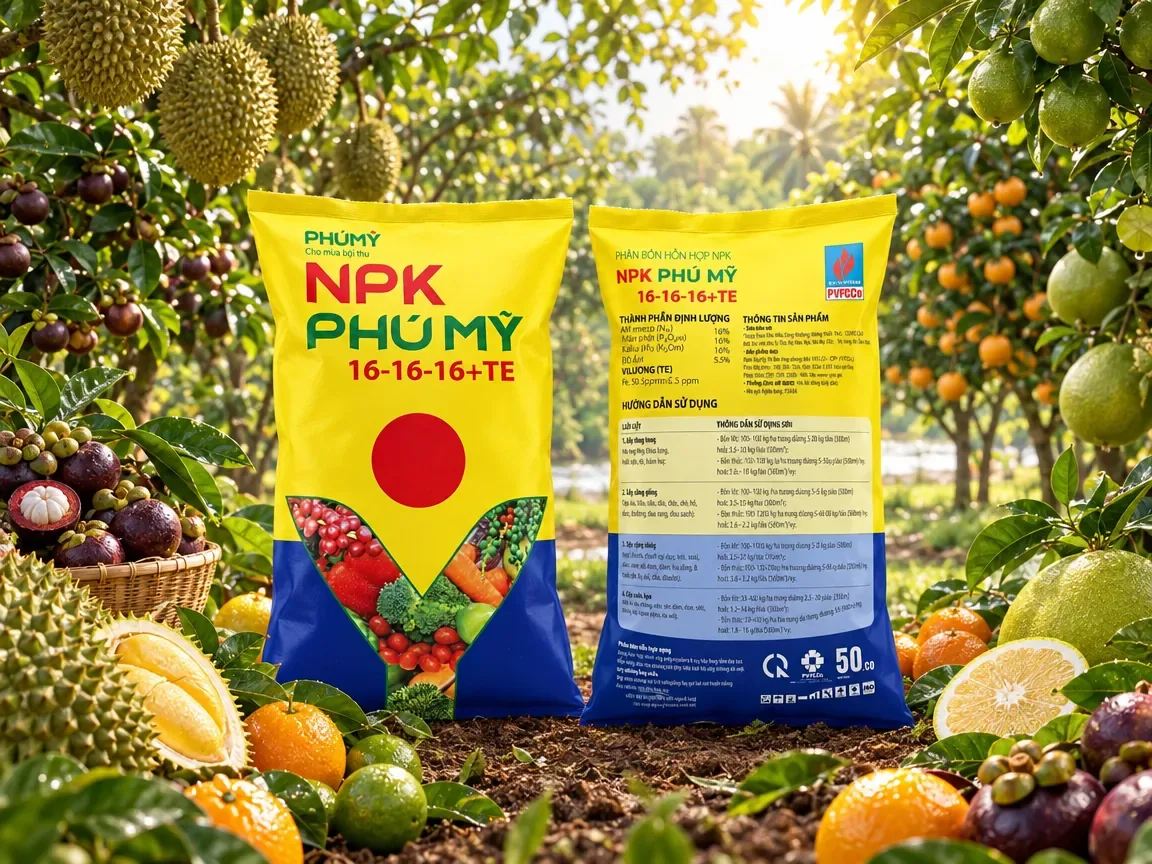
According to PVFCCo / Phú Mỹ's announcement, the product is an NPK compound fertilizer with approximately 16% N – 16% P₂O₅ – 16% K₂O, along with trace elements (approx. 50 ppm Zn, approx. 50 ppm B), and a moisture content of about 5%, used for root application (PVFCCo / Phú Mỹ, n.d.). The 1:1:1 ratio means that with each application, plants receive nitrogen, phosphorus, and potassium in nearly equal amounts — suitable for periods requiring canopy recovery, nutrient balancing after harvest, or stages when the plant simultaneously needs all three elements but has not yet entered the potassium-heavy fruit development phase.
The manufacturer describes the product as suitable for various crops and soil types, providing balanced macro- and micronutrients; the reference range for fruit trees is approximately 50–500 kg/ha for basal application and 50–800 kg/ha/crop for top dressing — a wide range as it depends on orchard age, density, and season (PVFCCo / Phú Mỹ, n.d.). Read the bag carefully and convert to g/plant based on actual density; do not use the upper limit as the default dose.
Clear limitations: 16-16-16+TE does not replace high potassium for final fruit development (many plants require a higher K ratio than N); it does not replace organic/calcium-microbial fertilizers when soil is compacted or severely acidic-saline; it is not a “one bag for the whole year” solution if the orchard schedule demands multiple application windows with different ratios.
Applying Fertilizer Correctly on the Orchard Calendar Along the Hau River
Imagine a typical care cycle:
1. After harvest / pruning: plants need to recover roots and shoots. This is typically a suitable window for balanced NPK (such as 16-16-16+TE), accompanied by organic fertilizer if the soil is poor in organic matter (Nông nghiệp và Môi trường, 2022; PVFCCo / Phú Mỹ, n.d.). 2. Before flowering: balanced formulas or those slightly leaning towards variety recommendations can still be used; Zn and B on the bag support flowering and fruit set at trace levels, but do not replace specialized boron-zinc fertilizers if the plant has a clear deficiency. 3. After fruit set – nurturing young fruit: choose the ratio according to the variety. Some orange studies show that higher potassium benefits quality; excessively high nitrogen-phosphorus can lead to larger fruit but reduced quality (Nguyễn et al., 2016). At this time, 16-16-16 can still be used if agricultural extension/variety recommendations allow for balance, but quality must be monitored — do not try to "push" by increasing the dose. 4. Nurturing late-stage fruit: prioritize higher potassium formulas if the variety requires it; do not use 16-16-16 as a final-stage fertilizer for all types of plants.
Thus, the phrase “effective for fruit trees in the southern and northern Hậu River regions” is not a regional slogan, but because the alluvial belt on both sides of the river equally requires balanced fertilization windows after harvest and at the beginning of the fruiting season; 16-16-16+TE is the tool for precisely those windows.
What Dealers Should Say (and Should Not Say)
It should be noted: this is Phú Mỹ NPK 16-16-16+TE as announced by PVFCCo; a 1:1:1 ratio with Zn–B; suitable for canopy recovery / balance after harvest and for times when simultaneous N–P–K is needed in orchards on alluvial soil along the Hậu River; dosage adjusted according to tree age and agricultural recommendations.
Avoid saying: replace all other fertilizers, any amount can be applied, 16-16-16 can be used at all fruit-growing stages. Út Nữ Co., Ltd distributes wholesale in Vĩnh Long – Trà Vinh – Mekong Delta; if you need to stock up, please call / Zalo 0294 3882069 – 02943 883791 – 02943 882837.
Conclusion
Fruit orchards along the Hậu River thrive on alluvial soil but still depend on balanced fertilization applied at the right window. Phú Mỹ NPK 16-16-16+TE, according to the manufacturer's announcement, provides equal N–P–K along with Zn–B — suitable when the orchard needs recovery and balance, not the key for all fruit development stages (PVFCCo / Phú Mỹ, n.d.). Experiments on pomelo, orange, and durian in the Mekong Delta all point to one thing: sufficient levels of all three elements, with ratios adjusted according to the stage and variety (Le et al., 2024; Nguyễn et al., 2016; Huỳnh et al., 2025). If advised at the right window, the fertilizer will be effective; if at the wrong window, even a good formula will result in imbalanced fertilization.
References (Harvard)
Huỳnh et al. (2025) 'Effects of NPK fertilizer dosage on yield and physiological disorders of Musang King durian fruit flesh in Phong Dien district, Can Tho city', *Journal of Agricultural Science and Technology*. doi: 10.46826/huaf-jasat.v9n3y2025.1257.
Le, N.N. et al. (2024) 'Evaluation of nitrogen use efficiency and N-supplying capacity on pomelo (Citrus grandis L. Osbeck) grown on alluvial soil in the Cuu Long Delta', *Journal of Agriculture and Development*. doi: 10.52997/jad.5.02.2024.
Nguyễn et al. (2016) 'Effect of NPK fertilizer ratio on yield and fruit quality of Soan oranges… in Phung Hiep district, Hau Giang province', *Can Tho University / journal publication*. Available via CTU publication record (Accessed: 22 September 2026).
Agriculture and Environment (2022) *Cultivating fruit trees on ancient alluvial soil*. Available at: https://nongnghiepmoitruong.vn/canh-tac-cay-an-trai-tren-nen-dat-phu-sa-co-d268589.html (Accessed: 22 September 2026).
PVFCCo / Phú Mỹ (n.d.) *NPK Phú Mỹ 16-16-16+TE*. Available at: https://www.dpm.vn/ (NPK Phú Mỹ 16-16-16+TE product page; Accessed: 22 September 2026).
Sinh thái Nông nghiệp (n.d.) *Hau Giang: Building a nutritional management model for Nam Roi pomelo trees*. Available at: https://sinhthainongnghiep.net.vn/ (Hau Giang Nam Roi pomelo model article; Accessed: 22 September 2026).
About Content and Responsibility
Content developed by Grokbot AI. Út Nữ Co., Ltd and Grokbot AI disclaim responsibility for any damages arising from the use of information in this article. All content is for exploratory and academic purposes only, does not replace professional technical advice, official recommendations from manufacturers or state agencies, and does not constitute a commercial promise of yield or economic efficiency.