
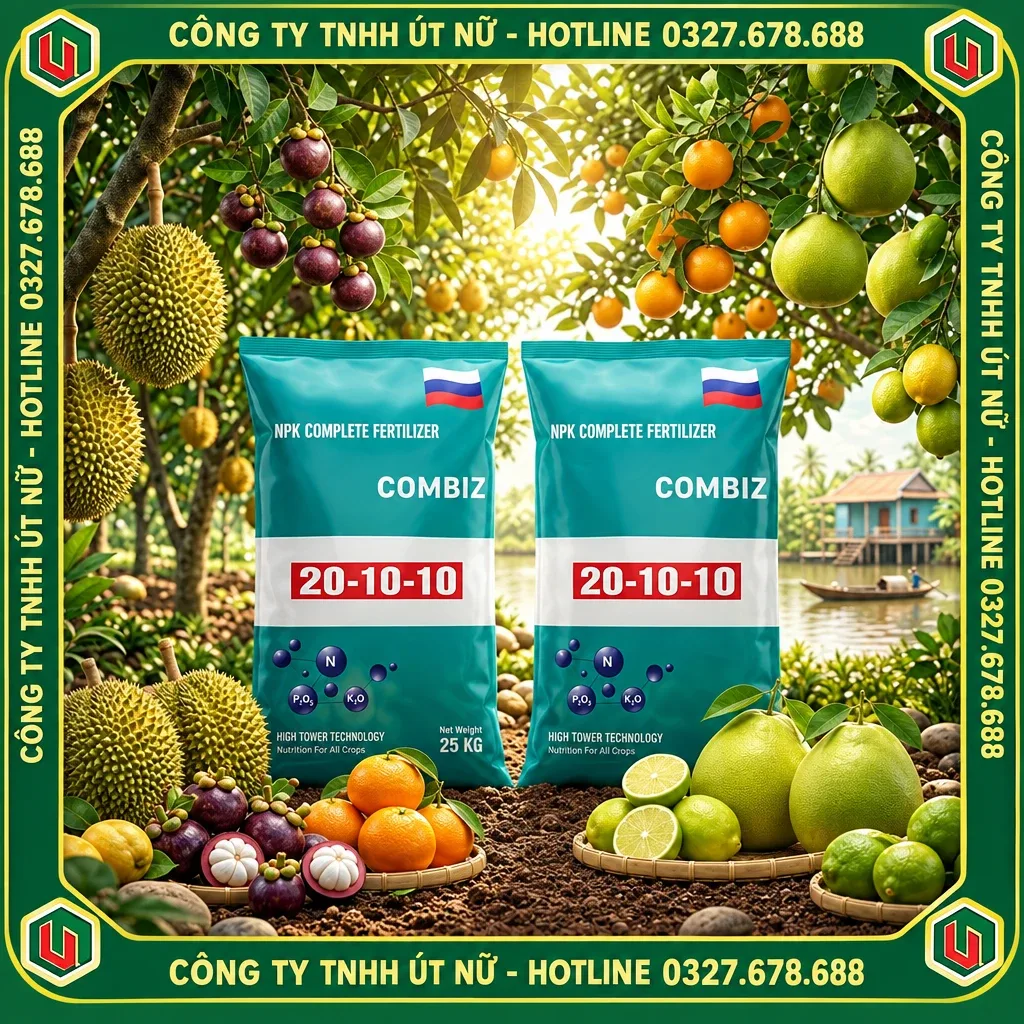
High nitrogen is a double-edged sword: stimulate rice tillering and tree shoot growth after floods with NPK Con Cò Vàng 20-10-10 at the right time.
Published · Út Nữ Co., Ltd
> Warning: The content of this article was created / supported by AI based on a synthesis of public documents. Út Nữ Co., Ltd disclaims responsibility for damages arising from the use of information in this article. You should cross-reference packaging, manufacturer's instructions, local seasonal calendars, and contact the hotline for advice suitable for actual conditions.
In early October 2026, fields and gardens in Vĩnh Long, Trà Vinh, and provinces along the Tiền and Hậu rivers are experiencing two simultaneous cycles. In many areas, the Autumn-Winter rice has headed and is developing grains, awaiting harvest; meanwhile, the 2026-2027 Winter-Spring crop already has a sowing schedule: early crop from October 10 to 30 in coastal areas, river mouths, and downstream regions at risk of early salinity; main crop from November 1 to 30; late crop from December 1 to 31, with transplanting to be completed before January 10, 2027 (Bích Hồng, 2026). In gardens, the recent full moon tide and prolonged rain have left many tree roots waterlogged, leaves pale, and new shoots weak.
At the agricultural supply store, a common question is: "Can I use a bag of 20-10-10 to boost rice growth, or apply it to the garden for new shoots?". The answer is yes, but at the right time. This article uses NPK Con Cò Vàng 20-10-10 as an example for you to read the formula on the bag and apply the right type – at the right time – in the right amount.
Real-world problem: high nitrogen is a "double-edged sword"
High nitrogen fertilizer helps rice grow green quickly, tiller strongly, and helps fruit trees flush new shoots. However, nitrogen itself, if applied at the wrong time, can cause harm:
- Rice with excess nitrogen tends to be dense, has soft leaves, is prone to pests and diseases, and lodges at the end of the season.
- If the field has just been flooded and nitrogen is applied while roots are still rotting, the roots cannot absorb it, and may even suffer shock or root burn (Lê Hoàng Vũ, 2025).
- Fruit trees that are developing large fruits with excess nitrogen tend to produce new shoots that compete with the fruits for nutrients.
Therefore, before asking "how much fertilizer to apply", one should ask "what stage is the plant in, and are the roots healthy yet?"
Product Specifications and the Significance of Each Component
According to Con Cò Vàng's product page, the product is named "NPK 20-10-10 tháp cao Nga", a compound NPK fertilizer, fertilizer code 01469, applied via root fertilization, with a shelf life of 24 months. The manufacturer recommends: 120–200 kg/ha/application for food crops; 150–200 kg/ha/application for vegetables; 3–4 kg/plant/year for fruit trees and long-term industrial crops, adjusting based on soil and variety (Con Cò Vàng, n.d.). For origin and production location information of each batch, please refer to the bag and auxiliary label.
- Total Nitrogen 20% (high): promotes stem and leaf growth, tillering, and new shoots.
- Effective Phosphorus 10% (moderate): sufficient for maintenance, not a formula for base fertilization or strong root stimulation.
- Effective Potassium 10% (moderate): nitrogen:potassium ratio is about 2:1, so it's not yet the type for panicle development or late-stage fruit nurturing.
- Moisture 5%: storage indicator; once opened, the bag should be tied tightly and stored in a dry place.
For Rice: When is the Best Time to Fertilize?
Autumn-Winter rice is heading and grain-filling: no need for additional high-nitrogen fertilizer. Applying it now will mainly cause the rice to stay green longer, be susceptible to diseases, and ripen slowly.
Winter-Spring Rice about to be sown: The nutritional framework for rice in the Mekong Delta, according to research by Can Tho University, is approximately 85–95 kg N/ha on alluvial soil and 70–80 kg N/ha on alum soil, saline-affected soil; 30–45 kg P2O5/ha of phosphorus and 25–35 kg K2O/ha of potassium when straw is incorporated (Ngo Ngoc Hung et al., 2020). This is a general scientific basis, not a specific experiment for each bag of fertilizer.
Application per dose:
- First application (approx. 7–10 days after sowing): Rice needs phosphorus for root development. The 20-10-10 formula is not the primary choice; a higher phosphorus type should be used.
- Second application (approx. 18–25 days after sowing, tillering promotion): This is where 20-10-10 is most suitable, especially when rice plants are yellow or tillering slowly.
- Panicle initiation (approx. 38–45 days after sowing): Switch to a high-potassium formula, reduce nitrogen, unless the field is still noticeably yellow.
Use a leaf color chart to decide. According to the International Rice Research Institute (IRRI), select at least 10 healthy rice tillers, compare the middle part of the uppermost fully expanded leaf with the color chart, stand in the shade to read, repeat every 7–10 days from early tillering to 5–10 days after panicle initiation; if the leaf color is below level 3, nitrogen application is needed (IRRI, n.d.). If the leaves are already dark green, no further application is required.
Calculate by nutrients, not by bags. Each 100 kg of 20-10-10 fertilizer provides 20 kg N, 10 kg P2O5, and 10 kg K2O. If applying a high rate of 200 kg/ha at once, the field receives 40 kg N, which is nearly half of the total nitrogen for the entire crop on alluvial soil and more than half on acid sulfate soil. Two high-rate applications are close to the total nitrogen for the entire crop. Therefore, sum up all applications, including additional urea, to avoid exceeding the limit.
On fruit trees: when to promote new shoots?
Garden just flooded: roots must be saved first. According to Prof. Dr. Trần Văn Hâu (Can Tho University), a garden after flooding should go through 3 steps: 0–3 days initially, drain water, loosen soil to break the crust, treat for fungi, and spread lime; 3–30 days next, stimulate roots with humic, fulvic, spray foliar fertilizer, do not apply urea; only when the plant produces new shoots and leaves turn green again (usually after 1–3 months) should basal fertilizer be applied with a balanced NPK ratio such as 2:1:2 or 3:1:2 (Lê Hoàng Vũ, 2025). The 20-10-10 formula (2:1:1 ratio) has lower potassium than this level, so when used for recovery gardens, potassium needs to be supplemented or a formula with higher potassium should be chosen.
Post-harvest garden: For Năm Roi pomelo in Vĩnh Long, it is recommended to apply lime, organic fertilizer combined with phosphorus first; then, 10–15 days later, apply NPK with high nitrogen and phosphorus to stimulate new shoots. For gardens still bearing fruit or flowering, NPK formulations such as 20-10-10, 30-10-10, 20-20-15+TE can be used at a dose of 400–600 g/tree or 300–500 kg/ha depending on tree age (Nguyễn Văn Liêm, 2018).
Durian needs more caution. For durian orchards with over 30% leaf drop after flooding, prioritize leaf recovery. Do not induce early flowering; it needs at least 4–6 months for the foliage to recover to a minimum of 70% (Lê Hoàng Vũ, 2025).
As the orchard/garden changes stages, so does the fertilizer:
- Plants preparing for flowering: limit nitrogen, increase phosphorus and potassium.
- Fruit from sizing up to 1–2 months before harvest: switch to high potassium fertilizers.
- If roots are still rotting or soil is still waterlogged: do not fertilize yet, treat soil and roots first.
Notes on application
- Pre-treatment of soil: for acid sulfate soil, leach the acidity and apply lime according to local guidelines; for flooded orchards, drain water and wait for roots to recover.
- Rice: apply when the field has a thin layer of water, avoid heavy rain or deep flooding.
- Fruit trees: spread fertilizer under the canopy projection, lightly till, cover with soil, and water sufficiently; divide into multiple applications instead of applying all at once.
- Do not arbitrarily mix with urea: the 20-10-10 bag already has high nitrogen content.
- Read the bag: check the ingredients, fertilizer code, manufacturing date, and expiry date.
What should dealers advise?
When farmers ask to buy 20-10-10 fertilizer, dealers should ask three things in return: what crop – what growth stage – what are the soil and roots like. From there:
- For rice promoting tillering, with yellowing leaves: 20-10-10 is a suitable choice; adjust dosage according to the bag and total nitrogen for the entire crop. For the same formula, stores can refer to NPK Phú Mỹ 20-10-10+TE or NPK Cà Mau 20-10-10.
- For newly sown rice, needing root establishment: prioritize formulas with higher phosphorus, such as NPK Phú Mỹ 20-20-15+TE.
- For rice at panicle initiation, or orchards with large fruit development: suggest high-potassium groups like NPK Phú Mỹ 17-7-17+TE.
- For recently flooded orchards, acidic soil: remember to apply lime and organic matter first, for example Vôi Phú Mỹ; only apply high-nitrogen fertilizer when plants have produced new shoots.
Út Nữ Co., Ltd provides wholesale distribution in the Vĩnh Long – Trà Vinh – Mekong Delta region. If you need to replenish your stock, you can call / Zalo 0294 3882069 – 02943 883791 – 02943 882837.
Conclusion
NPK Con Cò Vàng 20-10-10 is a formula with high nitrogen, and moderate phosphorus and potassium. For rice, it is best suited for the tillering stage when leaves are still yellow; newly sown rice needs higher phosphorus, rice at panicle initiation needs higher potassium, and rice during grain filling does not need additional fertilizer. For fruit trees, this formula helps promote new shoots when roots have recovered and the tree is still bearing fruit or recovering its canopy, but it cannot replace the steps of root rescue, liming, and organic fertilization after flooding, and additional potassium is needed when entering the fruit development stage. Applying the right type, at the right time, in the right amount, comparing leaf color, and calculating total nitrogen for the entire crop are ways to maintain healthy and sustainable fields and orchards.
References
Bich Hong (2026) 'Proactively responding to El Nino… ensuring production for the 2026-2027 Winter-Spring crop', *VietnamPlus*, 22 September. Available at: https://www.vietnamplus.vn/chu-dong-ung-pho-el-nino-bao-dam-san-xuat-vu-dong-xuan-2026-2027-post1137647.vnp (Accessed: 3 October 2026).
Con Cò Vàng – Con Cò Vàng Group Joint Stock Company (n.d.) *NPK 20-10-10 Russian high tower – product information and usage instructions*. Available at: https://ccv.vn/npk-20-10-10-thap-cao-nga (Accessed: 3 October 2026).
IRRI – International Rice Research Institute (n.d.) *Leaf Color Chart*. IRRI Rice Knowledge Bank. Available at: http://knowledgebank.irri.org/step-by-step-production/growth/soil-fertility/leaf-color-chart (Accessed: 3 October 2026).
Lê Hoàng Vũ (2025) 'Restoring Mekong Delta orchards: Don't rush to fertilize when roots are still suffocating', *Agriculture and Environment Newspaper*, 11 December. Available at: https://nongnghiepmoitruong.vn/tai-thiet-vuon-cay-an-trai-dbscl-dung-voi-bon-phan-khi-re-con-ngat-tho-d788806.html (Accessed: 3 October 2026).
Ngô Ngọc Hưng, Lý Ngọc Thanh Xuân, Trần Ngọc Hữu, Lâm Văn Thông, Nguyễn Bảo Vệ, Lê Phước Toàn, Lê Văn Dang, Nguyễn Kim Quyên, Trần Văn Dũng and Trịnh Quang Khương (2020) 'Using NPK for rice on major soil types in the Mekong Delta', *Can Tho University Journal of Science*, 56 (Special Issue on Soil Science), pp. 177–184. doi: 10.22144/ctu.jsi.2020.083.
Nguyen Van Liem (2018) 'Caring for Năm Roi pomelo orchards after Tet harvest', *Vinh Long Newspaper*, February 1. Available at: https://baovinhlong.com.vn/kinh-te/nong-nghiep/201802/cham-soc-vuon-buoi-nam-roi-sau-khi-thu-hoach-vu-tet-2879739/ (Accessed: 3 October 2026).
About Content and Responsibility
Content developed by Grokbot AI. Út Nữ Co., Ltd and Grokbot AI disclaim responsibility for any damages arising from the use of information in this article. All content is for exploratory and academic purposes only, does not replace professional technical advice, official recommendations from manufacturers or state agencies, and does not constitute a commercial promise of yield or economic efficiency.