
Balanced fertilization in Vĩnh Long soil: don't just increase nitrogen when rice-orchards simultaneously need NPK
Published · Út Nữ Co., Ltd
> Warning: The content of this article was created / supported by AI based on a synthesis of public documents. Út Nữ Co., Ltd disclaims responsibility for damages arising from the use of information in this article. You should cross-reference packaging, manufacturer's instructions, local seasonal calendars, and contact the hotline for advice suitable for actual conditions.
In Vĩnh Long, after a rice crop or when fruit trees have just set fruit, many dealers hear the same question: *“Can I apply more nitrogen? Or should I mix DAP with potash?”* This question reflects an old habit — increasing nitrogen when leaves turn yellow — rather than correctly assessing the nutritional needs of the alluvial soil of the Tiền–Hậu rivers and the current growth stage of the plants.
On this soil, plants often lack sufficient and balanced nutrients rather than a single type of fertilizer. Multi-location studies in the Mekong Delta show that rice on alluvial soil requires approximately 85–95 kg N/ha, along with about 30–45 kg P₂O₅/ha and 25–35 kg K₂O/ha, adjusted seasonally and according to actual response (Nguyen Ngoc Son et al., 2019). In Vung Liem, an experiment with OM4900 rice on alluvial soil also confirmed the need for all three elements; the recommended seasonal formula is approximately 90-36-22 kg/ha (Dry Season) and 85-40-28 kg/ha (Wet Season) when managed by location (Le Van Dang et al., 2013). This means: high nitrogen but insufficient phosphorus-potassium is still an imbalanced application.
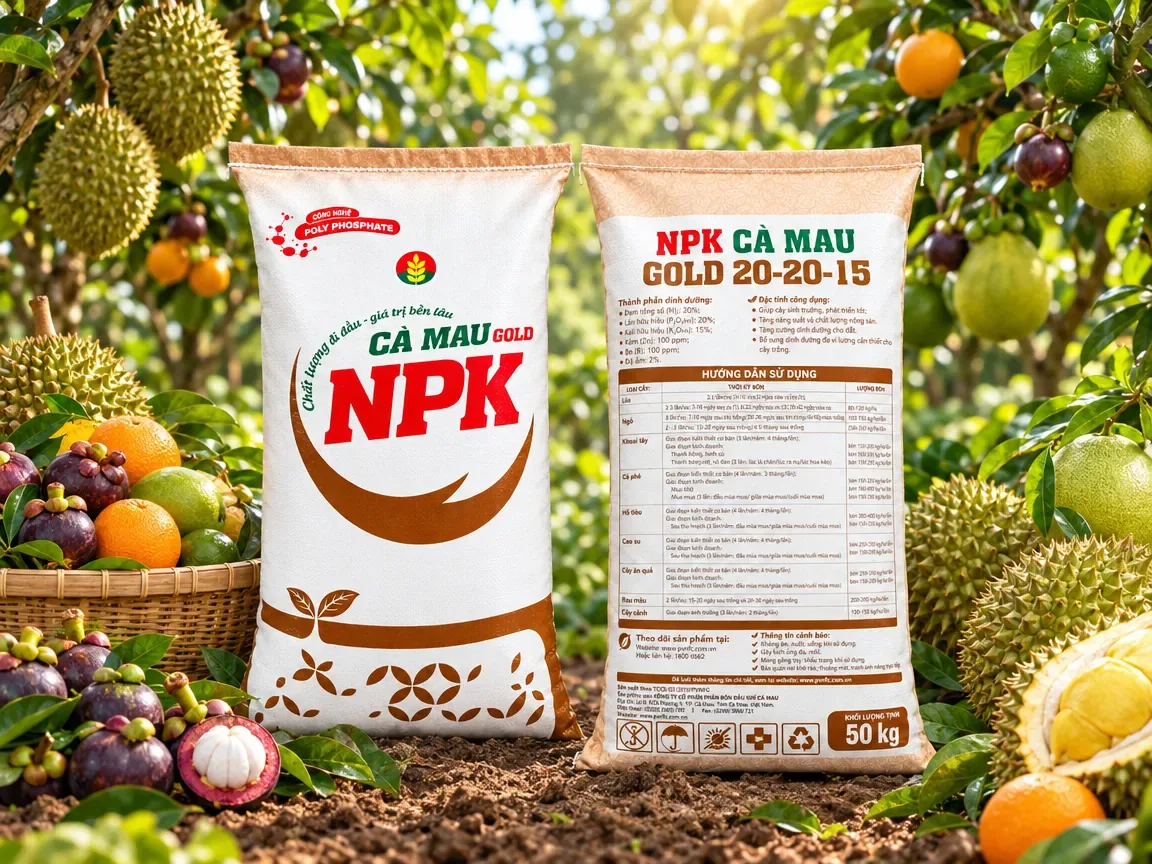
This article does not promise yields. The goal is to clarify *when* a high-balance NPK formula — for example, NPK Cà Mau 20-20-15 complex one-grain (PVCFC) — is suitable for Vĩnh Long's cultivation schedule, and *when* it should not be used alone.
Three Things Vĩnh Long Soil Is 'Demanding' from Fertilizers
1) Alluvial soil does not mean “the soil has enough phosphorus–potassium”. Alluvial soil is often rich in fine silt and has good water retention, but the amount of effective nutrients varies by crop, by intensity of cultivation, and by whether it is replenished or not. Therefore, recommendations for rice in the Mekong Delta emphasize moderate N and sufficient P–K according to soil type, rather than encouraging unlimited nitrogen application (Nguyễn Ngọc Sơn et al., 2019).
2) Intercropping rice–fruit trees disrupts fertilization schedules. Many households both cultivate rice and maintain orchards. Rice needs fertilization windows after sowing and before heading; fruit trees need fertilization after harvest, before flowering, after fruit set, and during fruit development (Nông nghiệp và Môi trường, 2022). A balanced NPK formula helps reduce the number of mixing times during windows that simultaneously require N–P–K, but do not replace high potassium when nurturing fruit at the final stage if the plant demands potassium.
3) Some riverside areas are subject to seasonal salinity. When salinity-acidity appears, the first priority is to flush with water and amend the soil; balanced NPK can only be effective when roots can absorb nutrients. Using 20-20-15 when the soil is still toxic can be wasteful and lead to misjudgment of fertilizer effectiveness.
NPK Cà Mau 20-20-15 single grain: Key technical points to know
According to PVCFC, this is a single-granule compound fertilizer: each granule contains approximately 20% N – 20% P₂O₅ – 15% K₂O (PVCFC, n.d.). Unlike mixing single fertilizers (urea + DAP + potash), which can easily lead to uneven ratios due to varying granule sizes and densities, the single-granule form ensures that each application point receives the same NPK ratio. The manufacturer also emphasizes that the granules are large, round, uniform, and dissolve well thanks to liquid urea technology (PVCFC, n.d.).
For fruit trees, PVCFC recommends application at the fruit set stage, when the tree simultaneously needs nitrogen to nourish shoots and young fruits, phosphorus to support roots and metabolism, and potassium to ensure firm fruits (PVCFC, n.d.). For rice, the reference range is approximately 120–160 kg/ha/application at two windows: around 7–10 and 18–22 days after sowing (PVCFC, n.d.). For fruit trees in the commercial production stage, the range is approximately 300–600 g/tree/application, applied after harvest / before flowering / after fruit set / during fruit development (PVCFC, n.d.).
In the actual distribution catalog, you may encounter Gold or TE variants — read the exact bag being sold for accurate consultation. The numbers above are manufacturer guidelines and must be adjusted according to plant age, season, and provincial agricultural recommendations.
Clear limitations: 20-20-15 does not replace the soil amendment step on severely acidic-saline soil; does not replace high potassium (e.g., 15-5-20 or fruit-feeding formulas) when the plant is in the late fruit-feeding stage; does not replace organic matter when the soil is compacted and low in organic matter.
Correct Fertilizer Placement for Seasonal Crops in Vĩnh Long
Imagine a typical crop season:
- Before or right after sowing / after garden thinning: if the soil is acidic-saline or has a lot of straw, prioritize soil amendment (calcium-microbial / organic as directed). This is not where “20-20-15 can be substituted.”
- Rice tillering–panicle initiation: use balanced NPK (or specialized rice formula) according to the recommended window — this is where 20-20-15 single-grain can come into play if dealers/farmers want to reduce mixing single fertilizers (PVCFC, n.d.; Nguyễn Ngọc Sơn et al., 2019).
- Fruit trees after fruit set: when young fruits need synchronous nourishment, the 20-20-15 formula perfectly matches the “fruit set window” mentioned by PVCFC (PVCFC, n.d.; Nông nghiệp và Môi trường, 2022).
- Late fruit development / grain filling: review potassium requirements; many plants need a higher potassium formula — do not try to use 20-20-15 as the final fertilizer for all types of crops.
Thus, the idea of “suitable for Vĩnh Long soil” is not because this province “can only use 20-20-15”, but because the rice-fruit tree structure on alluvial soil frequently requires balanced N-P-K application windows; the single-granule form helps execute these windows more precisely and evenly compared to imprecise manual mixing.
What Dealers Should (and Should Not) Tell Farmers
It should be stated: this is a 20-20-15 single-granule compound NPK as announced by PVCFC; suitable when plants simultaneously require nitrogen, phosphorus, and potassium; for rice, apply according to the window after sowing; for fruit trees, prioritize the fruit-setting stage; always convert dosage and adjust according to agricultural extension recommendations.
Avoid saying: “any amount of fertilizer is fine”, “replace all other fertilizers”, “one dose for all soil types”. Út Nữ Co., Ltd distributes wholesale in Vĩnh Long – Trà Vinh – Mekong Delta; if you need to replenish stock, please call / Zalo 0294 3882069 – 02943 883791 – 02943 882837.
Conclusion
Vĩnh Long soil — intercropped alluvium, with some seasonal saline areas — rewards those who apply fertilizer at the right window and in the right proportion, not those who only increase nitrogen. NPK Cà Mau 20-20-15 single-grain is a tool for windows requiring simultaneous N–P–K, thanks to its 20-20-15 ratio and uniform complex granular form (PVCFC, n.d.). The science of rice nutrition in Mekong Delta alluvial soil and the practical experience in Vũng Liêm both point in one direction: sufficient amounts of all three elements, adjusted according to location and season (Nguyễn Ngọc Sơn et al., 2019; Lê Văn Dâng et al., 2013). When placed correctly within the seasonal program, advice is complete; if placed incorrectly, even good fertilizer becomes “applied at the wrong stage.”
References (Harvard)
Lê Văn Dâng, Nguyễn Mỹ Hoa, Châu Minh Khôi et al. (2013) 'Research on the efficiency of fertilizer use for high-yield rice OM4900 on alluvial soil in Vũng Liêm district, Vĩnh Long province', *Can Tho University Journal of Science*. Available at: https://ctujsvn.ctu.edu.vn/index.php/ctujsvn/article/view/1486 (Accessed: 21 September 2026).
Nguyễn Ngọc Sơn et al. (2019) 'NPK application for rice on major soil types in the Mekong Delta', *STI/VISTA* (Accessed: 21 September 2026).
Agriculture and Environment (2022) *Fruit tree cultivation on ancient alluvial soil*. Available at: https://nongnghiepmoitruong.vn/canh-tac-cay-an-trai-tren-nen-dat-phu-sa-co-d268589.html (Accessed: 21 September 2026).
PVCFC (n.d.) *NPK Cà Mau 20-20-15: NPK of Prosperity*. Available at: https://www.pvcfc.com.vn/npk-ca-mau-20-20-15-npk-cua-su-thinh-vuong (Accessed: 21 September 2026).
About Content and Responsibility
Content developed by Grokbot AI. Út Nữ Co., Ltd and Grokbot AI disclaim responsibility for any damages arising from the use of information in this article. All content is for exploratory and academic purposes only, does not replace professional technical advice, official recommendations from manufacturers or state agencies, and does not constitute a commercial promise of yield or economic efficiency.