
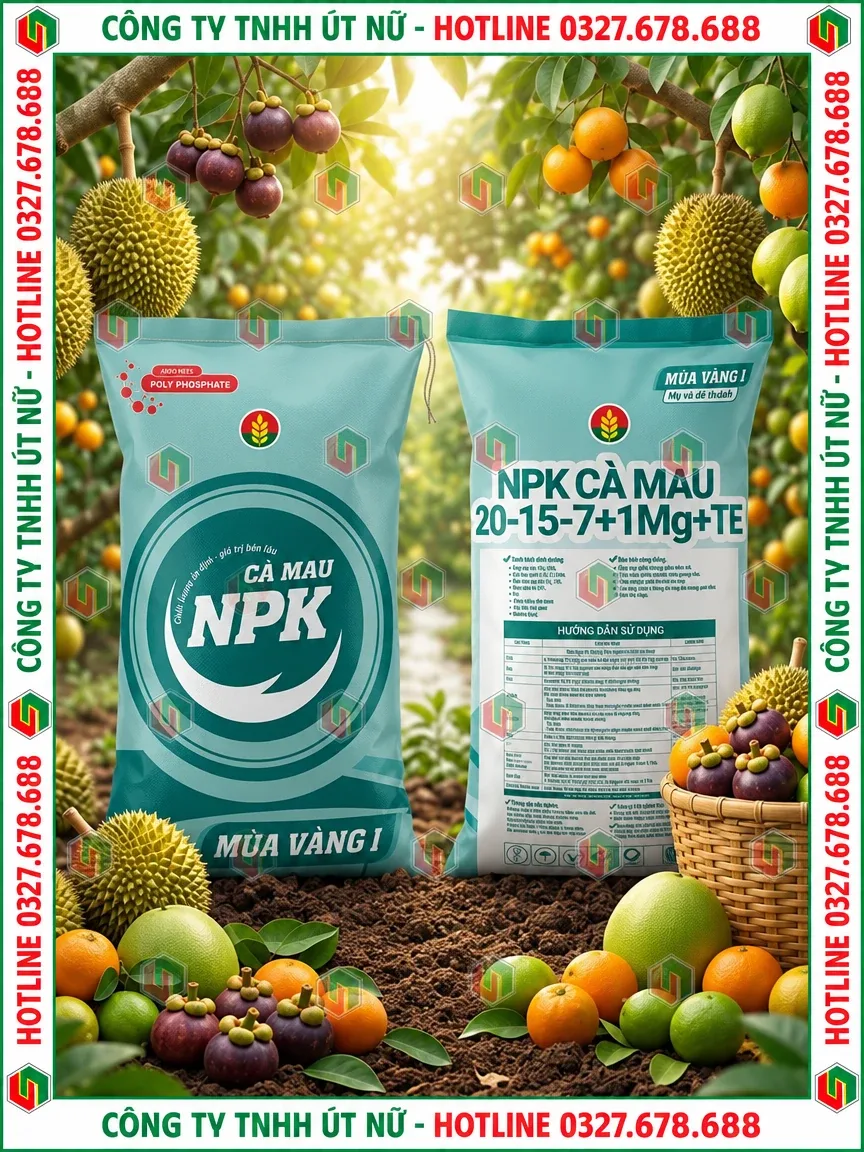
Early-sown Winter-Spring rice, just emerged: fertilization schedule at 7–10 and 18–22 days after sowing with NPK Cà Mau 20-15-7+1Mg+TE Mùa Vàng 1
Published · Út Nữ Co., Ltd
> Warning: The content of this article was created / supported by AI based on a synthesis of public documents. Út Nữ Co., Ltd disclaims responsibility for damages arising from the use of information in this article. You should cross-reference packaging, manufacturer's instructions, local seasonal calendars, and contact the hotline for advice suitable for actual conditions.
Early sown Winter-Spring rice fields in coastal areas were planted from October 10, following the seasonal schedule recommended by the Department of Crop Production and Plant Protection for areas at risk of drought and salinity late in the season (Dân Việt, 2026). In Cà Mau, the first sowing period was from October 2–20 (Thúy Lam, 2026). This means that around October 17–20, many fields reached their first top-dressing (7–10 days after sowing), and by late October to early November, it was time for the second top-dressing (18–22 days after sowing).
When rice seedlings have just emerged, farmers are often eager to apply a lot of nitrogen for "quick greening". This article provides guidance on calculating fertilization schedules based on sowing dates and selecting quantities for the first two applications, using NPK Cà Mau 20-15-7+1Mg+TE Mùa Vàng 1 as a technical example, following the principles of right type – right time – right amount.
Fertilization Schedule by Sowing Date
PVCFC guides the application of NPK Cà Mau 20-15-7+1Mg+TE for rice 2–3 times per crop: 7–10 days after sowing, 18–22 days after sowing, and 38–42 days after sowing (PVCFC, n.d.b). Count the schedule for the first two applications:
- Sow 10/10: 1st application 17–20/10; 2nd application 28/10–1/11.
- Sow 15/10: 1st application 22–25/10; 2nd application 2–6/11.
- Sow 20/10: 1st application 27–30/10; 2nd application 7–11/11.
- Sow 25/10: 1st application 1–4/11; 2nd application 12–16/11.
- Sow 30/10: 1st application 6–9/11; 2nd application 17–21/11.
The third application (38–42 days after sowing) is for panicle initiation, when rice needs more potassium; for this application, switch to a balanced nitrogen and potassium formula, which will be discussed below.
Why does the seedling – tillering stage need high, but moderate, nitrogen?
PVCFC classifies Mùa Vàng 1 into the high-nitrogen group for the seedling and tillering stages, helping "healthy roots, developed stems and leaves, increased tillers, and good tillering" (PVCFC, 2024).
However, IRRI's site-specific nutrient management principle reminds: during the first 21 days after sowing, only apply a moderate amount of nitrogen, because the young rice plant's need for nitrogen supplementation is still small; after that milestone, apply according to demand, based on leaf color (IRRI, 2007). Both topdressing applications at 7–10 and 18–22 days fall within or close to the 21-day milestone, so a restrained amount should be chosen.
NPK Cà Mau 20-15-7+1Mg+TE Specifications
According to PVCFC's product page (PVCFC, n.d.b):
- NPK compound fertilizer; the 20-15-7 range represents the percentage ratio of nitrogen (N) – phosphorus (P₂O₅) – potassium (K₂O), along with +1Mg+TE as per the product name.
- TE stands for trace elements; the PVCFC page lists zinc (Zn) and boron (B) in the composition. For specific data, please refer to the packaging.
- Two-layer bag: PP outer, PE inner; shelf life 36 months from the manufacturing date.
Each 100 kg of fertilizer provides approximately 20 kg N, 15 kg P₂O₅, and 7 kg K₂O.
Two applications, how much each time?
PVCFC's recommended range for rice is 80–120 kg/application, or 8–12 kg/công (PVCFC, n.d.b). The first two applications combined:
- Low rate 80 + 80 kg/ha: approximately 32 kg N, 24 kg P₂O₅, 11 kg K₂O.
- High rate 120 + 120 kg/ha: approximately 48 kg N, 36 kg P₂O₅, 17 kg K₂O.
Compared to the total seasonal nitrogen benchmarks from Can Tho University: approximately 85–95 kg N/ha on alluvial soil, 70–80 kg N/ha on acid sulfate soil and saline soil (Ngo Ngoc Hung et al., 2020). Two high-level topdressings have already used more than half of the total seasonal nitrogen for the acid sulfate-saline fields, while the panicle initiation application is still to come. Therefore:
- Top-dressing 1 (7–10 days after sowing): If base fertilizer has been applied, use the lower rate, about 8 kg/cong. For fields without base fertilizer, this can be increased to 10 kg/cong.
- Top-dressing 2 (18–22 days after sowing): Observe leaf color. If leaves are dark green, maintain 8 kg/cong or less; if leaves are pale yellow and tillering is slow, use 10–12 kg/cong.
- Acid sulfate soil, saline soil: Keep both applications at the lower rate.
For example: for a 12 công field, if the first topdressing is at 8 kg/công, approximately 96 kg is needed, which is nearly two 50 kg bags.
Third Application and Other Crops
- Panicle initiation stage (38–42 days after sowing): switch to a balanced nitrogen and potassium formula such as NPK Cà Mau 16-8-16 Mùa Vàng 2, at a rate of 150–180 kg/ha, applied 38–42 days after sowing (PVCFC, n.d.a). Instructions on how to count days and choose the appropriate application rate for this stage are available in the article Late Autumn-Winter rice still in panicle initiation: count days after sowing, apply NPK Cà Mau 16-8-16 Mùa Vàng 2 at the right time.
- Short-term leafy vegetables: PVCFC recommends 150–200 kg/ha/application (15–20 kg/1000m²), applied twice at 7–10 days and 20–30 days after planting (PVCFC, n.d.b).
Notes on Fertilizing Rice Seedlings
- Apply when the field has a thin layer of water and the rice has rooted.
- If the field is still saline, prioritize maintaining fresh water and flushing out salinity first; in rice-shrimp areas, only sow seeds when there is sufficient fresh water (Dân Việt, 2026).
- Avoid broadcasting immediately before heavy rain or high tides that could overflow the banks.
- Broadcast evenly, do not mix with lime.
What Should Dealers Ask?
1. When was the field sown? Count out the dates for the 1st and 2nd topdressing. 2. Has basal fertilizer been applied, and what type? If applied, use a low rate for the 1st topdressing. 3. Is the soil alluvial or acidic/saline? To keep the total nitrogen for the entire crop within limits. 4. Are the rice leaves green or yellow at the 2nd topdressing? To choose between 8 or 12 kg/cong.
For early-sown Winter-Spring rice fields approaching the first and second top-dressing, high-nitrogen fertilizer with phosphorus, magnesium, and micronutrients is needed. Dealers can recommend NPK Cà Mau 20-15-7+1Mg+TE (Mùa Vàng 1) and remind farmers to adjust the quantity based on leaf color. Út Nữ Co., Ltd distributes wholesale in Vĩnh Long – Trà Vinh – Mekong Delta; if you need to replenish stock, please call / Zalo 0294 3882069 – 02943 883791 – 02943 882837.
Conclusion
For fields sown early from October 10th, the first top-dressing will be around October 17th–20th, and the second top-dressing around October 28th–November 1st. NPK Cà Mau 20-15-7+1Mg+TE Mùa Vàng 1 is recommended by PVCFC for the seedling – tillering stage, 80–120 kg/time (8–12 kg/công). Because only moderate nitrogen is needed during the first 21 days, the first top-dressing should be at a low level, the second top-dressing should be chosen according to leaf color, then switch to a balanced nitrogen and potassium formula for panicle initiation. Applying the right type, at the right time, and in the right amount helps rice tiller strongly without wasting nitrogen.
References
Dân Việt (2026) 'Latest seasonal calendar to "avoid" El Nino-induced salinity for the 2026-2027 winter-spring crop, what does the Department of Crop Production and Plant Protection recommend?', *Dân Việt Newspaper*, 19 June. Available at: https://danviet.vn/khung-thoi-vu-moi-nhat-ne-han-man-do-el-nio-cho-vu-dong-xuan-2026-2027-cuc-trong-trot-va-bvtv-khuyen-cao-gi-d1436554.html (Accessed: 8 October 2026).
IRRI – International Rice Research Institute (2007) *Nutrients for irrigated rice: SSNM* (Rice Production e-learning, Nutrient management IV.4). Available at: http://knowledgebank.irri.org/ericeproduction/IV.4_SSNM.htm (Accessed: 8 October 2026).
Ngô Ngọc Hưng, Lý Ngọc Thanh Xuân, Trần Ngọc Hữu, Lâm Văn Thông, Nguyễn Bảo Vệ, Lê Phước Toàn, Lê Văn Dang, Nguyễn Kim Quyên, Trần Văn Dũng and Trịnh Quang Khương (2020) 'Using NPK for rice on major soil types in the Mekong Delta', *Can Tho University Journal of Science*, 56 (Special Issue on Soil Science), pp. 177–184. doi: 10.22144/ctu.jsi.2020.083.
PVCFC – Cà Mau Petroleum Fertilizer Joint Stock Company (2024) *NPKCàMauMùaVàng diverse formulas, boosting productivity*. Bí Kíp Vàng, October 25. Available at: https://bikipvang.pvcfc.com.vn/2024/10/25/npkcamaumuavang-da-dang-cong-thuc-thuc-day-nang-suat/ (Accessed: 8 October 2026).
PVCFC – PetroVietnam Ca Mau Fertilizer Joint Stock Company (n.d.a) *NPK Cà Mau 16-8-16*. Available at: https://www.pvcfc.com.vn/npk-ca-mau-16-8-16 (Accessed: 8 October 2026).
PVCFC – PetroVietnam Ca Mau Fertilizer Joint Stock Company (n.d.b) *NPK Cà Mau 20-15-7+1Mg+TE*. Available at: https://www.pvcfc.com.vn/npk-ca-mau-20-15-71mgte-3 (Accessed: 8 October 2026).
Thúy Lam (2026) 'Guidance on seasonal calendar and rice variety structure for the 2026–2027 Winter-Spring crop', *Cà Mau Provincial Agricultural Extension Center*, 6 October. Available at: http://khuyennongcamau.vn/thong-tin-va-truyen-thong/huong-dan-lich-thoi-vu-va-co-cau-giong-lua-vu-dong-xuan-2026-2027-85460 (Accessed: 8 October 2026).
About Content and Responsibility
Content developed by Grokbot AI. Út Nữ Co., Ltd and Grokbot AI disclaim responsibility for any damages arising from the use of information in this article. All content is for exploratory and academic purposes only, does not replace professional technical advice, official recommendations from manufacturers or state agencies, and does not constitute a commercial promise of yield or economic efficiency.