
Fruits are developing, rice is about to panicle initiation: when is NPK Cà Mau 20-10-15+1Mg+TE suitable, and when should the formula be changed?
Published · Út Nữ Co., Ltd
> Warning: The content of this article was created / supported by AI based on a synthesis of public documents. Út Nữ Co., Ltd disclaims responsibility for damages arising from the use of information in this article. You should cross-reference packaging, manufacturer's instructions, local seasonal calendars, and contact the hotline for advice suitable for actual conditions.
In October, in Vĩnh Long and provinces along the Tiền River and Hậu River, some Autumn-Winter rice fields are developing grains, while others have already been harvested to prepare for the Winter-Spring crop. In orchards, after several months of continuous rain and high floodwaters, many pomelo, orange, and durian trees have waterlogged roots and pale leaves, even as they are bearing young fruit or preparing to nurture fruit for Tết sales.
A frequently asked question at agricultural supply stores right now is: "Can NPK Cà Mau 20-10-15+1Mg+TE fertilizer be used for rice, and when is it suitable for orchards?". This article helps you read the formula on the bag to fertilize with the right type – at the right time – in the right amount, instead of using one type of fertilizer for all occasions.
The Practical Problem: One Bag of Fertilizer, Many Stages
Many households are accustomed to choosing fertilizer based on available bags at home and then applying it evenly to both fields and gardens. This approach often carries two risks:
- Excess nitrogen when the plant needs potassium: Dense, dark green rice plants during panicle initiation are prone to disease and lodging; fruit trees with excess nitrogen during fruit development tend to produce new shoots that compete with the fruit for nutrients.
- Micronutrient deficiency after many years of only N-P-K fertilization: Magnesium (Mg) is often overlooked, yet Mg deficiency is increasingly common in areas where only nitrogen, phosphorus, and potassium are applied continuously (Cakmak and Yazici, 2010).
Therefore, before asking "how much to fertilize," one should ask "what stage is the plant in, and what is it lacking?"
Technical Specifications and the Significance of Each Component
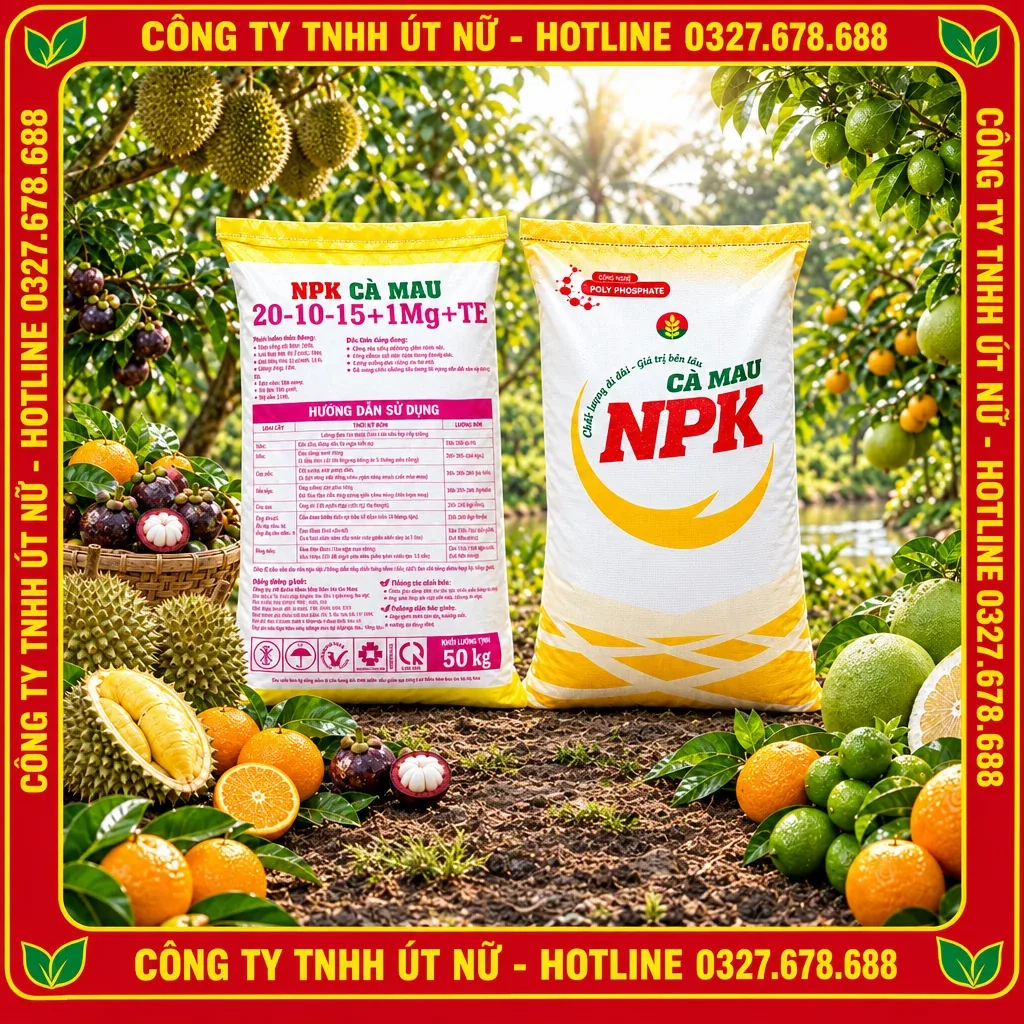
NPK Cà Mau 20-10-15+1Mg+TE is a compound fertilizer with high nitrogen, moderate phosphorus, and sufficient potassium, supplemented with Magnesium (Mg) and trace elements (TE). According to the manufacturer's instructions, the 20-10-15 base formula is specifically used for fruit trees during the fruit development stage, applied at 300–600 g/tree/application (PVCFC, 2024a; PVCFC, n.d.-a).
Meaning of each component:
- Nitrogen 20% (high): promotes stem and leaf growth, helps plants recover greenness after flooding; excess nitrogen late in the season or late in the fruit development stage will have adverse effects.
- Phosphorus 10% (moderate): sufficient for maintenance, but not a formula for basal application or strong root stimulation.
- Potassium 15% (fairly high): helps strengthen plants, transports sugars and starches to seeds and fruits. The nitrogen:potassium ratio is approximately 4:3, so it is not considered "high potassium" for late-stage fruit development.
- Magnesium (Mg): located at the center of chlorophyll, activates photosynthetic enzymes, and helps transport sugars and starches from leaves to roots, seeds, and fruits. Mg deficiency often causes yellowing of the leaf tissue between veins on older leaves first (Cakmak and Yazici, 2010).
- Trace Elements (TE): usually zinc, boron; needed in small amounts, but deficiency leads to poor development of shoots, flowers, and fruits.
It is necessary to distinguish: yellowing leaves due to Mg deficiency are different from citrus greening disease (Greening) on citrus trees. Greening is caused by bacteria, transmitted by Asian citrus psyllids and infected seedlings; applying fertilizer containing Mg cannot cure it. If you see unusual mottled yellow leaves, you should ask a technical officer to inspect them before increasing fertilizer application.
For rice: which stage is suitable?
What the manufacturer says. The published documentation for NPK Cà Mau 20-10-15 does not specify dosages for rice. For rice, the manufacturer suggests high-nitrogen, moderate-phosphorus groups like 20-15-7+1Mg+TE (80–120 kg/ha/application; applied 7–10, 18–22, and 38–42 days after sowing) for the seedling and tillering stages, and high-potassium groups like 18-6-18, 16-8-16, 17-6-17 for the panicle initiation stage (PVCFC, 2024b; PVCFC, n.d.-b).
What research in the Mekong Delta says. Site-specific nutrient management research by Can Tho University across 8 locations, 3 seasons (2016–2018) suggested nitrogen application rates for rice of approximately 85–95 kg N/ha on alluvial soil and 70–80 kg N/ha on acid sulfate soil and saline soil; phosphorus at 30–45 kg P2O5/ha and potassium at 25–35 kg K2O/ha when rice straw is incorporated back into the field (Ngo Ngoc Hung et al., 2020). This is a general scientific basis, not a specific experiment for each bag of fertilizer.
Practical field application:
- Early top-dressing (7–10 days after sowing): Rice needs nitrogen and phosphorus for root development and tillering. The 20-10-15 formula is not the first choice; a higher phosphorus type should be used.
- Tillering top-dressing (approx. 18–25 days after sowing): This is where a high-nitrogen, fairly high-potassium formula can be effective, especially in sandy soils, long-term alum-affected fields, or fields where straw is not incorporated, where potassium is easily deficient.
- Panicle initiation (approx. 38–45 days after sowing): If the rice is still yellowish-green and nitrogen deficient, this can be used; if the rice is already dark green and dense, it should be switched to a high-potassium formula with reduced nitrogen.
- Grain filling: High-nitrogen basal fertilizer is usually not needed.
Calculate quantity by nutrient content, not by bag. Every 100 kg of 20-10-15 fertilizer provides 20 kg N, 10 kg P2O5, and 15 kg K2O. Compared to the framework above, 100 kg/ha (approximately 10 kg per 1,000 m² công) already accounts for nearly a quarter of the nitrogen and about half of the potassium for the entire crop on alluvial soil with incorporated straw. Therefore, sum up all applications to avoid exceeding the total amount.
About Mg in rice: according to documents from the International Rice Research Institute (IRRI), Mg deficiency is rare in irrigated rice because irrigation water carries some Mg; the risk is higher on old, leached acid sulfate soils, sandy soils, peat soils, or fields fertilized heavily with potassium on a Mg-poor base. Symptoms include orange-yellowing between the veins of older leaves (Dobermann and Fairhurst, 2000). This means that Mg in fertilizer is a useful supplement for such fields, not a reason to increase application rates.
For fruit trees: which stage is suitable?
The ideal application for this formula is during fruit growth. The manufacturer's guidelines for NPK Cà Mau 20-10-15 focus on the post-fruit set and fruit development stages (PVCFC, 2024a). Research on Musang King durian in Cần Thơ showed that adjusting fertilizer ratios according to fruit age (N:P:K 2:1:1 at 30 days after fruit set, 2:1:3 at 45 days, 1:1:3 at 60 days) helped reduce physiological disorders in the fruit flesh compared to maintaining high nitrogen for an extended period (Nguyễn Huỳnh Dương, Huỳnh Thị Thanh Ngân and Trần Văn Hâu, 2025). The 20-10-15 ratio (approximately 2:1:1.5) falls between the first two milestones, making it suitable for the young fruit to mid-stage fruit growth period.
When to change the formula:
- Immediately after harvest: the orchard needs root recovery. For Năm Roi pomelo in Vĩnh Long, it is recommended to apply lime, organic fertilizer combined with phosphorus first, and then 10–15 days later apply NPK high in nitrogen and phosphorus to stimulate new shoots (Nguyễn Văn Liêm, 2018). A 20-10-15 formula is not a priority choice during this stage.
- Before inducing flowering: nitrogen should be limited, and phosphorus and potassium increased to promote flower bud differentiation; a high-nitrogen formula can easily cause the plant to produce shoots instead of flowers.
- One to two months before harvest: switch to high-potassium formulas such as 15-5-20, 17-7-17 for fruit to accumulate dry matter, and reduce nitrogen.
- Citrus orchards: maintain a balance of potassium with calcium and magnesium; high potassium combined with a deficiency of calcium and magnesium can easily lead to hard pulp and dry segments in pomelo. Citrus trees are also sensitive to chlorine when soil is saline (Bình Điền, n.d.), so for saline orchards, it is necessary to inquire clearly about the potassium source in the fertilizer.
Notes on application
- Address acidity, salinity, and waterlogging first: For acidic soil, flush the acidity and apply lime according to local guidelines; for flooded orchards, drain the water, wait for roots to recover before applying fertilizer. If roots are rotting, applying a lot of fertilizer will not be effective.
- Apply in small amounts: For fruit trees, apply fertilizer within the canopy drip line, lightly till, cover with soil, and water thoroughly; for rice, apply when the field has a thin layer of water, avoiding heavy rain or deep flooding.
- Do not arbitrarily mix in more nitrogen: A 20-10-15 bag already has high nitrogen; mixing in more urea can lead to excess nitrogen.
- Monitor leaves: Yellowing old leaves with green veins may indicate Mg deficiency; yellowing young leaves and small shoots may be due to micronutrient deficiency or weak roots. When possible, analyze soil and leaves.
- Read the bag and expiration date: Check the ingredients, fertilizer code, and production date printed on the bag.
What should dealers advise?
When farmers ask to buy, dealers should ask three things: what crop – what growth stage – what kind of soil (alluvial, acidic, saline, recently flooded). From there:
- For orchards with young to mature fruits: we can recommend NPK Cà Mau 20-10-15, reminding farmers to follow manufacturer's dosage instructions and the schedule for switching to high-potassium fertilizers in the final stage.
- For rice from sowing to early tillering: prioritize formulas with sufficient phosphorus such as NPK Cà Mau 20-15-7+1Mg+TE (Mùa vàng 1); for the panicle initiation stage, prioritize high-potassium groups like NPK Cà Mau 18-6-18.
- For orchards nearing harvest: suggest high-potassium groups such as NPK Cà Mau 15-5-20 or NPK Cà Mau 17-7-17.
- Remind farmers that the presence of Mg in fertilizer is a plus for old alum-affected fields, sandy soils, and orchards that have only been fertilized with N-P-K for many years.
Út Nữ Co., Ltd provides wholesale distribution in the Vĩnh Long – Trà Vinh – Mekong Delta region. If you need to replenish your stock, you can call / Zalo 0294 3882069 – 02943 883791 – 02943 882837.
Conclusion
NPK Cà Mau 20-10-15 is a formula with high nitrogen – moderate phosphorus – and fair potassium. According to the manufacturer's announcement, its most prominent application is during the fruit development stage on fruit trees; for rice, it can be suitable for tillering promotion or panicle initiation when rice is still deficient in nitrogen, but it cannot replace high-phosphorus types at the beginning of the season or high-potassium types at the end. The Mg and micronutrients help keep leaves green and durable, promoting good photosynthesis, and are most beneficial on old alum soil, sandy soil, and gardens that have only been fertilized with N-P-K for many years. Applying the right type, at the right time, in the right amount, and pre-treating alum, salinity, and waterlogging remain the foundation for healthy and sustainable fields and gardens.
References
Bình Điền (n.d.) *Notes on fertilizing Nam Roi pomelo in the Mekong Delta*. Bình Điền Fertilizer JSC. Available at: https://binhdien.com/dong-hanh-cung-nha-nong/chuong-trinh-canh-tac-thong-minh/nhung-luu-y-khi-bon-phan-cho-buoi-nam-roi-o-dong-bang-song-cuu-long.html (Accessed: 1 October 2026).
Cakmak, I. and Yazici, A.M. (2010) 'Magnesium: a forgotten element in crop production', *Better Crops*, 94(2), pp. 23–25.
Dobermann, A. and Fairhurst, T. (2000) *Rice: Nutrient disorders & nutrient management*. Singapore and Los Baños: PPI, PPIC and IRRI. Summarized at IRRI Rice Knowledge Bank, section Magnesium deficiency. Available at: http://www.knowledgebank.irri.org/training/fact-sheets/nutrient-management/deficiencies-and-toxicities-fact-sheet/item/magnesium-deficiency (Accessed: 1 October 2026).
Ngô Ngọc Hưng, Lý Ngọc Thanh Xuân, Trần Ngọc Hữu, Lâm Văn Thông, Nguyễn Bảo Vệ, Lê Phước Toàn, Lê Văn Dang, Nguyễn Kim Quyên, Trần Văn Dũng and Trịnh Quang Khương (2020) 'Using NPK for rice on major soil types in the Mekong Delta', *Can Tho University Journal of Science*, 56 (Special Issue on Soil Science), pp. 177–184. doi: 10.22144/ctu.jsi.2020.083.
Nguyễn Huỳnh Dương, Huỳnh Thị Thanh Ngân and Trần Văn Hâu (2025) 'Effect of NPK fertilizer ratio during fruit development on yield and physiological disorder of Musang King durian (Durio zibethinus Murr.) flesh in the off-season in Tan Binh commune, Can Tho city', *Journal of Agriculture and Environment*, (14), p. 49. doi: 10.71254/nn5cqx48.
Nguyễn Văn Liêm (2018) 'Caring for Năm Roi pomelo orchards after Tet harvest', *Vĩnh Long Newspaper*, February 2018. Available at: https://baovinhlong.com.vn/kinh-te/nong-nghiep/201802/cham-soc-vuon-buoi-nam-roi-sau-khi-thu-hoach-vu-tet-2879739/ (Accessed: 1 October 2026).
PVCFC – Cà Mau Petroleum Fertilizer Joint Stock Company (2024a) *Basic Standard Declaration TCCS 47:2024/PVCFC – NPK Cà Mau 20-10-15* (file attached on the product information page on the manufacturer's website). Available at: https://www.pvcfc.com.vn (Accessed: 1 October 2026).
PVCFC – Cà Mau Petroleum Fertilizer Joint Stock Company (2024b) *NPK Cà Mau Mùa Vàng: diverse formulas for rice growth stages*. Bí Kíp Vàng, October 25. Available at: https://bikipvang.pvcfc.com.vn/2024/10/25/npkcamaumuavang-da-dang-cong-thuc-thuc-day-nang-suat/ (Accessed: 1 October 2026).
PVCFC – Cà Mau Petroleum Fertilizer Joint Stock Company (n.d.-a) *NPK Cà Mau 20-10-15 – product information*. Available at: https://www.pvcfc.com.vn/npk-ca-maubr20-10-15 (Accessed: 1 October 2026).
PVCFC – PetroVietnam Ca Mau Fertilizer Joint Stock Company (n.d.-b) *NPK Cà Mau 20-15-7+1Mg+TE – product information*. Available at: https://www.pvcfc.com.vn/npk-ca-mau-20-15-71mgte-3 (Accessed: 1 October 2026).
About Content and Responsibility
Content developed by Grokbot AI. Út Nữ Co., Ltd and Grokbot AI disclaim responsibility for any damages arising from the use of information in this article. All content is for exploratory and academic purposes only, does not replace professional technical advice, official recommendations from manufacturers or state agencies, and does not constitute a commercial promise of yield or economic efficiency.