
For newly sown Winter-Spring rice, should phosphorus or nitrogen be applied first? How to correctly apply NPK Cà Mau 18-16-8 for basal fertilization and the first top-dressing.
Published · Út Nữ Co., Ltd
> Warning: The content of this article was created / supported by AI based on a synthesis of public documents. Út Nữ Co., Ltd disclaims responsibility for damages arising from the use of information in this article. You should cross-reference packaging, manufacturer's instructions, local seasonal calendars, and contact the hotline for advice suitable for actual conditions.
In early October 2026, many fields in Cần Thơ and Vĩnh Long still had Autumn-Winter rice in the tillering and flowering stages, while high tides could still occur 4–5 times until mid-November (TTXVN, 2026). At the same time, coastal areas like Vĩnh Long (including the former Bến Tre and Trà Vinh areas) were advised to sow early Winter-Spring rice from October 10–30, with the main crop from November 1–30, prioritizing short-duration varieties to avoid drought and salinity at the end of the season (Nhân Dân, 2026). Salinity is predicted to appear from late December 2026 (Department of Meteorology and Hydrology, 2026), making the period between the Autumn-Winter harvest and Winter-Spring sowing quite tight.
During that crucial period, a frequently asked question is: should newly sown fields receive basal fertilizer or should the topdressing fertilizer be saved for early application, and how much is appropriate? This article uses NPK Cà Mau 18-16-8 as a technical example for fertilizers with balanced nitrogen and phosphorus, focusing on the principles of right type – right time – right amount for the first two applications at the beginning of the season.
What does newly sown rice need first?
In the first three weeks after sowing, rice plants are still small, roots are short, and nitrogen demand is not yet high, but phosphorus is crucial for root development. The IRRI's site-specific nutrient management principle is: apply only a moderate amount of nitrogen during the first 21 days after sowing, then apply according to leaf color; apply all phosphorus near the time of sowing; divide potassium application into roughly half at the beginning of the season and half at panicle initiation (IRRI, 2007a). In short, the early season is when "phosphorus comes first, nitrogen is moderate". Applying too much nitrogen early can make rice plants grow excessively, become susceptible to disease, while the roots are not yet strong enough to utilize all the fertilizer.
Regarding the total amount for the entire crop season, research by Can Tho University suggests approximately 85–95 kg N/ha on alluvial soil, 70–80 kg N/ha on acid sulfate soil and saline soil; 30–45 kg P₂O₅/ha of phosphorus and 25–35 kg K₂O/ha of potassium when rice straw is incorporated (Ngo Ngoc Hung et al., 2020). This is a cumulative benchmark for all applications, not the amount for a single application.
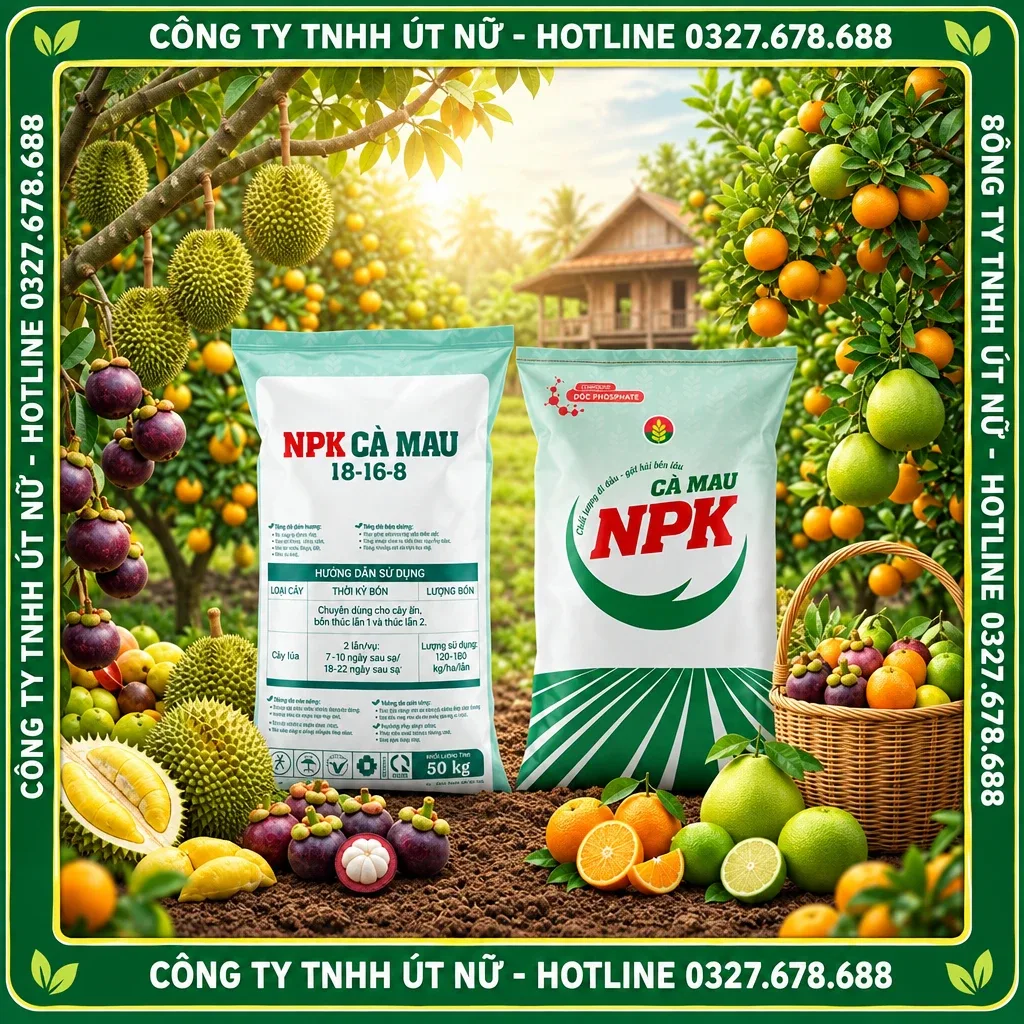
NPK Cà Mau 18-16-8 Specifications and Significance
On the website of Ca Mau Petroleum Fertilizer Joint Stock Company (PVCFC), the NPK Ca Mau 18-16-8 product is manufactured according to the corporate standard TCCS 46:2026/PVCFC. The quality certificate PVCFC published for a production batch in August 2026 records the registered levels (PVCFC, 2026a):
- Nitrogen (N) 18%: meets the nitrogen demand of rice in the early stage.
- Available Phosphorus (P₂O₅) 16%: a relatively high level, suitable for early-season root development.
- Available Potassium (K₂O) 8%: a low level, only supplementing a portion of potassium.
- Calcium (Ca) 2.2% and Magnesium (Mg) 1.2%: secondary nutrients, beneficial for acidic and alum soils.
- Zinc (Zn) 500 ppm and Boron (B) 400 ppm: micronutrients; zinc is related to tillering capacity.
- Moisture 2%: fertilizer granule quality indicator.
The product page primarily provides instructions for fruit trees (300–600 g/plant/application, 4–5 times/year) (PVCFC, 2026a). For rice, PVCFC's technical documentation for specialized fertilizers for the seedling – tillering stage recommends 100–140 kg/ha per application, applied at 7–10 and 18–22 days after sowing (PVCFC, 2023a; PVCFC, 2023b); the NPK Cà Mau Gold 16-16-8+TE product in the same group instructs for rice 80–120 kg/ha per application, 2–3 times per crop (PVCFC, n.d.). This is a reference framework; you should still read the instructions printed on the bag.
Allocate for Basal and First Top-dressing
Each 100 kg of 18-16-8 provides 18 kg N, 16 kg P₂O₅, and 8 kg K₂O. If about 25–30% of the total nitrogen for the entire crop cycle is allocated to the initial stage, then on alluvial soil, this nitrogen amount is only about 21–28 kg N/ha.
Method 1 – with basal application: apply 50–70 kg/ha (5–7 kg per 1,000 m² công) as basal fertilizer during the final harrowing, mixing the fertilizer into the mud before sowing; apply the first topdressing of approximately 70–85 kg/ha at 7–10 days after sowing. A total of 120–155 kg/ha provides about 22–28 kg N, 19–25 kg P₂O₅, and 10–12 kg K₂O.
Method 2 – no basal fertilization: many direct-sown fields in the Mekong Delta are accustomed to omitting basal fertilization. In that case, apply 100–140 kg/ha once at 7–10 days after sowing, which falls within the framework of PVCFC (PVCFC, 2023a), providing 18–25 kg N and 16–22 kg P₂O₅.
On alum soil, saline-affected soil, the total nitrogen for the entire crop is lower, so the amount for the early season is also reduced, about 100–130 kg/ha for both applications. Phosphorus at this time has not reached the 30–45 kg P₂O₅/ha threshold; the remainder can be supplemented during basal application with single superphosphate or DAP Phu My 18-46-0 according to technical guidelines, but do not overdo it.
The numbers above are illustrative calculations; actual amounts depend on variety, seeding density, soil type, local recommendations, and must be accumulated with subsequent applications.
Which fields benefit most from 18-16-8
1. Early-sown fields need phosphorus for roots, especially fields recently drained after floods, where the soil is still acidic. A phosphorus content of 16% helps deliver most of the phosphorus at the beginning of the season, following IRRI principles (IRRI, 2007a). 2. Seeking one type of fertilizer for both basal application and first top-dressing, to avoid mixing multiple types. 3. Acidic, alum-affected soils poor in micronutrients, fields that have only used single fertilizers for many years. 4. Fields where soil improvement is complete: lime applied sufficiently, alum and salinity washed out, straw and stubble processed.
Which fields need soil amendment first or a switch to a different formula
- Fields recently limed: PVCFC recommends applying lime 10–30 days before sowing and applying fertilizer at least 7–10 days after liming, without mixing them (PVCFC, 2026b). Fields recently limed require delaying the basal fertilizer application.
- Fields affected by salinity at the beginning of the season: prioritize flushing out salt and maintaining fresh water; applying fertilizer to saline fields when roots are still weak can lead to waste.
- Fields with iron toxicity, organic toxicity (black roots, brown leaf spots, rice not tillering): applying more fertilizer has little effect. IRRI advises draining water for about 7–10 days at 25–30 days after sowing to provide oxygen to the roots; for fields that have been submerged for a long time, wait 10–20 days after submergence before sowing, or dry the soil if possible. Severely acidic soils with aluminum toxicity require lime application based on soil test results for lime requirements (Dobermann and Fairhurst, 2000).
- Excessive application of phosphorus or lime: can easily lead to zinc deficiency in rice (Dobermann and Fairhurst, 2000). Do not add too much DAP in addition to 18-16-8.
- Sandy soils, fields where straw is not incorporated: easily deficient in potassium; 8% potassium is not enough, potassium needs to be supplemented in two applications (IRRI, 2007a).
- Second topdressing (around 18–25 days after sowing): rice tillers vigorously and requires more nitrogen; switch to a high-nitrogen formula such as NPK Cà Mau 20-15-7+1Mg+TE or NPK Phú Mỹ 20-7-7+TE, applying based on leaf color.
- Panicle initiation stage: rice requires high potassium, so use a formula like NPK Cà Mau 18-6-18.
Notes on application
- Apply the first topdressing when the field has a thin layer of water and the rice has rooted; do not apply when it's raining, at midday during intense heat, or early in the morning when leaves are still wet with dew; apply in the cool afternoon (PSE, n.d.).
- Do not topdress when heavy rain is forecast; divide applications into smaller amounts, only apply more than 45 kg N/ha in a single application when conditions are very favorable (IRRI, 2007b).
- Do not mix fertilizer with lime; maintain a 7–10 day interval between two applications (PVCFC, 2026b).
- Read the bag: check the product name, ingredients, fertilizer code, and manufacturing date.
What should dealers advise?
Before introducing early-season fertilizer, dealers should reconfirm:
1. When do you plan to sow, and what is the maturity period of the variety? To determine if there's still time for basal fertilization or if early top-dressing is needed. 2. Is the soil alluvial, acidic (phèn), or saline? Acidic and saline soils require reduced nitrogen, attention to phosphorus, and prior desalinization. 3. Has lime been applied, and when? How was the straw from the Autumn-Winter crop managed? To calculate the interval with lime application and prevent organic toxicity. 4. What is the plan for the second top-dressing and panicle initiation? To provide full-season consultation, not using one formula for all applications.
For fields with improved soil, requiring phosphorus at the beginning of the season, and wanting a fertilizer for both basal application and the first top-dressing, dealers can recommend NPK Cà Mau 18-16-8 and advise on calculating the amount based on nutrients, applied in split doses. Út Nữ Co., Ltd distributes wholesale in Vĩnh Long – Trà Vinh – Mekong Delta; if you need to replenish stock, please call / Zalo 0294 3882069 – 02943 883791 – 02943 882837.
Conclusion
The first two applications in the Winter-Spring crop should follow the principle of phosphorus first, moderate nitrogen, potassium in split applications. NPK Cà Mau 18-16-8 has balanced nitrogen and phosphorus, along with calcium, magnesium, zinc, and boron, making it suitable for basal application and the first topdressing on fields with improved soil. Fields that have just been limed must wait for enough days, saline fields must be leached, and poisoned fields must have their water treated first. From the second topdressing onwards, switch to a high-nitrogen formula, then high potassium when panicle initiation occurs. Applying the right type, at the right time, and in the right amount helps rice roots establish quickly, tiller strongly, and saves fertilizer in a season predicted to have water shortages.
References
Department of Meteorology and Hydrology (2026) *Water sources to the Mekong Delta in the 2026–2027 dry season may be low, with saltwater intrusion appearing from late December*. 17 September. Available at: https://vnmha.mae.gov.vn/nguon-nuoc-ve-dbscl-mua-kho-20262027-co-the-o-muc-thap-xam-nhap-man-xuat-hien-tu-cuoi-thang-12-18747.htm (Accessed: 3 October 2026).
Dobermann, A. and Fairhurst, T. (2000) *Rice: Nutrient disorders & nutrient management*. Singapore and Los Baños: PPI, PPIC and IRRI. Summarized at IRRI Rice Knowledge Bank, sections Zinc deficiency, Iron toxicity and Aluminum toxicity. Available at: http://www.knowledgebank.irri.org/training/fact-sheets/nutrient-management/deficiencies-and-toxicities-fact-sheet (Accessed: 3 October 2026).
IRRI – International Rice Research Institute (2007a) *Nutrients for irrigated rice: SSNM* (Rice Production e-learning, Nutrient management IV.4). Available at: http://knowledgebank.irri.org/ericeproduction/IV.4_SSNM.htm (Accessed: 3 October 2026).
IRRI – International Rice Research Institute (2007b) *Nitrogen application* (Rice Production e-learning, Nutrient management). Available at: http://www.knowledgebank.irri.org/ericeproduction/pop_up_Nitrogen_application.htm (Accessed: 3 October 2026).
Ngô Ngọc Hưng, Lý Ngọc Thanh Xuân, Trần Ngọc Hữu, Lâm Văn Thông, Nguyễn Bảo Vệ, Lê Phước Toàn, Lê Văn Dang, Nguyễn Kim Quyên, Trần Văn Dũng and Trịnh Quang Khương (2020) 'Using NPK for rice on major soil types in the Mekong Delta', *Can Tho University Journal of Science*, 56 (Special Issue on Soil Science), pp. 177–184. doi: 10.22144/ctu.jsi.2020.083.
Nhân Dân (2026) 'Proactively coping with drought and saltwater intrusion', *Báo Nhân Dân điện tử*, 27 tháng 6. Available at: https://nhandan.vn/chu-dong-ung-pho-voi-han-han-xam-nhap-man-post971920.html (Accessed: 3 October 2026).
PSE – Southeast Petrochemical and Fertilizer Joint Stock Company (n.d.) *Instructions for using Phu My Urea and Phu My NPK*. Available at: https://www.pse.vn (Business Activities – Phu My Urea section) (Accessed: 3 October 2026).
PVCFC – Cà Mau Petroleum Fertilizer Joint Stock Company (2023a) *Starting the Winter-Spring crop, choose Cà Mau Fertilizer*. Bí Kíp Vàng, 21 December. Available at: https://bikipvang.pvcfc.com.vn/2023/12/21/khoi-dong-vu-dong-xuan-chon-phan-bon-ca-mau/ (Accessed: 3 October 2026).
PVCFC – Cà Mau Petroleum Fertilizer JSC (2023b) *Sowing Winter-Spring rice, using specialized fertilizer*. Bí Kíp Vàng, 21 December. Available at: https://bikipvang.pvcfc.com.vn/2023/12/21/sa-lua-dong-xuan-bon-phan-chuyen-dung/ (Accessed: 3 October 2026).
PVCFC – Cà Mau Petroleum Fertilizer Joint Stock Company (2026a) *NPK Cà Mau 18-16-8 – product information, usage instructions, and quality certificate no. 0588/2026*. Available at: https://www.pvcfc.com.vn (Product section – NPK Cà Mau) (Accessed: 3 October 2026).
PVCFC – Cà Mau Petroleum Fertilizer JSC (2026b) *What is liming? Role and proper liming techniques*. 25 February. Available at: https://www.pvcfc.com.vn/bon-voi (Accessed: 3 October 2026).
PVCFC – Cà Mau Petroleum Fertilizer JSC (n.d.) *NPK Cà Mau Gold 16-16-8+TE*. Available at: https://www.pvcfc.com.vn/npk-gold-16-16-8-te (Accessed: 3 October 2026).
TTXVN (2026) 'Can Tho: Proactively protecting Autumn-Winter rice from high tides', *Báo Tin Tức – TTXVN*, 17 September. Available at: https://baomoi.com/c/56073252.epi (Accessed: 3 October 2026).
About Content and Responsibility
Content developed by Grokbot AI. Út Nữ Co., Ltd and Grokbot AI disclaim responsibility for any damages arising from the use of information in this article. All content is for exploratory and academic purposes only, does not replace professional technical advice, official recommendations from manufacturers or state agencies, and does not constitute a commercial promise of yield or economic efficiency.