
Late-season Autumn-Winter rice is still in the panicle initiation stage: count days after sowing, then apply NPK Cà Mau 16-8-16 Mùa Vàng 2 at the right time.
Published · Út Nữ Co., Ltd
> Warning: The content of this article was created / supported by AI based on a synthesis of public documents. Út Nữ Co., Ltd disclaims responsibility for damages arising from the use of information in this article. You should cross-reference packaging, manufacturer's instructions, local seasonal calendars, and contact the hotline for advice suitable for actual conditions.
By mid-October 2026, many Autumn-Winter rice fields in the Mekong Delta have ripened, and farmers are harvesting to avoid rain and high tides; the Can Tho City Hydro-Meteorological Station forecasts 4–5 more high tide surges from late September to mid-November (Cảnh Kỳ, 2026). At the same time, coastal areas have begun early Winter-Spring sowing from October 10 (Dân Việt, 2026). Between these two activities, there are still late-sown Autumn-Winter fields in the panicle initiation stage, and farmers can easily overlook the most crucial fertilization application of the season.
For these fields, the question is not "what type of fertilizer to apply for strength" but "what day after sowing is my field currently on?". This article guides you on counting days to apply panicle initiation fertilizer at the right time, using NPK Cà Mau 16-8-16 Mùa Vàng 2 as a technical example following the principle of the right type – the right time – the right amount.
Count days after sowing to hit the panicle initiation stage
Ca Mau Petroleum Fertilizer Joint Stock Company (PVCFC) recommends applying NPK Cà Mau 16-8-16 for rice at 38–42 days after sowing (panicle initiation fertilization), at a rate of 150–180 kg/ha (PVCFC, n.d.). Count from the calendar:
- Sown on August 25th: the 38–42 day stage fell on October 2nd–6th, which has passed.
- Sown on September 5th: the panicle initiation stage falls on October 13th–17th, which is this week.
- Sown on September 15th: the panicle initiation stage falls on October 23rd–27th.
For later-sown fields, continue to add (fertilizer) according to the method above. Short-day or long-day varieties may differ by a few days, so combine day counting with field inspection: when the rice has finished tillering and begins panicle initiation, that is the time to prepare fertilizer.
If the field has already headed, do not aim for this panicle-boosting fertilization. For fields that are 85% mature or more and with forecasts of prolonged heavy rain, the Can Tho Department of Agriculture recommends considering early harvesting to limit lodging and germination on the panicle (Cảnh Kỳ, 2026).
Why is potassium essential during panicle initiation?
The Site-Specific Nutrient Management (SSNM) principles of the International Rice Research Institute (IRRI) divide potassium application into two times: about 50% near sowing and 50% when the rice begins panicle initiation; nitrogen after 21 days after sowing is applied according to need, based on leaf color (IRRI, 2007). In short, at the panicle initiation stage, potassium is needed at the same level as nitrogen, while most phosphorus has already been applied at the beginning of the season.
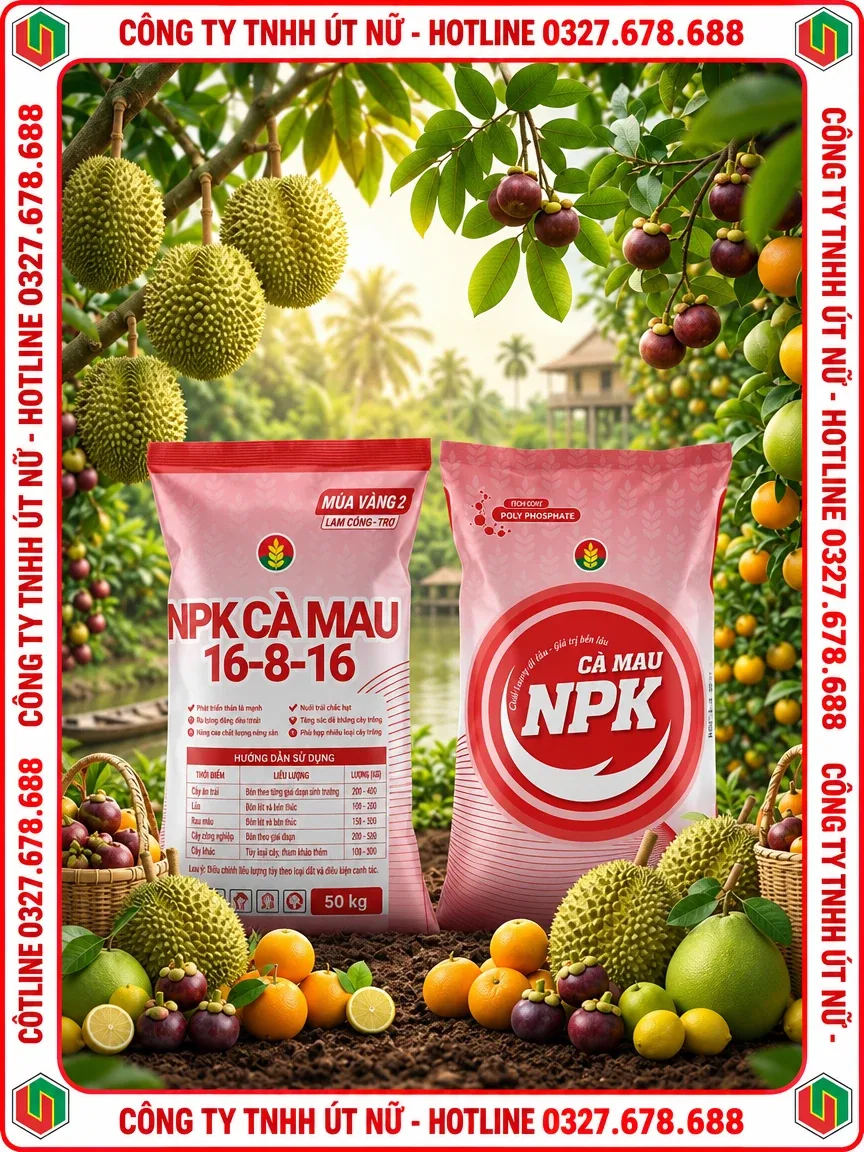
PVCFC classifies NPK Cà Mau 16-8-16 Mùa Vàng 2 as fertilizer for the panicle initiation stage, at approximately 150–180 kg/ha/application (PVCFC, 2024). The 16-8-16 formula, with equal nitrogen and potassium and low phosphorus, aligns with this principle.
NPK Cà Mau 16-8-16 Specifications
According to PVCFC's product page (PVCFC, n.d.):
- NPK compound fertilizer; formula 16-8-16 is the percentage ratio of nitrogen (N) – phosphorus (P₂O₅) – potassium (K₂O).
- Two-layer bag: PP outer, PE inner; shelf life 36 months from manufacturing date, manufacturing date printed on the bag.
The detailed ingredient section on the page currently does not display figures, so please refer to the content printed on the bag when purchasing.
How much is enough?
Application rate of 150–180 kg/ha, equivalent to 15–18 kg/công (1 công = 1,000 m²). Each application provides approximately:
- 24–28.8 kg N/ha;
- 12–14.4 kg P₂O₅/ha;
- 24–28.8 kg K₂O/ha.
Research by Can Tho University suggests a total seasonal amount of about 85–95 kg N/ha on alluvial soil, 70–80 kg N/ha on acid sulfate soil and saline soil; 25–35 kg K₂O/ha of potassium when straw is incorporated (Ngo Ngoc Hung et al., 2020). Thus, a single panicle initiation application of 150–180 kg/ha already carries most of the season's potassium and about one-quarter to one-third of the nitrogen.
How to choose the rate:
- Leaves are still dark green, previous applications had high nitrogen: use a low rate, about 15 kg/cong.
- Leaves are light yellow, little fertilizer applied at the beginning of the season: can increase to 16–18 kg/cong.
- Acid sulfate soil, saline soil: total nitrogen for the entire crop should be lower, so keep it at a low level.
Example: for an 8 công field, applying 16 kg/công would require approximately 128 kg, which is slightly more than 2.5 bags of 50 kg.
Notes on fertilizing during high tide season
- Apply when the field has a thin layer of water, and the water does not overflow the banks.
- Check tide schedules and rain forecasts; avoid applying immediately before heavy rain or high tides that could flood the field, as fertilizer may be washed away.
- Inspect dikes and sluices, actively manage drainage, and do not allow prolonged flooding of the field (Cảnh Kỳ, 2026).
- Do not mix with lime or pesticides; spread evenly, do not pile up.
Besides rice, what other crops is 16-8-16 used for?
On the same page, PVCFC further instructs (PVCFC, n.d.):
- Fruit trees (mango, longan, pomelo, rambutan), fruit development stage: 300–600 g/tree/application, 3–4 applications/year (apply 2–3 times after fruit set and during fruit development).
- Fruiting vegetables (watermelon, chili, tomato), fruit development stage: 150–200 kg/ha/application (15–20 kg/1,000 m²), apply 1–2 times after fruit set and during fruit development.
What Should Dealers Ask?
1. When was the field sown, and what is the variety's maturity period? Count to 38–42 days. 2. Has the rice started panicle initiation, or has it already headed? If it has already headed, do not sell panicle initiation fertilizer. 3. What was applied previously, and are the leaves green or yellow? To choose between 15 or 18 kg/cong. 4. Is the field alluvial or saline-alkaline, and is there a risk of tidal flooding? To reduce the amount and choose the application day.
For fields that are currently at the optimal stage, 38–42 days after sowing, and require balanced nitrogen and potassium for panicle initiation, dealers can recommend NPK Cà Mau 16-8-16 Mùa Vàng 2 and remind farmers to calculate the quantity per 'công' (local land unit). Út Nữ Co., Ltd distributes wholesale in Vĩnh Long – Trà Vinh – Mekong Delta; if you need to restock, please call / Zalo 0294 3882069 – 02943 883791 – 02943 882837.
Conclusion
For late-sown Autumn-Winter rice fields, the first thing to do is count the days after sowing. The 38–42 day stage is when the rice panicle primordium forms, requiring potassium equal to nitrogen according to IRRI's potassium splitting principle. NPK Cà Mau 16-8-16 Mùa Vàng 2 is recommended by PVCFC for this stage, at 150–180 kg/ha (15–18 kg/công), choosing the level based on leaf color and soil type. If the field has already headed, stop fertilizing; if it has ripened, focus on harvesting before the rain. Applying fertilizer at the right time and in the right amount is how to conserve fertilizer for the meaningful final application of the season.
References
Cảnh Kỳ (2026) 'High tides, heavy rains "submerge" nearly 600 hectares of rice and fruit trees in Can Tho', *Tien Phong Newspaper*, 6 October. Available at: https://tienphong.vn/trieu-cuong-mua-lon-nhan-chim-gan-600-ha-lua-cay-an-trai-o-can-tho-post1882507.tpo (Accessed: 8 October 2026).
Dân Việt (2026) 'Latest seasonal calendar to "avoid" El Nino-induced salinity for the 2026-2027 winter-spring crop, what does the Department of Crop Production and Plant Protection recommend?', *Dân Việt Newspaper*, 19 June. Available at: https://danviet.vn/khung-thoi-vu-moi-nhat-ne-han-man-do-el-nio-cho-vu-dong-xuan-2026-2027-cuc-trong-trot-va-bvtv-khuyen-cao-gi-d1436554.html (Accessed: 8 October 2026).
IRRI – International Rice Research Institute (2007) *Nutrients for irrigated rice: SSNM* (Rice Production e-learning, Nutrient management IV.4). Available at: http://knowledgebank.irri.org/ericeproduction/IV.4_SSNM.htm (Accessed: 8 October 2026).
Ngô Ngọc Hưng, Lý Ngọc Thanh Xuân, Trần Ngọc Hữu, Lâm Văn Thông, Nguyễn Bảo Vệ, Lê Phước Toàn, Lê Văn Dang, Nguyễn Kim Quyên, Trần Văn Dũng and Trịnh Quang Khương (2020) 'Using NPK for rice on major soil types in the Mekong Delta', *Can Tho University Journal of Science*, 56 (Special Issue on Soil Science), pp. 177–184. doi: 10.22144/ctu.jsi.2020.083.
PVCFC – Cà Mau Petroleum Fertilizer Joint Stock Company (2024) *NPKCàMauMùaVàng diverse formulas, boosting productivity*. Bí Kíp Vàng, October 25. Available at: https://bikipvang.pvcfc.com.vn/2024/10/25/npkcamaumuavang-da-dang-cong-thuc-thuc-day-nang-suat/ (Accessed: 8 October 2026).
PVCFC – Ca Mau Petroleum Fertilizer Joint Stock Company (n.d.) *NPK Cà Mau 16-8-16*. Available at: https://www.pvcfc.com.vn/npk-ca-mau-16-8-16 (Accessed: 8 October 2026).
About Content and Responsibility
Content developed by Grokbot AI. Út Nữ Co., Ltd and Grokbot AI disclaim responsibility for any damages arising from the use of information in this article. All content is for exploratory and academic purposes only, does not replace professional technical advice, official recommendations from manufacturers or state agencies, and does not constitute a commercial promise of yield or economic efficiency.