
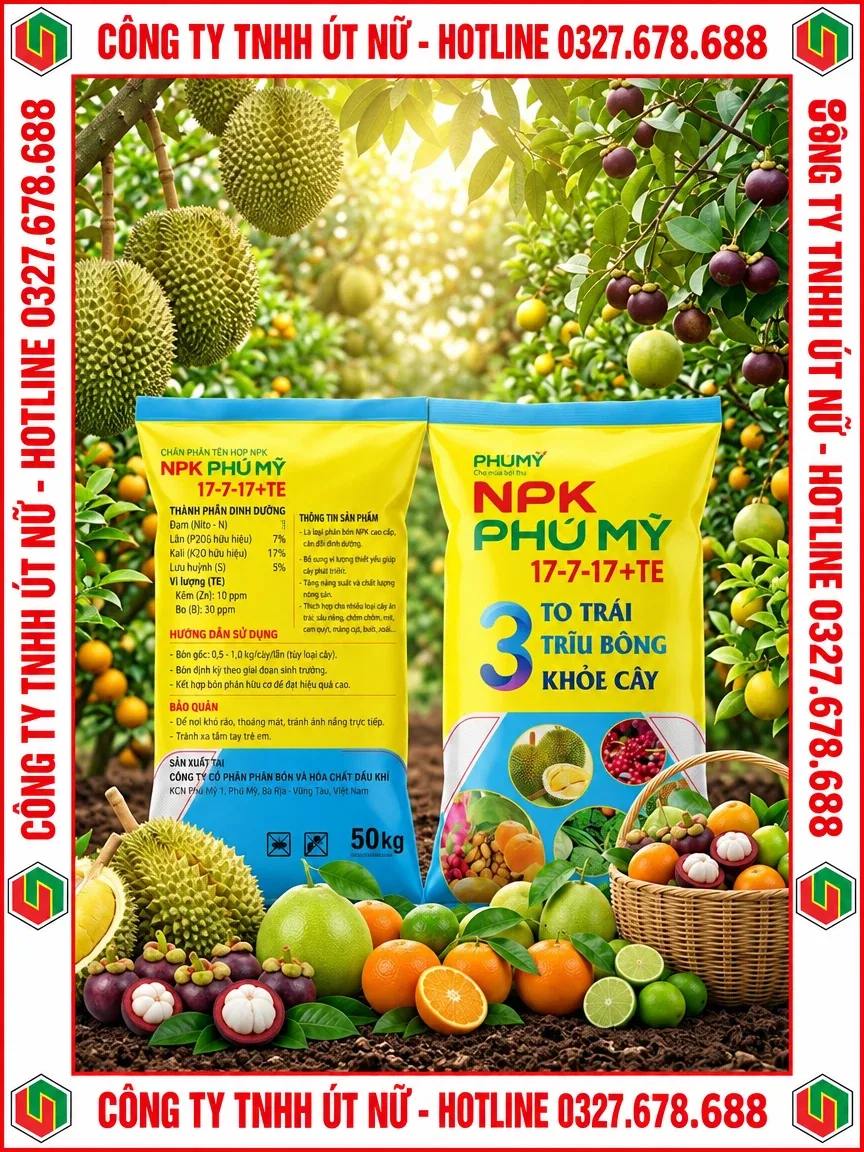
What does the 17-7-17+TE formula on the Phú Mỹ NPK bag mean? Read the label and convert kg/ha dosage to kg/công for fields and gardens in the Mekong Delta
Published · Út Nữ Co., Ltd
> Warning: The content of this article was created / supported by AI based on a synthesis of public documents. Út Nữ Co., Ltd disclaims responsibility for damages arising from the use of information in this article. You should cross-reference packaging, manufacturer's instructions, local seasonal calendars, and contact the hotline for advice suitable for actual conditions.
In mid-October 2026, dealerships in the Mekong Delta simultaneously welcomed various types of customers: late-season Autumn-Winter rice fields entering the panicle initiation stage, early-sown Winter-Spring rice fields in coastal areas (Dân Việt, 2026), fruit orchards that had just experienced heavy rain and high tides (Cảnh Kỳ, 2026), and year-end vegetable crops. Each person held a bag of fertilizer, looked at the numbers on the bag, and asked: "How much should I apply?"
To apply the correct amount, you must first read the label correctly. This article uses a bag of NPK Phú Mỹ 17-7-17+TE as an example to read each line on the label and convert the dosage from kg/ha to kg/công, following the principle of the right type – at the right time – in the right amount.
What does the 17-7-17 formula mean?
According to the website of PetroVietnam Fertilizer and Chemicals Corporation (PVFCCo, n.d.), the composition of NPK Phú Mỹ 17-7-17+TE is:
- Total Nitrogen (Nts): 17%. "ts" stands for total.
- Available Phosphorus (P₂O₅hh): 7%. "hh" stands for available, the portion plants can use; phosphorus is calculated as P₂O₅.
- Available Potassium (K₂Ohh): 17%. Potassium is calculated as K₂O.
The order is always nitrogen – phosphorus – potassium. Quickly read the 17-7-17 formula: nitrogen and potassium are equal, phosphorus is low.
What is "+TE"?
TE refers to micronutrients. For this product, the manufacturer states zinc (Zn) 50 ppm, boron (B) 50 ppm (PVFCCo, n.d.).
ppm stands for parts per million: 50 ppm means 50 g in 1 ton of fertilizer. A 50 kg bag contains approximately 2.5 g of zinc and 2.5 g of boron. These are small amounts, true to the name micronutrients: plants need little, but their presence in the fertilizer helps ensure consistent supplementation with each application.
Remaining lines on the label
Also according to the PVFCCo website (PVFCCo, n.d.):
- Fertilizer type: NPK compound fertilizer.
- Fertilizer code: 00126. This code helps verify the correct product.
- Moisture content: 5%.
- Application method: Root application.
- Shelf life: 36 months from the manufacturing date.
- Suitable for: Food crops, industrial crops, fruit trees, vegetable crops.
Upon receiving the goods, you should check the product name, formula, code, production date, and manufacturer's name printed on the bag; if the bag is torn or the fertilizer is caked due to moisture, you should report it to the seller.
How many nutrients does a 50 kg bag contain?
Calculation method: fertilizer weight × percentage ÷ 100.
- Nitrogen: 50 × 17 ÷ 100 = 8,5 kg N.
- Phosphorus: 50 × 7 ÷ 100 = 3,5 kg P₂O₅.
- Potassium: 50 × 17 ÷ 100 = 8,5 kg K₂O.
Calculating in reverse also works: if you want to apply 10 kg N/ha to the field using 17-7-17 fertilizer, you will need approximately 10 ÷ 0.17 ≈ 59 kg fertilizer/ha, or about 6 kg/công. This calculation method helps compare different types of fertilizers based on the actual nutrient content, instead of just comparing the number of bags.
Convert kg/ha dosage to kg/công
In this article, 1 công = 1,000 m², 1 ha = 10 công. If "công" is calculated using a different area, convert it back to the actual area. Quick rule: divide kg/ha by 10 to get kg/công.
PVFCCo guidelines for NPK Phú Mỹ 17-7-17+TE (PVFCCo, n.d.):
- Food crops: basal application 100–400 kg/ha = 10–40 kg/cong; top dressing 100–500 kg/ha/crop = 10–50 kg/cong per crop.
- Fruit trees: basal application 100–1,000 kg/ha = 10–100 kg/cong; top dressing 100–1,200 kg/ha/crop = 10–120 kg/cong per crop.
- Vegetable crops: basal application 50–400 kg/ha = 5–40 kg/cong; top dressing 50–500 kg/ha/crop = 5–50 kg/cong per crop.
Pay attention to the phrase "/crop": this is the total for the entire crop cycle, which must then be divided by the number of applications. For example, for vegetables, choose a top-dressing application of 300 kg/ha/crop, divided into 3 times:
1. 300 ÷ 10 = 30 kg/công for the entire crop. 2. 30 ÷ 3 = 10 kg/công per application. 3. For a 2.5 công field, each application requires 10 × 2.5 = 25 kg, which is half of a 50 kg bag.
Another example for dealers: if a customer has 25 công, and applies 10 kg/công each time, they will need 250 kg, which is 5 bags.
Wide application rate range, which level to choose?
The framework on the manufacturer's website is general for many types of crops and many soil regions, so it is very broad. When selecting the level:
- By crop and growth stage: For the same type of fertilizer, perennial fruit trees require significantly different amounts compared to rice or short-term vegetables.
- By soil type: For rice, research by Can Tho University suggests a total nitrogen application of about 85–95 kg N/ha per crop on alluvial soil, but only 70–80 kg N/ha on acid sulfate soil and saline soil (Ngo Ngoc Hung et al., 2020). For acid sulfate and saline soils, a lower rate should be chosen.
- Cumulative fertilizer types: If other fertilizers are also used in the same crop cycle, calculate the total nitrogen, phosphorus, and potassium from all applications, not just from one bag.
- Refer to the instructions printed on the bag and local seasonal calendar before fertilizing.
How should dealers guide farmers?
1. Show farmers/dealers the three numbers for nitrogen – phosphorus – potassium and the +TE line on the bag. 2. Ask for the area in "công", then convert the kg/ha dose to kg/công for the customer. 3. Ask for the intended number of applications to divide the "per crop" dose into a dose for each application. 4. Write down the kg per application and the number of bags needed, to avoid fertilizing by feel.
For customers needing an NPK fertilizer with equal nitrogen and potassium, low phosphorus, plus zinc and boron, dealers can recommend NPK Phú Mỹ 17-7-17+TE and help customers convert the dosage to kg/công right at the store. Út Nữ Co., Ltd distributes wholesale in Vĩnh Long – Trà Vinh – Mekong Delta; if you need to replenish stock, please call / Zalo 0294 3882069 – 02943 883791 – 02943 882837.
Conclusion
The 17-7-17+TE sequence on Phú Mỹ NPK bags means 17% total nitrogen, 7% available phosphorus, 17% available potassium, along with 50 ppm each of zinc and boron. A 50 kg bag contains approximately 8.5 kg N, 3.5 kg P₂O₅, and 8.5 kg K₂O. To adjust dosage, just remember two steps: divide by 10 to get kg/công, then divide again by the number of applications if the dosage is listed as "/crop". Reading the label correctly is the first step to applying the right type, at the right time, in the right amount for every field and garden.
References
Cảnh Kỳ (2026) 'High tides, heavy rains "submerge" nearly 600 hectares of rice and fruit trees in Can Tho', *Tien Phong Newspaper*, 6 October. Available at: https://tienphong.vn/trieu-cuong-mua-lon-nhan-chim-gan-600-ha-lua-cay-an-trai-o-can-tho-post1882507.tpo (Accessed: 8 October 2026).
Dân Việt (2026) 'Latest seasonal calendar to "avoid" El Nino-induced salinity for the 2026-2027 winter-spring crop, what does the Department of Crop Production and Plant Protection recommend?', *Dân Việt Newspaper*, 19 June. Available at: https://danviet.vn/khung-thoi-vu-moi-nhat-ne-han-man-do-el-nio-cho-vu-dong-xuan-2026-2027-cuc-trong-trot-va-bvtv-khuyen-cao-gi-d1436554.html (Accessed: 8 October 2026).
Ngô Ngọc Hưng, Lý Ngọc Thanh Xuân, Trần Ngọc Hữu, Lâm Văn Thông, Nguyễn Bảo Vệ, Lê Phước Toàn, Lê Văn Dang, Nguyễn Kim Quyên, Trần Văn Dũng and Trịnh Quang Khương (2020) 'Using NPK for rice on major soil types in the Mekong Delta', *Can Tho University Journal of Science*, 56 (Special Issue on Soil Science), pp. 177–184. doi: 10.22144/ctu.jsi.2020.083.
PVFCCo – PetroVietnam Fertilizer and Chemicals Corporation (n.d.) *NPK Phú Mỹ 17-7-17+TE* (code 00126). Available at: https://dpm.vn/san-pham/npk-phu-my-17-7-17te-99 (Accessed: 8 October 2026).
About Content and Responsibility
Content developed by Grokbot AI. Út Nữ Co., Ltd and Grokbot AI disclaim responsibility for any damages arising from the use of information in this article. All content is for exploratory and academic purposes only, does not replace professional technical advice, official recommendations from manufacturers or state agencies, and does not constitute a commercial promise of yield or economic efficiency.