
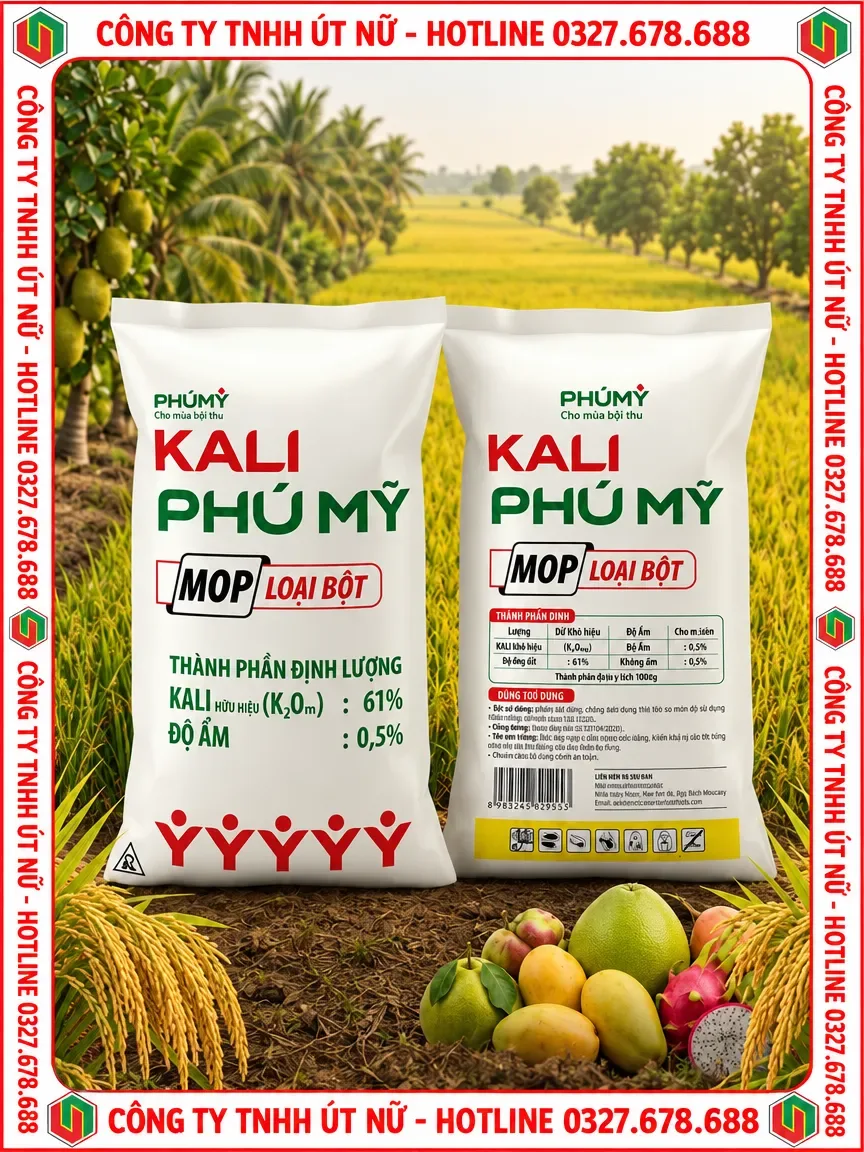
What does “61% K2O” on a bag of Kali Phú Mỹ mean? How much potassium is in a 50 kg bag and how to adjust the dosage for rice and fruit trees
Published · Út Nữ Co., Ltd
> Warning: The content of this article was created / supported by AI based on a synthesis of public documents. Út Nữ Co., Ltd disclaims responsibility for damages arising from the use of information in this article. You should cross-reference packaging, manufacturer's instructions, local seasonal calendars, and contact the hotline for advice suitable for actual conditions.
In late October, late Autumn-Winter rice is in the grain-filling stage, and fruit orchards are developing fruits for Tết sales. These are two times when farmers often ask about potassium. But looking at a bag of Kali Phú Mỹ, what exactly does the number “61%” mean, and how much potassium does one bag provide when applied to the field?
Today's "reading fertilizer bags" lesson follows the principles of the right type – the right time – the right amount: understand the label first, then calculate the quantity.
What does the Phú Mỹ Potash label say?
According to PetroVietnam Fertilizer and Chemicals Corporation (PVFCCo, n.d.):
- Potassium fertilizer, code 00059.
- Effective potassium (K₂Ohh) 61%; moisture 0.5%.
- Application method: root application; available in 2 types: powder and granular.
- Packed in 50 kg or 25 kg bags; shelf life 36 months from manufacturing date.
What does “61% K₂O” mean?
- K₂O is the conventional way to express potassium content on fertilizer labels. The potassium numbers in NPK formulas (for example, the 15 at the end of the 20-20-15 formula) are also calculated as K₂O.
- 61% means that for every 100 kg of fertilizer, there are 61 kg of effective K₂O.
- A 50 kg bag: 50 × 61% = approximately 30.5 kg of K₂O. A 25 kg bag: approximately 15.25 kg.
To illustrate with a comparison: to obtain 30.5 kg of K₂O from an NPK fertilizer with 15% potassium, approximately 200 kg of fertilizer is needed. Therefore, when NPK fertilizer containing potassium has already been applied, any supplementary single potassium fertilizer should be calculated by subtracting this amount to avoid over-application.
Powder or Flake?
The manufacturer offers two forms: powder and flake (PVFCCo, n.d.). The stated content on the page is the same; the main difference lies in the particle form. Please choose according to your usual application method and mixing practice, and carefully read the information printed on the bag you purchase.
Convert Dosage Framework to kg/Công
PVFCCo guidance (PVFCCo, n.d.):
- Food crops: basal application 30–200 kg/ha, top-dressing 30–300 kg/ha/crop → 3–20 and 3–30 kg/1,000 m².
- Fruit trees: basal application 50–800 kg/ha, top-dressing 50–1,000 kg/ha/crop → 5–80 and 5–100 kg/1,000 m².
- Vegetables and short-term crops: basal application 30–200 kg/ha, top-dressing 30–500 kg/ha/crop.
Illustrative example: for a 4-công field, if you plan to supplement 5 kg of potassium/công, you will need 20 kg, less than half a bag, equivalent to about 12 kg K₂O. For a 3-công orchard, if you apply 10 kg/công each time, you will need 30 kg. These figures are for calculation purposes only, within the manufacturer's guidelines; actual amounts depend on soil, crop, and other fertilizers already applied.
Important Notes When Using Potassium
1. Accumulate potassium from all sources: NPK, specialized fertilizers, and potassium chloride all contribute K₂O. 2. Spread evenly, apply when soil is sufficiently moist: For orchards, spread along the canopy projection, then irrigate. 3. Coastal areas should be mindful of salinity: The Department of Crop Production and Plant Protection recommends measuring salinity before drawing water for irrigation (Dân Việt, 2026). 4. The rainy season may end early (Thúy Lam, 2026): mulch around the base, maintain moisture for orchards bearing fruit.
Advice from Our Dealers
1. Which NPK type and how much has been applied, to calculate the remaining potassium needed. 2. The area of the field or garden in 'công' to convert to kilograms. 3. Powder or granular, depending on the farmer's spreading or mixing method.
Product reference page: Kali Phú Mỹ. Út Nữ Co., Ltd distributes wholesale in Vĩnh Long – Trà Vinh – Mekong Delta; if you need to restock, please call / Zalo 0294 3882069 – 02943 883791 – 02943 882837.
Conclusion
“61% K₂O” on a bag of Kali Phú Mỹ means that a 50 kg bag contains approximately 30.5 kg of potassium, calculated as K₂O. Understanding this figure helps you add the correct amount of potassium from all fertilizer types and convert manufacturer's dosage recommendations into kg/công. Reading the label first, then calculating the amount, is the first step to applying the right type, at the right time, and in the right quantity.
References
Dân Việt (2026) 'Latest seasonal calendar to "avoid" El Nino-induced salinity for the 2026-2027 winter-spring crop, what does the Department of Crop Production and Plant Protection recommend?', *Dân Việt Newspaper*, 19 June. Available at: https://danviet.vn/khung-thoi-vu-moi-nhat-ne-han-man-do-el-nio-cho-vu-dong-xuan-2026-2027-cuc-trong-trot-va-bvtv-khuyen-cao-gi-d1436554.html (Accessed: 8 October 2026).
PVFCCo – PetroVietnam Fertilizer and Chemicals Corporation (n.d.) *Kali Phú Mỹ* (code 00059). Available at: dpm.vn, Products section, Kali Phú Mỹ page (Accessed: 10 October 2026).
Thúy Lam (2026) 'Guidance on seasonal calendar and rice variety structure for the 2026–2027 Winter-Spring crop', *Cà Mau Provincial Agricultural Extension Center*, 6 October. Available at: http://khuyennongcamau.vn/thong-tin-va-truyen-thong/huong-dan-lich-thoi-vu-va-co-cau-giong-lua-vu-dong-xuan-2026-2027-85460 (Accessed: 8 October 2026).
About Content and Responsibility
Content developed by Grokbot AI. Út Nữ Co., Ltd and Grokbot AI disclaim responsibility for any damages arising from the use of information in this article. All content is for exploratory and academic purposes only, does not replace professional technical advice, official recommendations from manufacturers or state agencies, and does not constitute a commercial promise of yield or economic efficiency.