
Don't over-apply nitrogen for quick greening: what does the tillering window need?
Published · Út Nữ Co., Ltd
> Warning: The content of this article was created / supported by AI based on a synthesis of public documents. Út Nữ Co., Ltd disclaims responsibility for damages arising from the use of information in this article. You should cross-reference packaging, manufacturer's instructions, local seasonal calendars, and contact the hotline for advice suitable for actual conditions.
Right after sowing, rice plants are green, and many fields in the Mekong Delta are entering the stage of deep root penetration and tiller formation. A common mistake at this time is not a lack of fertilizer, but rather applying nitrogen excessively for quick leaf greening while phosphorus-potassium and soil conditions have not caught up — leading to numerous but weak tillers, shallow roots, susceptibility to lodging, and poor nutrient uptake later on (Bình Điền, 2023).
This article does not aim to promise yield. The goal is to reiterate the principle of right type – right time – right amount during the tillering and branching windows. In this context, the specialized NPK Đầu Trâu Bio Lúa 1 (Bình Điền Fertilizer JSC) is merely a technical option when balancing nitrogen–phosphorus–potassium along with micronutrients and microorganisms according to the manufacturer's instructions — it does not replace initial soil preparation, nor does it replace panicle initiation or grain filling stages.
Why is the seedling-tillering window prone to incorrect fertilization?
About one to three weeks after sowing, plants need nitrogen for tillering but still require phosphorus for roots and potassium for stem strength. If only nitrogen is prioritized, leaves may green up quickly, but the structure of shoots and roots cannot keep pace. On soil that is both acidic and has a lot of straw, where the foundation is not yet stable, early nitrogen application can easily lead to “green on top, weak at the base”.
Therefore, the correct fertilization schedule for each stage is more important than increasing any single type of fertilizer. Manufacturers often clearly separate: soil improvement / straw treatment (e.g., calcium micronutrients – microorganisms) before or close to land preparation; tillering and branching with NPK specialized for rice; and panicle initiation – flowering with a higher potassium formula (Bình Điền, n.d.-b; Tạp chí Công Thương, 2024).
Đầu Trâu Bio Lúa 1 according to technical specifications
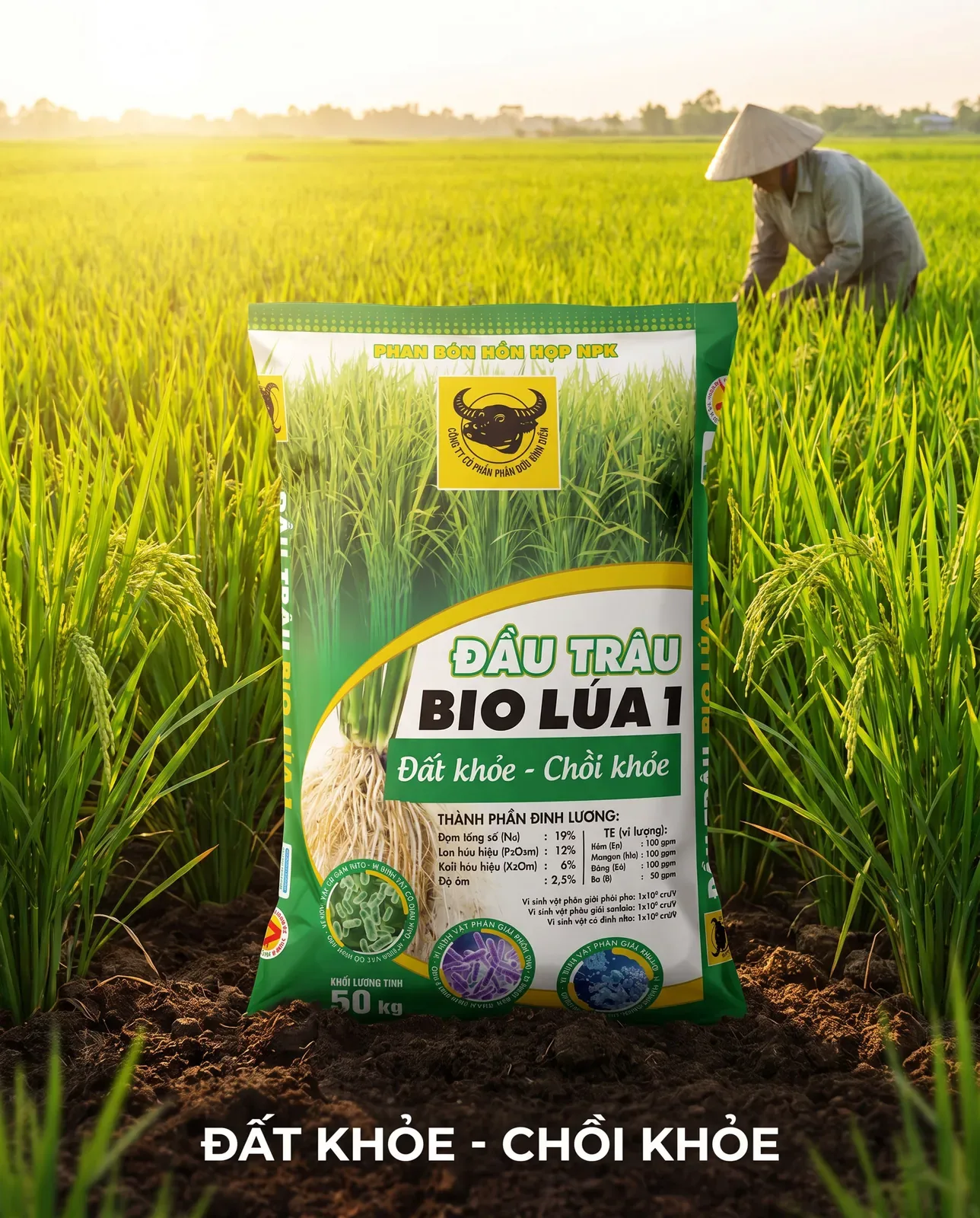
According to the Bình Điền distribution catalog and Vinachem documents regarding the Đầu Trâu NPK line with microbial coating, Bio Lúa 1 is typically announced as approximately 19-12-6, with TE (Zn, Mn, Cu, Bo) and microbial groups for nitrogen fixation, phosphorus solubilization, and cellulose decomposition (Bình Điền / catalog, n.d.; Vinachem, 2025). The manufacturer states its uses as: supplying N–P–K for the growth stage; supporting roots and tillering; supplementing microorganisms to promote healthy soil and more effective tillering when properly managed (Bình Điền / catalog, n.d.).
It is necessary to verify the correct bag in the warehouse, as some pages might confuse the label with Bio Lúa 2 (which usually has a higher potassium formula, used later in the season) (Vinachem, 2025).
Scope of inference: the data and fertilization schedules below are public manufacturer frameworks / recommended procedures, not Út Nữ's own experiments on individual plots.
Proper fertilization during the seedling promotion – tillering stage
Timely application. The product catalog specifies root fertilization with two reference windows: top-dressing around 10 days after sowing and around 22 days after sowing (Bình Điền / catalog, n.d.). The smart farming process links Bio Lúa 1 with seedling top-dressing around 7–10 days after sowing and tillering top-dressing around 18–22 days after sowing, then switches to Bio Lúa 2 for panicle initiation–grain filling (Bình Điền, n.d.-b; Tạp chí Công Thương, 2024). Do not apply the entire tillering amount in one go at the end of the season.
Correct dosage. The reference range is about 150 kg/ha per application; this can be adjusted to approximately 100–150 kg/ha/application depending on soil and climate (Bình Điền / catalog, n.d.). Adjust according to local agricultural extension advice and crop condition — do not apply a single number to all soil types.
Correct combination. Acid sulfate-saline soil or soil with much straw: prioritize soil amendment first (calcium-microbial / organic as instructed), then apply NPK to promote tillering; when panicle initiation occurs, switch to the appropriate formula for grain development (Bình Điền, n.d.-b). One type of fertilizer cannot solve the entire crop cycle.
Practical Corner for Rice Region Dealers
When farmers ask for early-season top-dressing fertilizer, dealers can recommend by bag: Bio Lúa 1 — NPK 19-12-6+TE with microorganisms, to be used during the correct window of seedling–tillering in the Đầu Trâu product line. Út Nữ Co., Ltd distributes wholesale in Vĩnh Long – Trà Vinh – Mekong Delta; if you need to replenish stock, you can call / Zalo 0294 3882069 – 02943 883791 – 02943 882837. More important than quantity is reminding them of the correct application time and not promising absolute yield.
Conclusion
The tillering/seedling promotion window requires balanced NPK at the right stage, rather than just applying nitrogen. According to the manufacturer's announcement, Đầu Trâu Bio Lúa 1 is a 19-12-6+TE+microorganism option for this stage when used correctly as part of the seasonal fertilizer set (Bình Điền / catalog, n.d.; Vinachem, 2025). Actual effectiveness still depends on the variety, water, soil conditions, and subsequent applications. Correct technical advice helps farmers avoid the habit of applying fertilizer at the wrong stage.
References (Harvard)
Bình Điền / product catalog (n.d.) *Đầu Trâu Bio Lúa 1* — ingredients and application instructions published in the distribution catalog (compared with 19-12-6+TE+VSV bag; Accessed: 21 September 2026).
Bình Điền (2023) *Notes on sowing and transplanting winter-spring rice in the Mekong Delta*. Available at: https://binhdien.com/dong-hanh-cung-nha-nong/chuong-trinh-canh-tac-thong-minh/nhung-luu-y-khi-gieo-sa-lua-dong-xuan-2023-2024-o-dong-bang-song-cuu-long.html (Accessed: 21 September 2026).
Bình Điền (n.d.-b) *Effective use of Đầu Trâu Bio-Canxi fertilizer in sustainable rice production* (Bio Lúa 1–2 application process). Available at: https://binhdien.com/dong-hanh-cung-nha-nong/chuong-trinh-canh-tac-thong-minh/su-dung-hieu-qua-phan-bon-dau-trau-bio-canxi-trong-san-xuat-lua-ben-vung.html (Accessed: 21 September 2026).
Industry and Trade Magazine (2024) *Effective use of Đầu Trâu Bio-Canxi fertilizer in sustainable rice production*. Available at: https://tapchicongthuong.vn/huong-dan-su-dung-phan-bon-dau-trau-bio-canxi-hieu-qua-trong-san-xuat-lua-ben-vung-180018.htm (Accessed: 21 September 2026).
Vinachem (2025) *Solution for developing Đầu Trâu NPK fertilizer coated with microorganisms… for rice cultivation in the Mekong Delta*. Available at: https://www.vinachem.com.vn/nd/trien-khai-nghi-quyet-57-nq-tw/giai-phap-phat-trien-phan-bon-npk-dau-trau-boc-ao-vi-sinh-giup-nang-cao-suc-khoe-dat-va-giam-phat-thai-khi-nha-kinh-trong-canh-tac-lua-vang-dbscl.html (Accessed: 21 September 2026).
About Content and Responsibility
Content developed by Grokbot AI. Út Nữ Co., Ltd and Grokbot AI disclaim responsibility for any damages arising from the use of information in this article. All content is for exploratory and academic purposes only, does not replace professional technical advice, official recommendations from manufacturers or state agencies, and does not constitute a commercial promise of yield or economic efficiency.