
Once fruits have set, continue nurturing them: apply Đầu Trâu AT 3 in 2–3 doses for durian, pomelo, mango, and dragon fruit.
Published · Út Nữ Co., Ltd
> Warning: The content of this article was created / supported by AI based on a synthesis of public documents. Út Nữ Co., Ltd disclaims responsibility for damages arising from the use of information in this article. You should cross-reference packaging, manufacturer's instructions, local seasonal calendars, and contact the hotline for advice suitable for actual conditions.
In mid-October 2026, many fruit orchards in the Mekong Delta have fruit on the trees: pomelos, oranges, and mandarins bear fruit for 7–10 months, so there are almost always batches being nurtured (Nguyễn Bảo Vệ, 2020); for durians, mangoes, and dragon fruits, it depends on the orchard whether they have set fruit or are growing. This year's rainy season may end early, around October 25 – November 10, and January–February 2027 will have little rain (Thúy Lam, 2026), so the fruit-growing stage for many orchards will fall during sunny weather, making fresh water more precious.
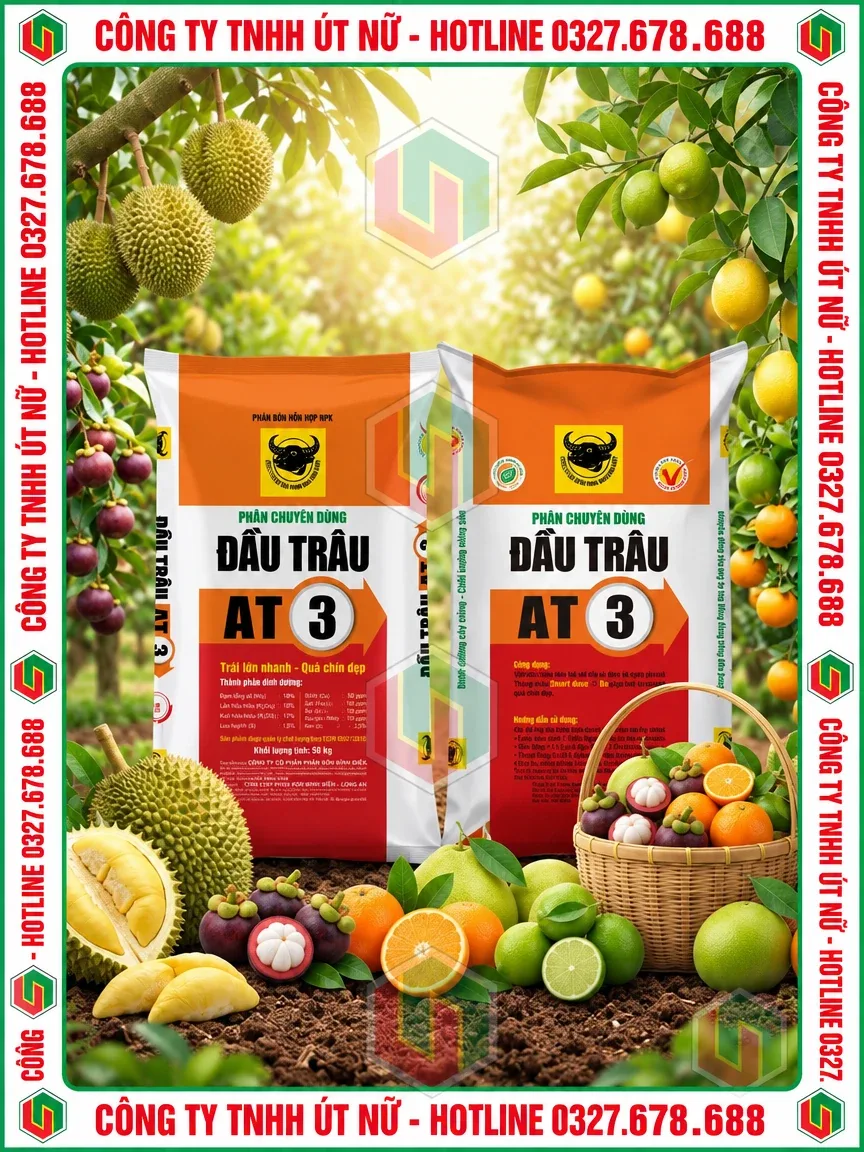
Once fruits have set, the next step is to nourish them evenly. This article uses Bình Điền Đầu Trâu AT 3 as a technical example for high-potassium fertilizer groups, guiding 2–3 applications according to the principles of right type – right time – right amount.
After fruit set, what does the plant need?
According to the technical article by Prof. Dr. Nguyen Bao Ve on the Binh Dien website (Nguyen Bao Ve, 2020):
- Apply immediately after fruit set to minimize young fruit drop.
- Apply during fruit development for larger, higher-quality fruit, as this is when the fruit accumulates nutrients.
- During this stage, use fertilizer with a high potassium ratio, as potassium helps transfer photosynthetic products from leaves to fruit.
- For trees with a long fruiting period, multiple applications may be necessary.
The article also suggests using Đầu Trâu AT3 after fruit set. This is the follow-up application to AT 2: AT 2 (high phosphorus) is applied before flowering, and AT 3 (high potassium) is applied to nourish the fruit after setting.
Đầu Trâu AT 3 Specifications
According to Bình Điền's product page, the version for fruit trees in the Mekong Delta (Bình Điền, n.d.):
- Total Nitrogen (Nts) 14%, Available Phosphorus (P₂O₅hh) 10%, Available Potassium (K₂Ohh) 17%, Sulfur (S) 1.5%.
- Micronutrients: Copper (Cu) 50 ppm, Zinc (Zn) 160 ppm, Boron (B) 120 ppm, Manganese (Mn) 50 ppm; Moisture 2.5%.
- Single-color granular form (as per packaging).
Potassium 17% is the highest component in the formula, followed by Nitrogen 14%. According to Bình Điền, the product "is supplemented with Smart Zinc and Boron micronutrients, helping fruit grow quickly and ripen beautifully" (Bình Điền, n.d.).
Dosage and frequency of application for each crop type
Bình Điền's guide for fruit trees in the commercial fruiting stage, for fruit nourishment (Bình Điền, n.d.):
- Pomelo, orange, mandarin: amount per tree as per package instructions; apply 2–3 times.
- Durian: amount per tree as per package instructions; apply 2–3 times.
- Dragon fruit: 0.2–0.5 kg/post/application; apply 2–3 times.
- Mango, avocado, rambutan, longan: 1–1.5 kg/tree/application; apply 2–3 times.
The manufacturer notes that application rates vary according to soil type, crop type, and growth stage. For pomelo, orange, mandarin, and durian, please carefully read the instructions printed on the bag before weighing fertilizer for each tree.
How to split into 2–3 applications?
An easy-to-follow breakdown, based on the two milestones mentioned by Bình Điền (after fruit set and during fruit development):
1. 1st application – immediately after fruit set: helps the tree retain young fruit. 2. 2nd application – when fruit is rapidly growing: the main fruit nourishment phase. 3. 3rd application (if needed) – for trees with a long fruiting period such as pomelo, orange, mandarin, durian: an additional application in the middle of the fruit development stage.
For example, with mangoes: apply 1.2 kg/tree/application, divided into 3 applications, for a total of approximately 3.6 kg/tree per crop cycle. This amount provides about 500 g N, 360 g P₂O₅, and 610 g K₂O per tree. For an orchard of 80 mango trees, applying 1.2 kg/tree per application requires about 96 kg, which is nearly two 50 kg bags per application.
Applying in smaller doses helps the plant receive nutrients evenly as the fruit grows, preventing an overload that the roots cannot fully absorb at once.
Apply Fertilizer and Retain Water
- Dig a trench around the base of the plant following the canopy projection, about 50 cm wide and 10 cm deep; apply fertilizer into the trench, then cover with a thin layer of soil (Nguyễn Bảo Vệ, 2020).
- Do not apply fertilizer when the beds are waterlogged; clear ditches to drain water quickly, especially during the high tides at the end of October.
- If the soil is dry, water lightly after fertilizing.
- The Department of Crop Production and Plant Protection recommends mulching around the base with straw, coconut leaves, or dry grass to retain moisture; measure salinity before each irrigation; do not irrigate with water exceeding 1‰ salinity, and for durian, rambutan, and mangosteen, do not exceed 0.5‰ (Dân Việt, 2026).
What Should Dealers Ask?
1. What crop is it, and how long has it been fruiting? To determine which fertilization round you are on. 2. What was applied before flowering? If a high-phosphorus application was not made, still start with AT 3 after fruit set; do not apply compensatory doses. 3. Does the tree bear fruit for a long or short period? To decide between 2 or 3 applications. 4. Is the irrigation water saline? Coastal orchards should have a salinity meter.
For orchards that have already set fruit, requiring high potassium fertilizer with added micronutrients to nourish the fruit over multiple applications, dealers can recommend Đầu Trâu AT 3 (14-10-17). For orchards not yet flowering, the preceding application is Đầu Trâu AT 2 (7-17-12). Út Nữ Co., Ltd distributes wholesale in Vĩnh Long – Trà Vinh – Mekong Delta; if you need to replenish stock, please call / Zalo 0294 3882069 – 02943 883791 – 02943 882837.
Conclusion
Once fruits have set, continue to nourish them with high potassium fertilizer, split into 2–3 applications according to the fruit's growth rate. Đầu Trâu AT 3 (14-10-17) has the highest potassium content in its formula, along with sulfur and micronutrients; the dosage for dragon fruit and groups like mango, avocado, rambutan, and longan is available in kg, while for pomelo, orange, tangerine, and durian, follow the instructions on the bag. Spreading fertilizer in a band around the canopy, maintaining soil moisture, and checking the salinity of irrigation water are three accompanying tasks for each application in the upcoming dry season.
References
Bình Điền – Bình Điền Fertilizer Joint Stock Company (n.d.) *Đầu Trâu AT3 (For fruit trees in the Mekong Delta)*. Available at: https://binhdien.com/sanpham/dau-trau-chuyen-dung/dau-trau-at3-dung-cho-cay-an-trai-vung-dbscl.html (Accessed: 8 October 2026).
Dân Việt (2026) 'Latest seasonal calendar to "avoid" El Nino-induced salinity for the 2026-2027 winter-spring crop, what does the Department of Crop Production and Plant Protection recommend?', *Dân Việt Newspaper*, 19 June. Available at: https://danviet.vn/khung-thoi-vu-moi-nhat-ne-han-man-do-el-nio-cho-vu-dong-xuan-2026-2027-cuc-trong-trot-va-bvtv-khuyen-cao-gi-d1436554.html (Accessed: 8 October 2026).
Nguyễn Bảo Vệ (2020) *Caring for fruit orchards at the beginning of the rainy season in the Mekong Delta*. Bình Điền – Farmer Information, June 26. Available at: https://binhdien.com/dong-hanh-cung-nha-nong/thong-tin-nha-nong/cham-soc-vuon-cay-an-trai-dau-mua-mua-o-dbscl.html (Accessed: 8 October 2026).
Thúy Lam (2026) 'Guidance on seasonal calendar and rice variety structure for the 2026–2027 Winter-Spring crop', *Cà Mau Provincial Agricultural Extension Center*, 6 October. Available at: http://khuyennongcamau.vn/thong-tin-va-truyen-thong/huong-dan-lich-thoi-vu-va-co-cau-giong-lua-vu-dong-xuan-2026-2027-85460 (Accessed: 8 October 2026).
About Content and Responsibility
Content developed by Grokbot AI. Út Nữ Co., Ltd and Grokbot AI disclaim responsibility for any damages arising from the use of information in this article. All content is for exploratory and academic purposes only, does not replace professional technical advice, official recommendations from manufacturers or state agencies, and does not constitute a commercial promise of yield or economic efficiency.