
Durian, pomelo, orange at flowering stage: Đầu Trâu AT 2 dosage for each tree type and how to apply around the canopy
Published · Út Nữ Co., Ltd
> Warning: The content of this article was created / supported by AI based on a synthesis of public documents. Út Nữ Co., Ltd disclaims responsibility for damages arising from the use of information in this article. You should cross-reference packaging, manufacturer's instructions, local seasonal calendars, and contact the hotline for advice suitable for actual conditions.
Mid-October 2026, the rainy season in the Mekong Delta is entering its final weeks. Climate assessments cited by the Cà Mau Department of Agriculture and Environment indicate that this year's rainy season may end early, around October 25 – November 10, with little rain in January–February 2027 (Thúy Lam, 2026). Most fruit trees in the Mekong Delta flower and bear fruit during the dry season (Nguyễn Bảo Vệ, 2020), so this is when many durian, pomelo, orange, mandarin, and mango orchards begin planning for flowering induction.
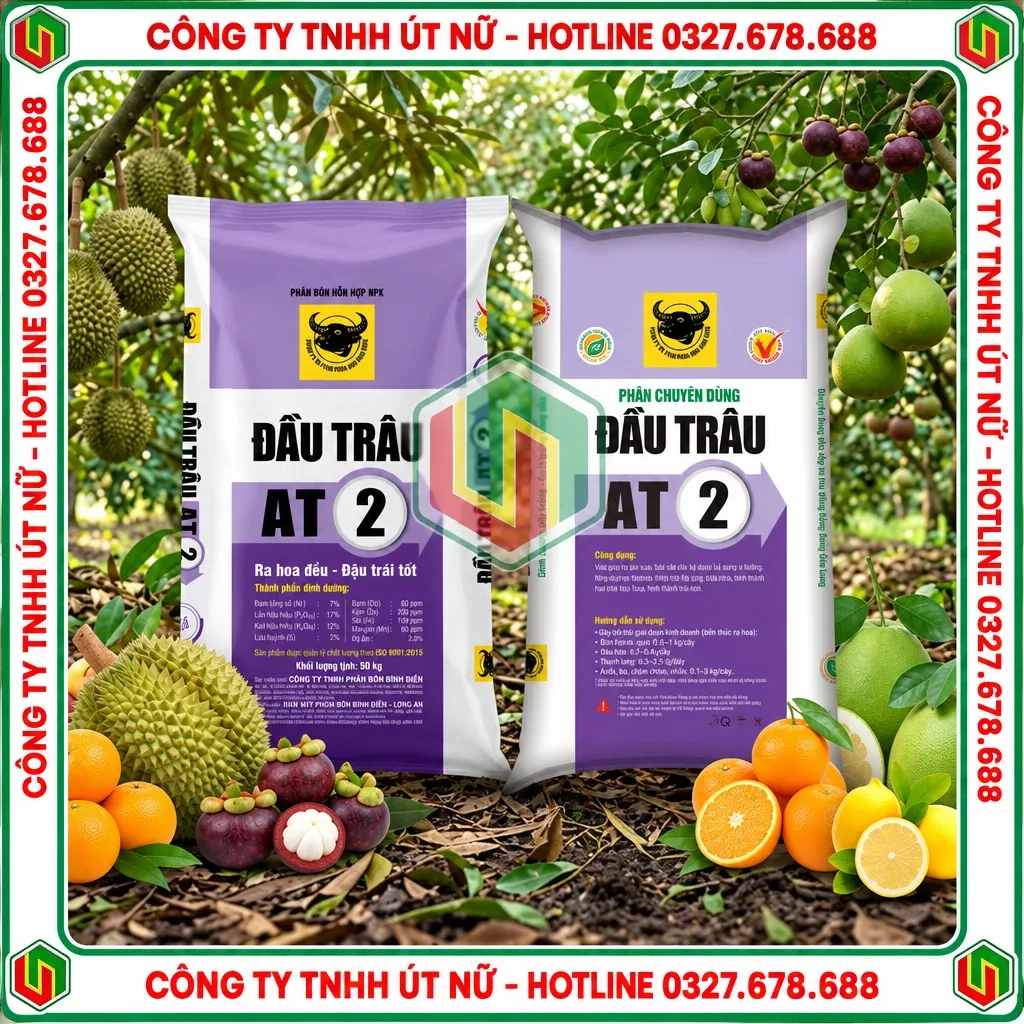
A common question from dealers is: what type of fertilizer should be applied before flowering, and how much per plant? This article uses Bình Điền Đầu Trâu AT 2 as a technical example for high-phosphorus fertilizers, adhering to the principles of the right type – at the right time – in the right amount.
Why fertilize before flowering?
According to the technical article by Prof. Dr. Nguyễn Bảo Vệ published on the Bình Điền website, approximately 1–2 months before the plant flowers, fertilizer should be applied to help developing leaves mature quickly, limit the emergence of new shoots competing for nutrients, and simultaneously stimulate flower bud differentiation; fertilizers used during this period should have a high phosphorus ratio, such as Đầu Trâu AT2 (Nguyễn Bảo Vệ, 2020).
That same article divides the fruit orchard into three main fertilization rounds (Nguyễn Bảo Vệ, 2020):
- After harvest, pruning: use fertilizer with high nitrogen content for plant recovery and new branch and leaf growth.
- Before flowering: use fertilizer with high phosphorus content (AT 2 group).
- After fruit set and during fruit development: use fertilizer with high potassium content (AT 3 group).
This means AT 2 is only suitable when the plant has passed the recovery phase, the new shoots are stable, and it's preparing for flowering. If the garden is still producing young shoots or has just recovered from flooding, and the roots haven't recuperated, then it's not the right time.
Đầu Trâu AT 2 Specifications
According to Bình Điền's product page, the version for fruit trees in the Mekong Delta (Bình Điền, n.d.):
- Total Nitrogen (Nts) 7%, available Phosphorus (P₂O₅hh) 17%, available Potassium (K₂Ohh) 12%, Sulfur (S) 2%.
- Micronutrients: Copper (Cu) 60 ppm, Zinc (Zn) 200 ppm, Boron (B) 160 ppm, Manganese (Mn) 60 ppm; moisture 2.5%.
- Single-color granular form (as per packaging).
17% Phosphorus is the highest component in the formula: high phosphorus, moderate potassium, low nitrogen. According to Bình Điền, the product "is supplemented with Smart Zinc and Boron micronutrients to help plants produce many good flower buds, limiting flower and young fruit drop" (Bình Điền, n.d.).
Dosage for each crop type
Bình Điền's guide for fruit trees during the commercial stage, promoting flowering (Bình Điền, n.d.):
- Pomelo, orange, tangerine: 0.5–1 kg/tree.
- Durian: 1–2 kg/tree.
- Dragon fruit: 0.2–0.5 kg/post.
- Mango, avocado, rambutan, longan: 0.1–2 kg/tree.
The manufacturer notes that the dosage varies depending on soil type, crop type, and growth stage. How to choose within the frame:
- Small trees, narrow canopies, or newly rejuvenated orchards: use the lower rate.
- Large, wide-canopied, healthy trees: can use the higher rate, but do not exceed the recommended range.
- The recommended range for mango, avocado, rambutan, and longan is very broad (0.1–2 kg/tree), so calculate based on the actual canopy size rather than applying a uniform rate across the entire orchard.
To easily visualize the nutrient content: 1 kg of AT 2 provides approximately 70 g N, 170 g P₂O₅, and 120 g K₂O. A durian tree fertilized with 2 kg receives about 140 g N, 340 g P₂O₅, and 240 g K₂O. A garden with 100 durian trees fertilized with 1.5 kg/tree would require about 150 kg, or 3 bags of 50 kg.
How to properly spread around the canopy
Bình Điền provides guidance on how to fertilize gardens in the Mekong Delta: dig a trench around the base of the tree following the canopy's drip line, about 50 cm wide and 10 cm deep, then apply fertilizer into the dug trench; for beds with two rows and trees whose canopies have met, dig a long trench down the middle of the bed and a herringbone trench between two trees in a row (Nguyễn Bảo Vệ, 2020).
A few small points:
- Do not spread close to the base: roots absorb more in the canopy drip line area; spreading close to the base wastes fertilizer.
- Cover lightly with soil, water gently if the soil is dry, so that the fertilizer is not left on the surface.
- Do not fertilize when beds are still waterlogged: clear drainage ditches first; Mekong Delta soil is rich in clay, so water drains slowly (Nguyễn Bảo Vệ, 2020).
Water preparation for the fruiting season
The Department of Meteorology and Hydrology forecasts that saltwater intrusion in the Mekong Delta may appear from late December 2026 (Cục Khí tượng Thủy văn, 2026). The Department of Crop Production and Plant Protection advises farmers to store fresh water, mulch to retain moisture, measure salinity before each irrigation, and not to irrigate with water exceeding 1‰ salinity; specifically for durian, rambutan, and mangosteen, do not irrigate with water exceeding 0.5‰. The Department also recommends against off-season fruit tree cultivation during drought if there is insufficient fresh water (Dân Việt, 2026). When planning for flowering, also consider the water source for the entire fruiting season.
What Should Dealers Ask?
1. What type of plant, how old, and what is its canopy size? To select the correct dosage within the recommended range. 2. Has the plant completed its recovery phase, and are the new shoots stable? If not stable, do not apply AT 2 yet. 3. When do you plan for it to flower? Apply 1–2 months beforehand. 4. Is there enough fresh water for the dry season? Coastal orchards need a water storage plan.
For orchards preparing to flower, requiring high phosphorus fertilizer with added micronutrients, dealers can recommend Đầu Trâu AT 2 (7-17-12) and advise on dosage according to each crop type. After fruit set, the next application is for fruit development with high potassium fertilizer such as Đầu Trâu AT 3 (14-10-17). Út Nữ Co., Ltd. is a wholesale distributor for Vĩnh Long – Trà Vinh – Mekong Delta; if you need to restock, please call / Zalo 0294 3882069 – 02943 883791 – 02943 882837.
Conclusion
The pre-flowering application requires high phosphorus fertilizer, applied about 1–2 months before the plant flowers, spread in a band around the canopy's drip line. Đầu Trâu AT 2 (7-17-12) has high phosphorus, moderate potassium, along with sulfur and micronutrients, with specific dosages for pomelo, orange, mandarin, durian, dragon fruit, and the mango and longan groups. Selecting the appropriate amount based on tree size, applying at the right time, and preparing fresh water early are three tasks that should be done simultaneously this dry season.
References
Bình Điền – Bình Điền Fertilizer JSC (n.d.) *Đầu Trâu AT2 (For fruit trees in the Mekong Delta)*. Available at: https://binhdien.com/sanpham/dau-trau-chuyen-dung/dau-trau-at2-dung-cho-cay-an-trai-vung-dbscl.html (Accessed: 8 October 2026).
Department of Meteorology and Hydrology (2026) *Water sources for the Mekong Delta in the 2026–2027 dry season may be low, saltwater intrusion appearing from late December*. September 17. Available at: https://vnmha.mae.gov.vn/nguon-nuoc-ve-dbscl-mua-kho-20262027-co-the-o-muc-thap-xam-nhap-man-xuat-hien-tu-cuoi-thang-12-18747.htm (Accessed: 8 October 2026).
Dân Việt (2026) 'Latest seasonal calendar to "avoid" El Nino-induced salinity for the 2026-2027 winter-spring crop, what does the Department of Crop Production and Plant Protection recommend?', *Dân Việt Newspaper*, 19 June. Available at: https://danviet.vn/khung-thoi-vu-moi-nhat-ne-han-man-do-el-nio-cho-vu-dong-xuan-2026-2027-cuc-trong-trot-va-bvtv-khuyen-cao-gi-d1436554.html (Accessed: 8 October 2026).
Nguyễn Bảo Vệ (2020) *Caring for fruit orchards at the beginning of the rainy season in the Mekong Delta*. Bình Điền – Farmer Information, June 26. Available at: https://binhdien.com/dong-hanh-cung-nha-nong/thong-tin-nha-nong/cham-soc-vuon-cay-an-trai-dau-mua-mua-o-dbscl.html (Accessed: 8 October 2026).
Thúy Lam (2026) 'Guidance on seasonal calendar and rice variety structure for the 2026–2027 Winter-Spring crop', *Cà Mau Provincial Agricultural Extension Center*, 6 October. Available at: http://khuyennongcamau.vn/thong-tin-va-truyen-thong/huong-dan-lich-thoi-vu-va-co-cau-giong-lua-vu-dong-xuan-2026-2027-85460 (Accessed: 8 October 2026).
About Content and Responsibility
Content developed by Grokbot AI. Út Nữ Co., Ltd and Grokbot AI disclaim responsibility for any damages arising from the use of information in this article. All content is for exploratory and academic purposes only, does not replace professional technical advice, official recommendations from manufacturers or state agencies, and does not constitute a commercial promise of yield or economic efficiency.