
Saline-acidic soil before the Winter-Spring crop: prepare the soil first, then apply nitrogen fertilizer.
Published · Út Nữ Co., Ltd
> Warning: The content of this article was created / supported by AI based on a synthesis of public documents. Út Nữ Co., Ltd disclaims responsibility for damages arising from the use of information in this article. You should cross-reference packaging, manufacturer's instructions, local seasonal calendars, and contact the hotline for advice suitable for actual conditions.
In late September, early October, many fields in the Mekong Delta, having just finished the summer-autumn / autumn-winter harvest, are entering the land preparation phase: clearing straw, plowing it under, flushing water, and checking for acidity-salinity before planting the Winter-Spring crop. On acidic-saline soil, if the "soil remediation" step is skipped and nitrogen is applied too early, young roots can easily encounter iron-aluminum toxicity or anaerobic conditions from undecomposed straw (Nông nghiệp và Môi trường, 2025; Bình Điền, 2023).
This article does not promise yields. The goal is to encourage using the right fertilizer – at the right time – in the right amount when treating acid sulfate and saline soils: prioritize basal fertilization / soil amendment combined with water management, and then apply NPK according to the crop stage. Among these, the secondary and micronutrient fertilizer Đầu Trâu Bio-Canxi (Bình Điền Fertilizer JSC) is a technical option positioned by the manufacturer to increase pH, support salt and acid leaching, and decompose straw (Bình Điền, n.d.).
What do early-season acid sulfate and saline soils require?
Acid sulfate soils in the Mekong Delta often have low pH, with easily soluble aluminum and iron harming roots; saline-acid sulfate soils add sodium pressure. Water management (flooding-draining) strongly influences the release of toxins into canals and ditches on acid sulfate soils in the Mekong Delta. From a soil science perspective, supplementing with calcium-magnesium-rich materials (lime / limestone with Mg) is a common improvement method to raise pH and reduce Al/Fe toxicity in acid sulfate soils for rice cultivation (Suswanto et al., 2007).
It should be clarified: liming / GML studies are not specific experiments for each bag of Đầu Trâu Bio-Canxi at Út Nữ's warehouse. They only reinforce the general principle — amend the soil first, then fertilize — when cultivating on acidic-alum soil.
Concurrently, post-harvest organic toxicity (anaerobic decomposition of residual straw, H₂S / organic acids) often overlaps with early-season acid sulfate soil issues; agricultural media in the Mekong Delta frequently mention these two problems together (Agriculture and Environment, 2025).
Đầu Trâu Bio-Canxi according to the manufacturer: its role on acidic saline soil
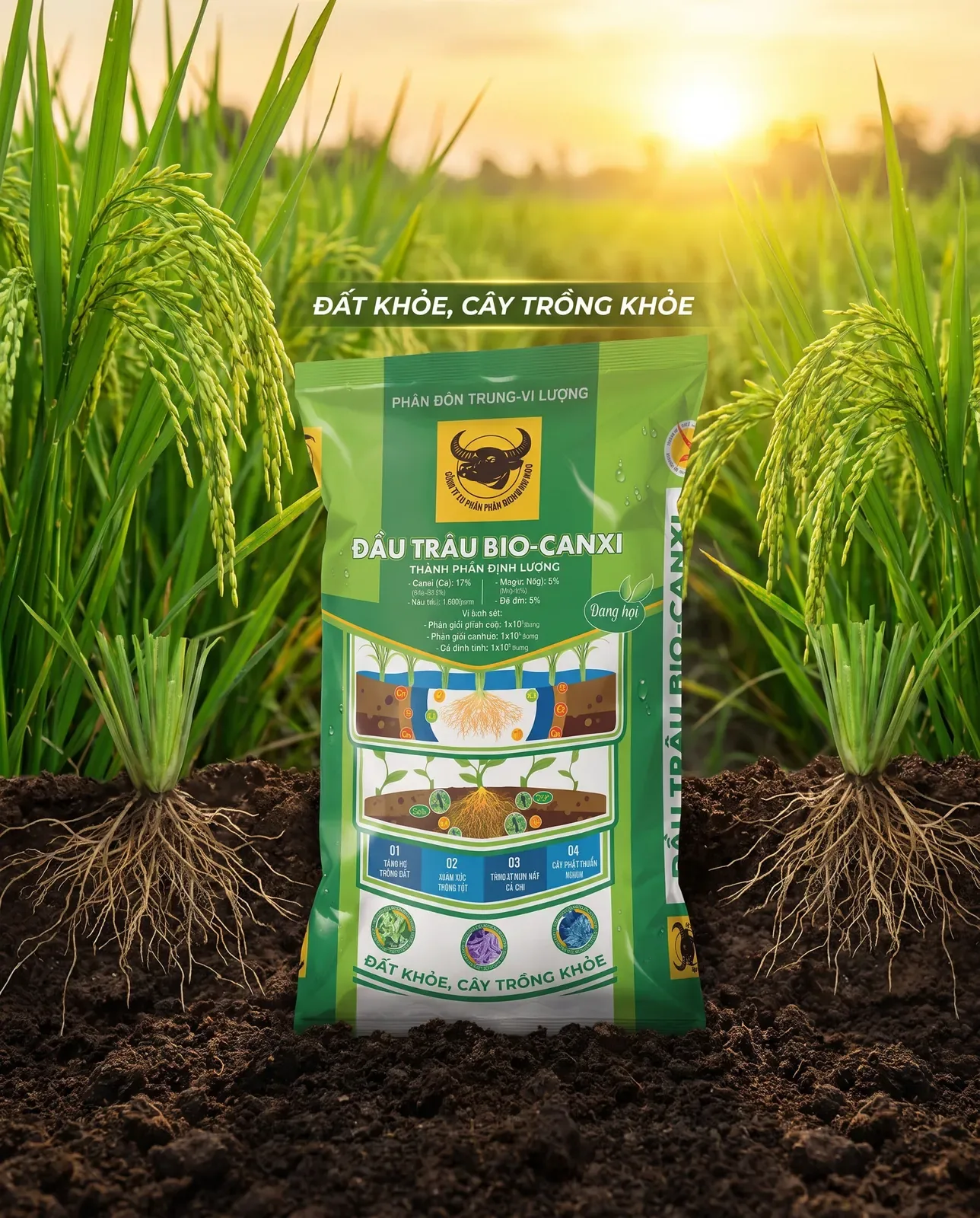
According to the Bình Điền product page, Đầu Trâu Bio-Canxi belongs to the granular secondary and micronutrient fertilizer group, with a declared composition including approximately 17% Calcium (Ca), approximately 3% Magnesium (Mg), approximately 1,000 ppm Zinc (Zn), along with nitrogen-fixing, phosphorus-solubilizing, and cellulose-decomposing microbial groups (each group approximately 1×10⁴ CFU/g), and a moisture content of approximately 3% (Bình Điền, n.d.).
The manufacturer states the main uses: supplying calcium and microorganisms to help increase pH, leach salinity and alum; promote straw decomposition and reduce organic toxicity; support root development and tillering; balance soil nutrients for rice, orchards, and vegetables; and increase fertilizer use efficiency when properly managed (Bình Điền, n.d.). Articles on the Smart Farming channel / Agriculture and Environment Newspaper also explain the mechanism of Ca²⁺ helping to push Na⁺ out of soil colloids during salinity leaching, and note project models on alum soil showing a trend of increased pH after application — this information comes from the brand/agricultural extension project and needs to be verified against actual conditions for each specific soil type (Bình Điền, 2024; Nông nghiệp và Môi trường, 2025).
Important Note: Bio-Calcium does not completely replace the water-based salinity-acidity leaching process, nor does it replace the NPK regimen for different stages. It is a key link in soil amendment / basal fertilization, used in conjunction with land preparation and irrigation schedule.
Proper Fertilization: at the right time – in the right amount – with the right combination
1) Timely application. Bình Điền recommends basal fertilization before sowing on deeply active acid sulfate soil; procedural guidelines also suggest application after harvest combined with plowing to manage straw, or application before the final tillage (Bình Điền, n.d.; Bình Điền, 2023; Bình Điền, 2024). Key takeaway: apply during the soil preparation phase, do not wait until rice leaves turn yellow to "patch up."
2) Correct dosage according to instructions and soil acidity. The product page provides a reference range of about 300 kg/ha/crop for rice in deeply active acid sulfate soil, applied as a basal fertilizer before sowing, and emphasizes that the amount can be adjusted according to soil fertility, plant condition, and previous crop (Bình Điền, n.d.). The Đông Xuân guide on the Smart Farming channel also states about 150–300 kg/ha depending on the level of acidity / pH (e.g., less acidic soil, pH above 5, may require less) (Bình Điền, 2023). Dealers should remind farmers to measure / estimate pH and listen to local agricultural extension advice, not to apply a fixed amount for every plot.
3) Correct combination. Once the foundation is more stable, then consider boosting N-P-K according to the stages of seedling, tillering, and panicle initiation. Manufacturers often recommend combining specialized Đầu Trâu fertilizer sets according to the stage (Bình Điền, 2024). Correct application means selling/using seasonal sets, not encouraging “applying one type for all times”.
Mekong Delta Dealer Corner
When farmers ask about saline-alkaline soil, poor roots, and slow straw decomposition before the Winter-Spring crop, dealers have clear advice: the familiar Đầu Trâu Bio-Canxi micronutrient, with uses stated on the packaging as increasing pH / washing away salinity-alkalinity / supporting microorganisms and organic decomposition (Bình Điền, n.d.). Út Nữ Co., Ltd distributes wholesale in the Vĩnh Long – Trà Vinh – Mekong Delta region; if you need to replenish stock according to the seasonal schedule, you can call / Zalo 0294 3882069 – 02943 883791 – 02943 882837. More important than quantity is reminding them when to fertilize and not promising absolute yields.
Conclusion
On saline-acidic soils in the Mekong Delta, the crucial first step of the season is soil preparation – flushing – and foundation improvement before fertilization. According to the manufacturer, Đầu Trâu Bio-Canxi is a mid-trace element option combining calcium–magnesium–zinc and functional microorganisms to increase pH, support saline-acidic flushing, and reduce organic toxicity pressure from straw (Bình Điền, n.d.; Nông nghiệp và Môi trường, 2025). Soil science supports the principle of Ca–Mg supplementation and water management on acidic soils (Suswanto et al., 2007) — but actual effectiveness still depends on soil type, water, and how mineral fertilizers are combined. Dealers selling with correct technical guidance contribute to maintaining the profession's reputation.
References (Harvard)
Bình Điền (n.d.) *Dau Trau Bio-Calcium*. Available at: https://binhdien.com/sanpham/dau-trau-chuyen-dung/dau-trau-bio-canxi-2.html (Accessed: 21 September 2026).
Bình Điền (2023) *Notes on sowing and transplanting winter-spring rice in the Mekong Delta*. Available at: https://binhdien.com/dong-hanh-cung-nha-nong/chuong-trinh-canh-tac-thong-minh/nhung-luu-y-khi-gieo-sa-lua-dong-xuan-2023-2024-o-dong-bang-song-cuu-long.html (Accessed: 21 September 2026).
Bình Điền (2024) *Đầu Trâu Bio-Canxi — a sustainable rice cultivation solution, reducing emissions*. Available at: https://binhdien.com/dong-hanh-cung-nha-nong/chuong-trinh-canh-tac-thong-minh/dau-trau-bio-canxi-giai-phap-canh-tac-lua-gao-ben-vung-giam-phat-thai.html (Accessed: 21 September 2026).
Agriculture and Environment (2025) *Đầu Trâu Bio-Canxi: a breakthrough solution for soil affected by organic toxicity and acidity*. Available at: https://nongnghiepmoitruong.vn/dau-trau-bio-canxi-giai-phap-dot-pha-cho-dat-bi-ngo-doc-huu-co-va-phen-d412183.html (Accessed: 21 September 2026).
Suswanto, T., Shamshuddin, J., Syed Omar, S.R., Mat, P. and Teh, C.B.S. (2007) 'Alleviating an acid sulfate soil cultivated to rice (Oryza sativa) using ground magnesium limestone and organic fertilizer', *Jurnal Ilmu Tanah dan Lingkungan*, 9(1), pp. 1–9. doi: 10.29244/jitl.9.1.1-9.
About Content and Responsibility
Content developed by Grokbot AI. Út Nữ Co., Ltd and Grokbot AI disclaim responsibility for any damages arising from the use of information in this article. All content is for exploratory and academic purposes only, does not replace professional technical advice, official recommendations from manufacturers or state agencies, and does not constitute a commercial promise of yield or economic efficiency.