
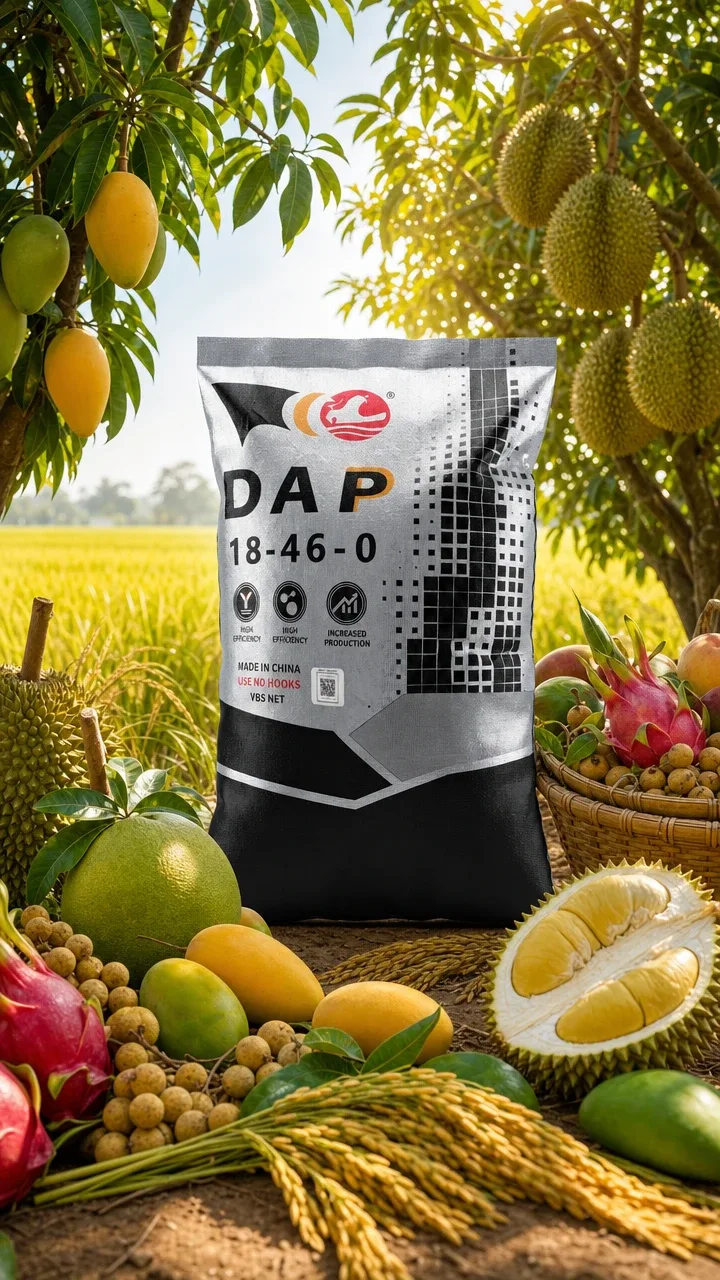
DAP Hồng Hà 18-46 black granules early season: basal application for rice, stimulate root growth in gardens after floods without excess phosphorus
Published · Út Nữ Co., Ltd
> Warning: The content of this article was created / supported by AI based on a synthesis of public documents. Út Nữ Co., Ltd disclaims responsibility for damages arising from the use of information in this article. You should cross-reference packaging, manufacturer's instructions, local seasonal calendars, and contact the hotline for advice suitable for actual conditions.
October is when many fields in Vĩnh Long and Trà Vinh, having just harvested the Autumn-Winter rice crop, are already planning land preparation for the 2026-2027 Winter-Spring crop. According to recommendations from the Department of Crop Production and Plant Protection, early sowing should occur from October 10 to 30 in coastal and estuarine areas at risk of early salinity, the main crop from November 1 to 30, and late crop from December 1 to 31 (Bích Hồng, 2026). At the same time, fruit orchards that have just passed the flood season need root nourishment, while year-end vegetable crops are preparing for sowing.
At the beginning of the season, a common question at the store is: "How much DAP should be applied as a basal fertilizer for rice to root well? Is black-grained DAP different from green-grained DAP?". This article uses Hồng Hà 18-46 black-grained DAP as an example to clarify where high phosphorus is truly needed and where it can be reduced, following the principle of right type – right time – right amount.
Why is DAP often considered at the beginning of the season?
Phosphorus helps plants form roots, tiller, and accumulate energy. Plants need phosphorus early, when roots are still short, so phosphorus is often applied as a basal fertilizer or very early. DAP combines both nitrogen and high phosphorus in one granule, making it easy to spread, and is therefore widely used at the beginning of the crop season.
But there are two things many people haven't paid attention to:
- Phosphorus levels in many rice fields in the Mekong Delta have accumulated to high levels after many years of excessive fertilization.
- In acid sulfate soils, applied phosphorus is easily retained by iron and aluminum, so applying more does not necessarily mean plants absorb more.
Therefore, DAP is a good tool if used correctly, not "the more you fertilize, the stronger the roots".
Product Specifications and the Significance of Each Component
DAP (diammonium phosphate, formula (NH4)2HPO4) has a standard content of 18% N and 46% P2O5; when dissolved, the soil around the fertilizer granule temporarily becomes alkaline, with a solution pH of approximately 7.5–8 (Mosaic Crop Nutrition, n.d.). Public information from a distributor states that Hồng Hà DAP contains 18% total nitrogen and 46% effective phosphorus; it suggests top-dressing for rice at 50–70 kg/ha/application, and for fruit trees at 50–200 kg/ha/application after harvest or before flowering (Việt Nga, n.d.). For manufacturer, importer, and fertilizer code information for the black granule batch, please refer to the bag and supplementary label.
- Nitrogen 18% (ammonium form): helps seedlings green up, tiller; not enough to replace nitrogen fertilizer for the entire crop season.
- Effective Phosphorus 46% (very high): the main component for stimulating root growth, early season root establishment.
- No potassium: potassium must be supplemented with other types of fertilizer.
- Black granule color: merely an identification characteristic, not a quality indicator; quality is determined by the content stated on the bag.
Dosage Calculation: A small amount of DAP is enough phosphorus for the whole crop
Research by Can Tho University suggests a phosphorus application rate for rice of approximately 30–45 kg P2O5/ha on major soil types in the Mekong Delta (Ngo Ngoc Hung et al., 2020). Each 100 kg of DAP provides 46 kg of P2O5 and 18 kg of N. This means that only about 65–100 kg of DAP/ha is sufficient for the entire season's phosphorus requirement.
A 7-crop continuous experiment on triple-cropped rice land in Bạc Liêu showed that the soil accumulated phosphorus; applying 20 or 40 kg P2O5/ha did not reduce available phosphorus, phosphorus in straw, grains, and yield compared to the farmer's common application rate of 60 kg P2O5/ha (Vũ Văn Long et al., 2016). In vegetable and crop land in Cần Thơ, An Giang, Vĩnh Long, Trà Vinh, the soil's phosphorus release capacity is also very high, explaining why plants show little response to phosphorus fertilizer on soils with medium to high available phosphorus (Nguyễn Mỹ Hoa and Phạm Thị Phương Thúy, 2015).
Practical lesson: if DAP has been applied as a basal fertilizer, subsequent applications should use NPK with low phosphorus, do not continue to add high phosphorus.
Where DAP Application is Worthwhile, and Where Soil Needs Prior Amendment
Suitable when:
- Early-season rice in low-phosphorus fields, newly cultivated fields, fields where straw is not incorporated: apply as a basal fertilizer or early top-dressing to promote root development.
- Vegetables after planting: apply as a basal fertilizer, incorporating it into the soil, away from seeds and seedlings' roots.
- Fruit trees after harvest: For Năm Roi pomelo in Vĩnh Long, it is recommended to apply lime, organic fertilizer, and phosphorus first; after 10–15 days, apply NPK with high nitrogen and phosphorus such as 18-46-0 to stimulate new shoots (Nguyễn Văn Liêm, 2018).
Should soil be prepared or should one wait before fertilizing:
- Severely acidic soil: In acidic soil in Tri Tôn (An Giang), applied phosphorus primarily converts to iron phosphate; farmyard manure yields results equivalent to applying 60 kg P2O5 as superphosphate, and phosphorus accumulated over many seasons is still utilized by plants in subsequent seasons (Do Thi Thanh Ren et al., 2004). Here, it is advisable to leach acidity, apply lime, and increase organic matter; lime helps reduce acidity and releases phosphorus held tightly by soil colloids (Nguyễn Văn Liêm, 2018).
- Recently drained orchard: If roots are still damaged, chemical fertilizers should not be applied yet; for the first 3–30 days, prioritize drainage, aerate the soil, stimulate root growth with humic and fulvic acids, and do not apply urea (Lê Hoàng Vũ, 2025). DAP contains 18% nitrogen, so wait until the plant develops new roots and new shoots before using it.
- Fields with many years of excess phosphorus application: Reduce the amount of DAP; the phosphorus portion for the first application of the season is sufficient.
Notes on application
- Do not place DAP close to germinating seeds: Ammonia from DAP granules can turn into ammonia gas, harming sprouts and young roots, especially in alkaline soil around the fertilizer granules (Mosaic Crop Nutrition, n.d.). For basal application, spread before the final harrowing or plowing so the fertilizer mixes into the soil; for vegetables, apply in furrows, cover with soil, then sow.
- Supplement with potassium: DAP does not contain potassium, so combine with potassium or NPK containing potassium in subsequent applications.
- Cumulative nitrogen: 100 kg of DAP already contains 18 kg of N; subtract this amount when calculating urea or NPK for topdressing.
- Check goods: The market has previously warned about counterfeit Hồng Hà DAP bags; check auxiliary stamps, traceability codes, and the importer's name on the bag (Hiệp Phát, 2023).
- Storage: Seal the bag opening tightly, store in a dry place, away from moisture to prevent caking.
What should dealers advise?
When farmers ask about DAP, dealers should ask: field or garden – alluvial or acidic soil – how much phosphorus was applied in the previous crop. From there:
- Alluvial fields fertilized with phosphorus for many years: advise reducing DAP, only use for the first application of the season; subsequent applications should switch to NPK with less phosphorus and more potassium, such as NPK Phú Mỹ 17-7-17+TE.
- Acid sulfate soils: remind to apply lime and organic matter first, for example Vôi Phú Mỹ or organic fertilizer like Quế Lâm Organic Minerals.
- Orchards after harvest: apply lime, organic matter, and phosphorus first; only apply DAP or NPK with high nitrogen and phosphorus 10–15 days later to promote new shoots.
- For the same 18-46-0 formula, stores can refer to DAP Phú Mỹ 18-46-0.
Út Nữ Co., Ltd provides wholesale distribution in the Vĩnh Long – Trà Vinh – Mekong Delta region. If you need to replenish your stock, you can call / Zalo 0294 3882069 – 02943 883791 – 02943 882837.
Conclusion
DAP Hồng Hà 18-46 black granular is a high-phosphorus fertilizer with nitrogen, most suitable for basal application, early-season application, and when plants need to develop roots and sprout after harvest. Approximately 65–100 kg of DAP/ha is sufficient phosphorus for the entire rice crop, so applying more often does not help further, especially on soils that have accumulated phosphorus. Acid sulfate soils require lime and organic matter first; recently flooded orchards need root recovery first. Applying fertilizer in the right place, supplementing potassium, combining nitrogen, and checking the packaging are small actions that help each bag of fertilizer fulfill its intended role.
References
Bich Hong (2026) 'Proactively responding to El Nino… ensuring production for the 2026-2027 Winter-Spring crop', *VietnamPlus*, 22 September. Available at: https://www.vietnamplus.vn/chu-dong-ung-pho-el-nino-bao-dam-san-xuat-vu-dong-xuan-2026-2027-post1137647.vnp (Accessed: 3 October 2026).
Do Thi Thanh Ren, Tran Kim Tinh, Nguyen Thi Ngoc Minh và Tran Ba Linh (2004) 'Applying mixed manure and inorganic phosphorus fertiliser to improve rice yield on acid sulfate soil (Hydraquentic Sulfaquept)', *Australian Journal of Soil Research*, 42(6), pp. 693–698. doi: 10.1071/SR03082.
Hiệp Phát – Hiệp Phát Agricultural Co., Ltd. (2023) *Fake DAP Hồng Hà is common*, December 6. Available at: https://phanbonhiepphat.com/2023/12/06/dap-hong-ha-gia-dang-pho-bien/ (Accessed: 3 October 2026).
Lê Hoàng Vũ (2025) 'Restoring Mekong Delta orchards: Don't rush to fertilize when roots are still suffocating', *Agriculture and Environment Newspaper*, 11 December. Available at: https://nongnghiepmoitruong.vn/tai-thiet-vuon-cay-an-trai-dbscl-dung-voi-bon-phan-khi-re-con-ngat-tho-d788806.html (Accessed: 3 October 2026).
Mosaic Crop Nutrition (n.d.) *Diammonium Phosphate* (summarized from Nutrient Source Specifics No. 17, International Plant Nutrition Institute). Available at: https://www.cropnutrition.com/resource-library/diammonium-phosphate/ (Accessed: 3 October 2026).
Ngô Ngọc Hưng, Lý Ngọc Thanh Xuân, Trần Ngọc Hữu, Lâm Văn Thông, Nguyễn Bảo Vệ, Lê Phước Toàn, Lê Văn Dang, Nguyễn Kim Quyên, Trần Văn Dũng and Trịnh Quang Khương (2020) 'Using NPK for rice on major soil types in the Mekong Delta', *Can Tho University Journal of Science*, 56 (Special Issue on Soil Science), pp. 177–184. doi: 10.22144/ctu.jsi.2020.083.
Nguyễn Mỹ Hoa and Phạm Thị Phương Thúy (2015) 'Phosphorus composition and phosphorus release capacity of key vegetable-crop soils in the Mekong Delta', in *National Workshop: Effective Use of Van Dien Fertilizer in Vietnam*, Ho Chi Minh City, 28 May, pp. 207–220. Available at: https://qldiem.ctu.edu.vn/ql/docgia/tacgia-5526/baibao-30808.html (Accessed: 3 October 2026).
Nguyen Van Liem (2018) 'Caring for Năm Roi pomelo orchards after Tet harvest', *Vinh Long Newspaper*, February 1. Available at: https://baovinhlong.com.vn/kinh-te/nong-nghiep/201802/cham-soc-vuon-buoi-nam-roi-sau-khi-thu-hoach-vu-tet-2879739/ (Accessed: 3 October 2026).
Việt Nga – Việt Nga Fertilizer (n.d.) *DAP Hong Ha – Ingredients and Usage Instructions*. Available at: https://vietnga.vn/en/products/dap-hong-ha/ (Accessed: 3 October 2026).
Vũ Văn Long, Nguyễn Văn Quí, Châu Minh Khôi and Nguyễn Minh Đông (2016) 'Effects of reduced phosphorus fertilization on available phosphorus in soil and rice yield in triple-cropping rice areas in Hoa Binh district, Bac Lieu province', *Can Tho University Journal of Science*, (43), pp. 61–67. doi: 10.22144/ctu.jvn.2016.052.
About Content and Responsibility
Content developed by Grokbot AI. Út Nữ Co., Ltd and Grokbot AI disclaim responsibility for any damages arising from the use of information in this article. All content is for exploratory and academic purposes only, does not replace professional technical advice, official recommendations from manufacturers or state agencies, and does not constitute a commercial promise of yield or economic efficiency.