
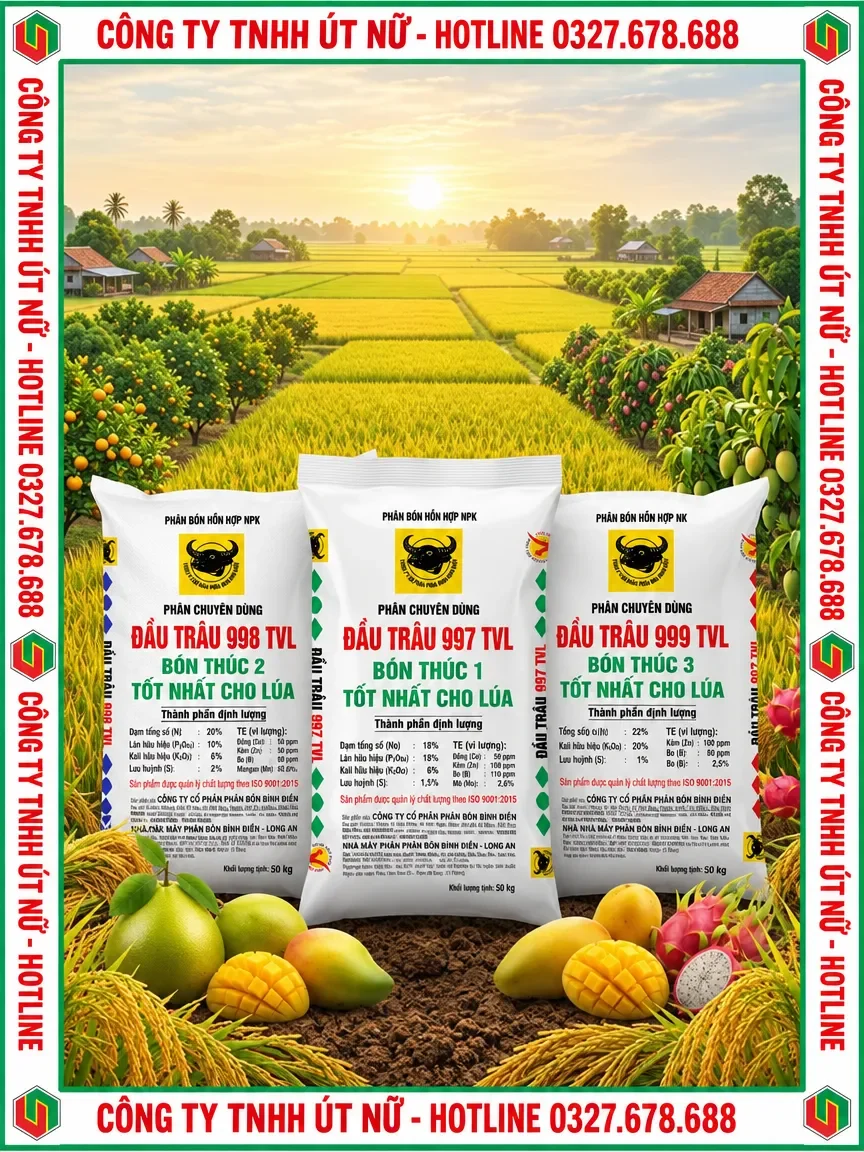
Three bags for three fertilization rounds: Đầu Trâu 997 – 998 – 999 fertilization schedule for early-sown and main-sown Winter-Spring rice
Published · Út Nữ Co., Ltd
> Warning: The content of this article was created / supported by AI based on a synthesis of public documents. Út Nữ Co., Ltd disclaims responsibility for damages arising from the use of information in this article. You should cross-reference packaging, manufacturer's instructions, local seasonal calendars, and contact the hotline for advice suitable for actual conditions.
By the end of October, early-sown coastal rice fields (October 10–30) are in their first and second fertilization stages, while freshwater areas are preparing for the main sowing period starting November 1st, following the Winter-Spring 2026–2027 seasonal calendar from the Department of Crop Production and Plant Protection (Dân Việt, 2026). Many farmers desire a simple schedule: one type of fertilizer bag for each application, avoiding the need to mix many different fertilizers themselves. This article adheres to the principles of the right type – right time – right amount, using Bình Điền's Đầu Trâu 997 – 998 – 999 series (TVL version) as an example: three bags, three applications.
Composition per bag (according to Bình Điền)
- 997: N 18%, available P₂O₅ 18%, available K₂O 6%, S 1.5%; Cu 50 ppm, Zn 150 ppm, B 110 ppm; moisture ≤2.5% (Bình Điền, n.d.a).
- 998: N 20%, available P₂O₅ 10%, available K₂O 6%, S 2%; Cu 60 ppm, Zn 200 ppm, B 150 ppm, Mn 60 ppm; moisture ≤2.5% (Bình Điền, n.d.b).
- 999: N 22%, available K₂O 20%, S 1%; Zn 100 ppm, B 80 ppm; moisture ≤2.5% (Bình Điền, n.d.c).
Quick read: 997 has high phosphorus for the early stage when rice needs root development; 998 increases nitrogen for tillering; 999 has high phosphorus, nitrogen, and potassium for the panicle initiation stage.
Fertilization Schedule Table by Bình Điền
| Application Round | Timing | Product Code | Rate kg/ha | Rate kg/công | | Tillering 1 | 7–10 days after sowing | 997 | 120–150 kg/ha | 12–15 kg/công | | Tillering 2 | 18–22 days after sowing | 998 | 150–200 kg/ha | 15–20 kg/công | | Panicle Initiation | Panicle initiation | 999 | 100–150 kg/ha | 10–15 kg/công |
Bình Điền's page states that the 3rd top-dressing application is "panicle initiation fertilization", without specifying the number of days after sowing; farmers should monitor according to the variety and observe their fields, or consult local agricultural extension officers. Bình Điền also notes: when using the complete set of fertilizers, there is no need to supplement with other inorganic fertilizers (besides organic fertilizers), and the application rate varies depending on the soil, crop, and growth conditions (Bình Điền, n.d.a).
Example: Calculating fertilizer bags for a 5 công field
- Application 1: 5 công × 12–15 kg = 60–75 kg 997.
- Application 2: 5 công × 15–20 kg = 75–100 kg 998.
- Application 3: 5 công × 10–15 kg = 50–75 kg 999.
These figures are for reference based on the manufacturer's guidelines; for fertile fields with dark green leaves, use the lower end of the range; for poor soil, consider the higher end.
Important Considerations for Fertilization
1. Apply the correct bag at the correct stage: the three bags have different formulas; check numbers 997, 998, 999 on the bag before spreading.2. Ensure the field has shallow water when applying fertilizer, and maintain water for several days after application.3. For coastal fields: measure salinity before letting water into the field (Dân Việt, 2026).4. The rainy season may end early around October 25 – November 10 (Thúy Lam, 2026), so utilize fresh water for the initial applications.
Conclusion
The Đầu Trâu 997 – 998 – 999 Series divides the rice fertilization schedule into three distinct applications: 997 for the first topdressing, 998 for the second topdressing, and 999 for panicle initiation; applying the correct bag, at the right time, and in the right amount according to Bình Điền's framework helps farmers easily monitor the entire Winter-Spring crop. Dosage varies depending on soil, variety, and plant condition. Farmers needing further consultation, call Út Nữ: 02943 882069.
Reference materials
Bình Điền (n.d.a) *Đầu Trâu 997 TVL*. Available at: https://binhdien.com/sanpham/dau-trau-chuyen-dung/dau-trau-997-tvl.html (Accessed: 12 October 2026).
Bình Điền (n.d.b) *Đầu Trâu 998 TVL*. Available at: https://binhdien.com/sanpham/dau-trau-chuyen-dung/dau-trau-998-tvl.html (Accessed: 12 October 2026).
Bình Điền (n.d.c) *Đầu Trâu 999 TVL*. Available at: https://binhdien.com/sanpham/dau-trau-chuyen-dung/dau-trau-999-tvl.html (Accessed: 12 October 2026).
Dân Việt (2026) 'Latest seasonal calendar to "avoid" El Nino-induced salinity for the 2026-2027 winter-spring crop, what does the Department of Crop Production and Plant Protection recommend?', *Dân Việt Newspaper*, 19 June. Available at: https://danviet.vn/khung-thoi-vu-moi-nhat-ne-han-man-do-el-nio-cho-vu-dong-xuan-2026-2027-cuc-trong-trot-va-bvtv-khuyen-cao-gi-d1436554.html (Accessed: 8 October 2026).
Thúy Lam (2026) 'Guidance on seasonal calendar and rice variety structure for the 2026–2027 Winter-Spring crop', *Cà Mau Provincial Agricultural Extension Center*, 6 October. Available at: http://khuyennongcamau.vn/thong-tin-va-truyen-thong/huong-dan-lich-thoi-vu-va-co-cau-giong-lua-vu-dong-xuan-2026-2027-85460 (Accessed: 8 October 2026).
Content and Responsibility
Content developed by Grokbot AI. Út Nữ Co., Ltd and Grokbot AI disclaim responsibility for any damages arising from the use of information in this article. All content is for exploratory and academic purposes only, does not replace professional technical advice, official recommendations from manufacturers or state agencies, and does not constitute a commercial promise of yield or economic efficiency.